Is Your Credit Card Interest Killing Your Savings? Why This HELOC Strategy Is the Ultimate Reset Button

You open your monthly statement and there it is: another "minimum payment" that barely scratches the surface of what you actually owe. If you feel like you are running on a financial treadmill that is moving faster than you can keep up with, you are not alone.
High-interest debt is one of the most significant hurdles to building long term wealth. Whether you are a homeowner in Chicago or a real estate investor managing a portfolio in Florida, credit card balances can quietly erode your cash flow.
Today, we are looking at a strategy that many savvy property owners use to stop the bleeding. It involves leveraging the equity you have already built in your home to hit the "reset button" on high-interest debt.
The Invisible Drain: How Credit Card Interest Works Against You
Most people look at their credit card balance, but they don't always look at the APR (Annual Percentage Rate). With average rates hovering above 20%, these cards use daily compounding interest. This means the bank charges you interest on the principal balance and the interest that accumulated the day before.
When you carry a $20,000 balance at 24% APR, you are essentially paying hundreds of dollars every month just for the "privilege" of owing that money. That is cash that could be going toward a down payment on a rental property in Virginia or an adjustable-rate mortgage on a new investment.

Defining the Tools: What is a HELOC?
Before we dive into the strategy, let's define the primary tool we are using.
HELOC (Home Equity Line of Credit): A revolving credit line secured by the equity in your primary residence or investment property that allows you to borrow, repay, and borrow again during a set "draw period."
Practical Application: Think of it like a credit card with a much larger limit and a significantly lower interest rate because it is secured by your real estate.
LTV (Loan-to-Value): The ratio of the total loan amount compared to the appraised value of the property.
Practical Application: Lenders use this to determine how much equity you can access; most allow you to borrow up to 80% or 85% of your home’s value.
DTI (Debt-to-Income Ratio): A personal finance measure that compares your monthly debt payments to your monthly gross income.
Practical Application: Lowering your high-interest monthly payments through consolidation improves your DTI, making it easier to qualify for future conventional loans or other financing.
The Strategy: Debt Consolidation via Home Equity
The concept is straightforward: Use a low-interest HELOC to pay off high-interest credit cards.
By doing this, you aren't just moving debt around. You are changing the fundamental math of your liabilities. You transition from a 22%–29% interest environment to one that is typically in the single digits or low double digits.
For homeowners looking for an Alabama HELOC lender or a Missouri HELOC lender, the goal is to free up monthly cash flow. This "freed-up" money can then be redirected back into the principal of the HELOC or used to fund your next real estate deal.
Jump In: A Real-World Financial Comparison
Let's look at a scenario involving a homeowner in Michigan with $40,000 in high-interest debt and a home worth $450,000.
The Current Situation:
- Total Credit Card Debt: $40,000
- Average Interest Rate: 24%
- Monthly Minimum Payments (approx.): $1,200
- Total Interest Paid over 1 year (if only paying interest): $9,600
The HELOC Reset:
- Property Value: $450,000
- Current Mortgage Balance: $250,000
- Available Equity (at 85% LTV): $132,500
- HELOC Interest Rate (estimated): 9%
- New Monthly Payment (Interest only during draw period): $300
- New Monthly Payment (Principal + Interest over 20 years): $360
- Total Interest Paid over 1 year (on the $40k): $3,600
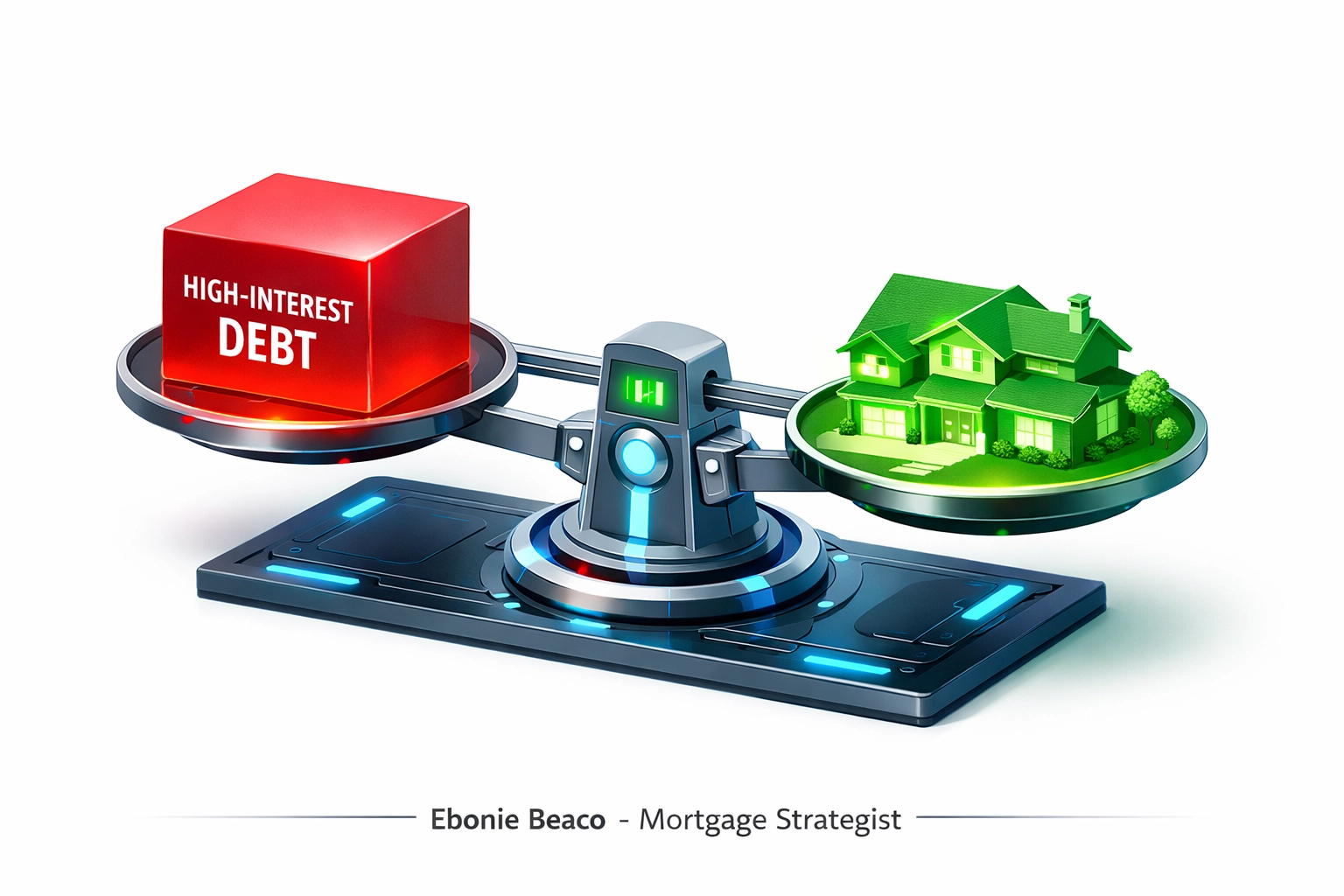
By using this strategy, the homeowner reduces their monthly obligation from $1,200 to roughly $360. This creates an extra $840 in monthly cash flow. In states like Indiana or Kentucky, where the cost of living allows for significant reinvestment, that $840 a month could be the difference between stagnating and scaling a rental portfolio.
Why This Strategy Appeals to Real Estate Investors
If you are a landlord or a fix-and-flip investor in Georgia or California, you know that liquidity is king. Having $40,000 tied up in high-interest consumer debt limits your ability to secure hard money loans or DSCR rental property loans.
Explore how a HELOC can function as your emergency fund. Instead of keeping $50,000 in a low-interest savings account while paying 20% on a credit card, you can pay off the card and keep the HELOC line open. If an emergency happens, the line of credit is there. If no emergency happens, you aren't paying interest on money you aren't using.
Regional Market Activity: From Virginia to Arkansas
Real estate activity varies across the states we serve.
- In Florida and Georgia, where property values have seen steady appreciation, many homeowners are sitting on a "gold mine" of equity they haven't tapped into yet.
- In Illinois (specifically Chicago), savvy investors use HELOCs to fund the down payments on FHA-insured multi-unit properties, essentially using their primary home to buy their first "house hack."
- In Missouri and Alabama, lower entry prices for rental properties mean that a modest HELOC can often cover the entire purchase price of a distressed property, which can then be renovated and refinanced using a cash-out refinance strategy.

The Transparent Truth: Risks to Consider
We believe in transparency. A HELOC is not a "magic" solution; it is a financial tool that requires discipline.
- Your Home is Collateral: Unlike a credit card, which is unsecured debt, a HELOC is secured by your home. If you fail to make payments, your property is at risk.
- Variable Rates: Most HELOCs have variable interest rates. While they are lower than credit cards now, they can fluctuate based on the market. Always check the "ceiling" or maximum rate your loan can reach.
- The Temptation to Spend: The "Reset Button" only works if you don't run the credit card balances back up. This strategy is for those ready to change their financial habits and focus on long term equity growth.
Accessing Your Equity: The Process
If you are ready to stop the cycle of high-interest debt, the process is simpler than a full mortgage refinance.
- Evaluate Your Equity: Use our mortgage calculators to estimate how much equity you have.
- Check Your Credit: While HELOCs are secured, your credit score will influence the interest rate you receive.
- Select a Strategist: Work with a loan officer who understands both the loan process and the long term goals of property ownership.
Whether you are looking for a Missouri HELOC lender to consolidate debt or an Alabama HELOC lender to fund your next renovation, the key is to act while your equity is high and interest rates for secured debt remain competitive compared to unsecured alternatives.
Compare Your Options
Do not let credit card companies dictate your financial future. If you own property in AL, AR, CA, FL, GA, IL, IN, KY, MI, MO, or VA, you have options that go beyond simple monthly payments. You can leverage your property to build a more stable, cash-flow-positive life.
Compare the cost of your current debt against the potential savings of a home equity strategy. Access the tools available to you as a homeowner and start treating your home like the asset it truly is.
Schedule a 1 on 1 at https://calendly.com/homeloansnetwork
Ebonie Beaco
Mortgage Strategist | Senior Loan Officer
Home Loans Network powered by Loan Factory Inc.
NMLS #2389954
HomeLoansNetwork.com
312-392-0664