Is PMI Really a Bad Thing? What Every Homebuyer Should Know
For decades, the standard advice in real estate has been to save a 20% down payment to avoid Private Mortgage Insurance (PMI). Many buyers view PMI as a "waste of money" because it protects the lender rather than the homeowner. However, in today’s fast-moving housing markets: from the suburbs of Chicago to the growing communities in Florida and Virginia: waiting to save that 20% can often cost you more in home price appreciation than you would have paid in insurance premiums.
Understanding how PMI works is a fundamental step for any homebuyer or aspiring real estate investor. It is not necessarily a hurdle to be feared, but a tool that can be used to enter the market years earlier than otherwise possible.
Defining Private Mortgage Insurance
Private Mortgage Insurance (PMI): A risk-management insurance policy required by commercial lenders for conventional loans where the borrower provides a down payment of less than 20% of the home's purchase price.
Practical Application: This insurance provides lenders with a safety net, allowing them to offer financing to buyers who do not have a large cash reserve, thereby increasing homeownership opportunities for those with 3%, 5%, or 10% down payments.
Why PMI Exists in the First Place
Lenders view a smaller down payment as a higher risk. If a borrower defaults on a loan and the home must be sold through foreclosure, a lender needs to ensure they can recoup the loan balance. PMI covers the gap between what the home sells for and what is owed.
While it is true that you, the borrower, pay the premium for a policy that benefits the lender, the secondary benefit to you is the ability to secure a mortgage without waiting a decade to save six figures in cash.
The Financial Trade-Off: Waiting vs. Buying Now
When you analyze the cost of PMI, you must compare it against the cost of waiting. In states like California, Georgia, and Florida, home values have historically trended upward. If you wait two years to save an extra $40,000 to reach a 20% down payment, the house you wanted might increase in price by $50,000 or more during that same period.
In this scenario, paying $150 a month in PMI for a few years is significantly cheaper than paying $50,000 more for the same property later. You also miss out on the principal reduction that occurs every month you own the home.
Explore the Math: What PMI Actually Costs
The cost of PMI varies based on your credit score, the loan-to-value (LTV) ratio, and the specific lender's rates. Generally, it ranges from 0.3% to 1.5% of the original loan amount annually.
Let’s look at a real-world scenario for a homebuyer in a market like Indianapolis or Little Rock, using a standard 3% down payment on a conventional loan.
Scenario Details:
- Purchase Price: $350,000
- Down Payment (3%): $10,500
- Loan Amount: $339,500
- Estimated Annual PMI Rate: 0.75%
The Calculation:
- Multiply the loan amount by the annual PMI rate: $339,500 x 0.0075 = $2,546.25 per year.
- Divide the annual total by 12 months: $2,546.25 / 12 = $212.19 per month.
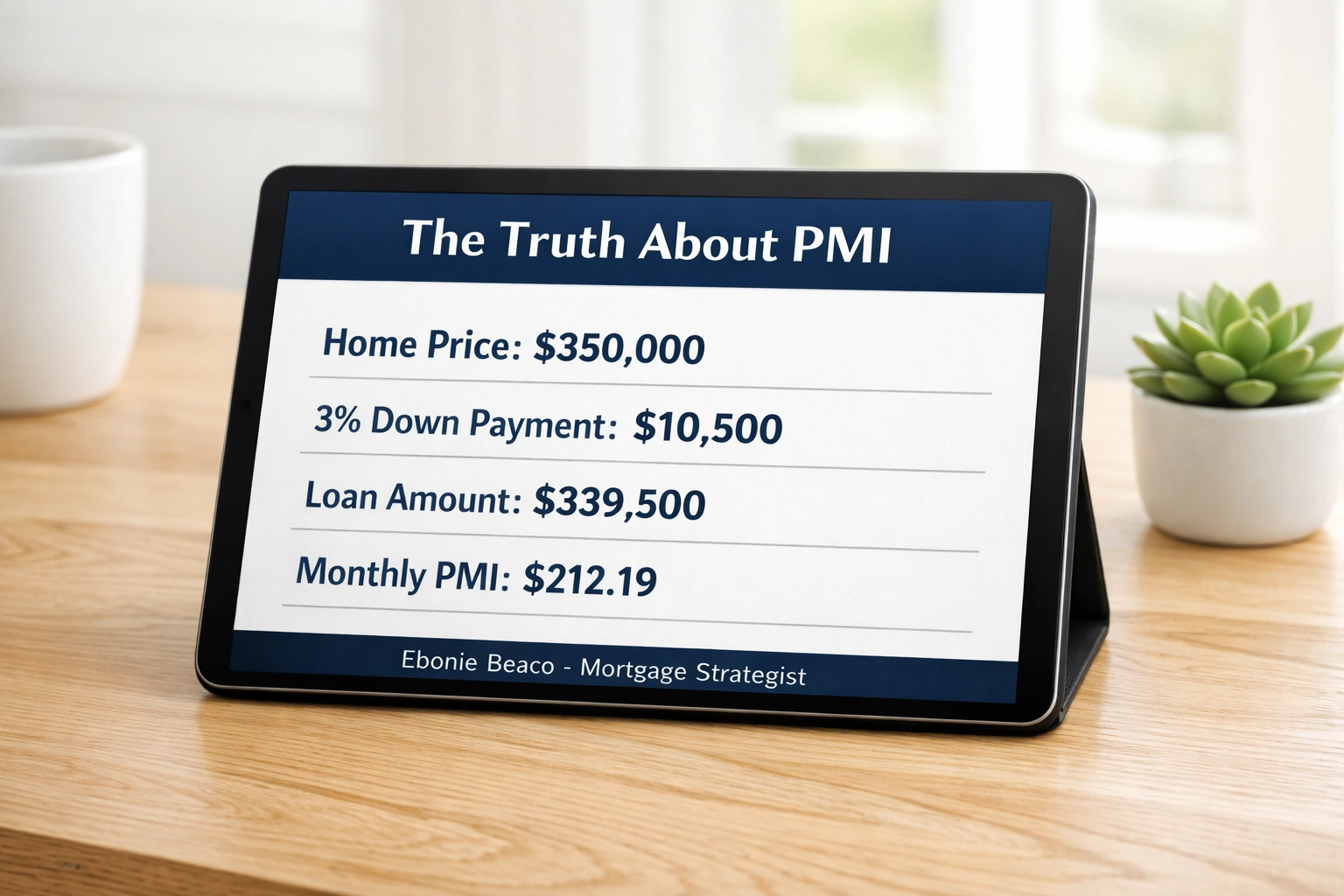
Note: Image title "The Truth About PMI". Calculation shown: $350k Price - 3% Down = $339,500 Loan. $339,500 x 0.75% / 12 = $212.19/mo PMI. Footer: Ebonie Beaco - Mortgage Loan Officer.
How Real Estate Investors View PMI
Savvy real estate investors often use PMI to their advantage, particularly those using the "house hacking" strategy. By moving into a property with a low down payment (3% to 5%), an investor can control a high-value asset with minimal capital.
In cities like Richmond, Virginia, or Birmingham, Alabama, an investor might purchase a duplex, live in one unit, and rent out the other. Even with the added cost of PMI, the rental income from the second unit often covers the entire mortgage payment, including the insurance premium. This allows the investor to keep their cash liquid for other opportunities, such as a DSCR Investor Loan on a future rental property or a Fix and Flip Loan for a renovation project.
Accessing Equity While Paying PMI
Even if you have PMI on your current mortgage, you may still have options to utilize your home's equity. Homeowners in high-growth areas often see their property values rise quickly. If your home has appreciated significantly, you might be able to remove PMI without even refinancing.
Once your loan-to-value ratio reaches 80% based on the original purchase price, you can request cancellation. If it hits 78%, the lender is typically required by law to terminate it automatically. However, if your home value has skyrocketed due to market conditions, a new appraisal could show that you have 20% equity now, allowing you to drop the PMI payment immediately.
Strategies to Eliminate PMI
If you are already paying PMI and want to lower your monthly obligation, there are several paths to explore:
- Request Cancellation: Once you reach 20% equity based on your original purchase price through regular payments, contact your servicer.
- Order a New Appraisal: If you believe your home value has increased significantly: common in many Florida and Michigan markets recently: your lender may allow a new appraisal to prove you have 20% equity.
- Home Improvements: Substantial renovations can increase your home's value. If you’ve finished a basement or remodeled a kitchen, you can request a value reassessment.
- Refinance: If interest rates are favorable, or if you have reached 20% equity, a Home Refinance can eliminate PMI and potentially lower your interest rate simultaneously.
Compare Conventional PMI to FHA Mortgage Insurance
It is important to distinguish between PMI (on conventional loans) and MIP (Mortgage Insurance Premium) on FHA loans.
- Conventional PMI: Can be removed once you reach 20% equity.
- FHA MIP: Usually stays for the life of the loan if you put down less than 10%.
For many borrowers in Illinois, Indiana, or Kentucky with good credit scores, a conventional loan with PMI is often the superior choice because it offers a clear exit strategy for the insurance cost. You can read more about various loan structures on our Mortgage Basics page.
Real-World Market Context
In markets like Chicago or Northern Virginia, where competition is high, being able to close quickly with a lower down payment can be the difference between winning a bid and losing out. Sellers are often more concerned with the strength of the pre-approval than the specific down payment percentage.
If you are a landlord managing multiple properties in Missouri or Arkansas, you know that cash flow is king. Paying a small amount of PMI to keep $50,000 in your bank account for emergency repairs or the down payment on your next Landlord Loan is often a smart move. Liquidity provides a safety net that a 20% down payment does not.
Is PMI Right for You?
The decision to pay PMI should be based on your personal financial goals and the local market conditions.
Jump in and consider PMI if:
- You want to stop renting and start building equity immediately.
- Home prices in your area are rising faster than you can save.
- You want to keep your cash liquid for investments or home improvements.
- You plan to stay in the home long enough for appreciation to naturally eliminate the insurance requirement.
Skip PMI and wait for 20% if:
- You have a high amount of cash that isn't earning a better return elsewhere.
- You are buying in a stagnant or declining market.
- The monthly cost of PMI puts your Debt-to-Income (DTI) ratio at a level that feels uncomfortable.
For more information on how different loan types affect your monthly payment, you can check out our FAQ or explore our Loan Process section.
Moving Forward with Confidence
PMI is not a permanent sentence. It is a temporary bridge to homeownership. By understanding the calculations and the strategies for removal, you can make a transparent and informed decision about your mortgage.
Whether you are a first-time homebuyer in Georgia or an experienced investor looking for Non-QM Mortgage Loans in California, navigating the world of private mortgage insurance is easier when you have a strategist on your side.
If you are currently paying PMI and believe your home value has increased, or if you want to explore a Cash-Out Refinance to consolidate debt while the market is strong, let’s look at your specific scenario.
Schedule a 1 on 1 at https://calendly.com/homeloansnetwork
Ebonie Beaco Mortgage Strategist | Senior Loan Officer Home Loans Network powered by Loan Factory Inc. NMLS #2389954 HomeLoansNetwork.com 312-392-0664