Is Investing in Condos a Good Idea? Pro and Cons

When you start looking at real estate investment options in high-demand markets like Chicago, Miami, or Los Angeles, condos often pop up as the most affordable entry point. For a lot of first-time investors or landlords looking to scale quickly, the lower price tag is a massive draw. But is it the right move for your portfolio?
The reality of condo investing is transparent: it offers a unique blend of convenience and frustration. You are trading some control for a lower maintenance lifestyle. To decide if this path fits your strategy, you need to look past the granite countertops and focus on the underlying numbers and association rules.
Defining the Condo Investment Landscape
Before we break down the benefits, let’s define some core terms you will encounter.
Condominium (Condo): A private residence within a larger building or complex where you own the interior space of your unit while sharing ownership of common areas. Practical Application: You are responsible for everything inside your walls, while the association handles the roof, siding, and hallways.
HOA (Homeowners Association): An organization in a subdivision or planned community that makes and enforces rules for the properties and their residents. Practical Application: They collect the fees that fund the building’s operations and set the rules for whether you can even use the unit as a rental.
Special Assessment: An extra charge billed to unit owners by the HOA to cover unexpected expenses or major capital improvements not covered by the reserve fund. Practical Application: If the building needs a new elevator and the reserves are low, you might receive a bill for thousands of dollars due immediately.
The Advantages of Investing in Condos
For many investors in Florida or Virginia, condos represent a way to get into premium zip codes that would otherwise be too expensive for a single-family home.
Lower Purchase Price: Condos are typically priced lower than detached homes in the same neighborhood. Practical Benefit: This often leads to a lower down payment requirement, making it easier for new investors to enter the market. You can explore home purchase options to see how this fits your budget.
Maintenance Handled for You: The HOA manages the "big ticket" items like roof repairs, snow removal, and landscaping. Practical Benefit: This is ideal for out-of-state landlords or those who do not want to spend their weekends managing contractors for exterior repairs.
Built-In Amenities: Many condo buildings include pools, fitness centers, and 24/7 security. Practical Benefit: These features attract high-quality tenants and allow you to charge premium rent compared to a basic apartment unit.
High Rental Demand: Condos are often located in urban centers near major employers or tourist attractions. Practical Benefit: This proximity often leads to lower vacancy rates, especially in bustling markets like Chicago or Atlanta.
The Challenges of Condo Investing
While the low maintenance is great, there are trade-offs that can impact your long-term wealth building.
The HOA Fee Factor: Monthly association fees are mandatory and can increase at any time. Practical Risk: High fees can quickly eat into your monthly cash flow, sometimes making an otherwise good deal look like a liability.
Slower Appreciation: Historically, condos tend to appreciate at a slower rate than single-family homes. Practical Risk: Since you do not own the land beneath the building, you are solely relying on the value of the structure and the local market demand for that specific unit type.
Rental Restrictions: Some HOAs have "rental caps" that limit the number of units that can be rented out at any given time. Practical Risk: You could buy a property intending to rent it out, only to find out there is a five-year waiting list to become a landlord in that building.
Financing Complexity: Lenders look at the "health" of the entire building, not just your credit score. Practical Risk: If the building has too many delinquent owners or is involved in a lawsuit, you might find it difficult to secure traditional financing. This is where Non-QM Mortgage Loans or DSCR loans become essential tools for investors.
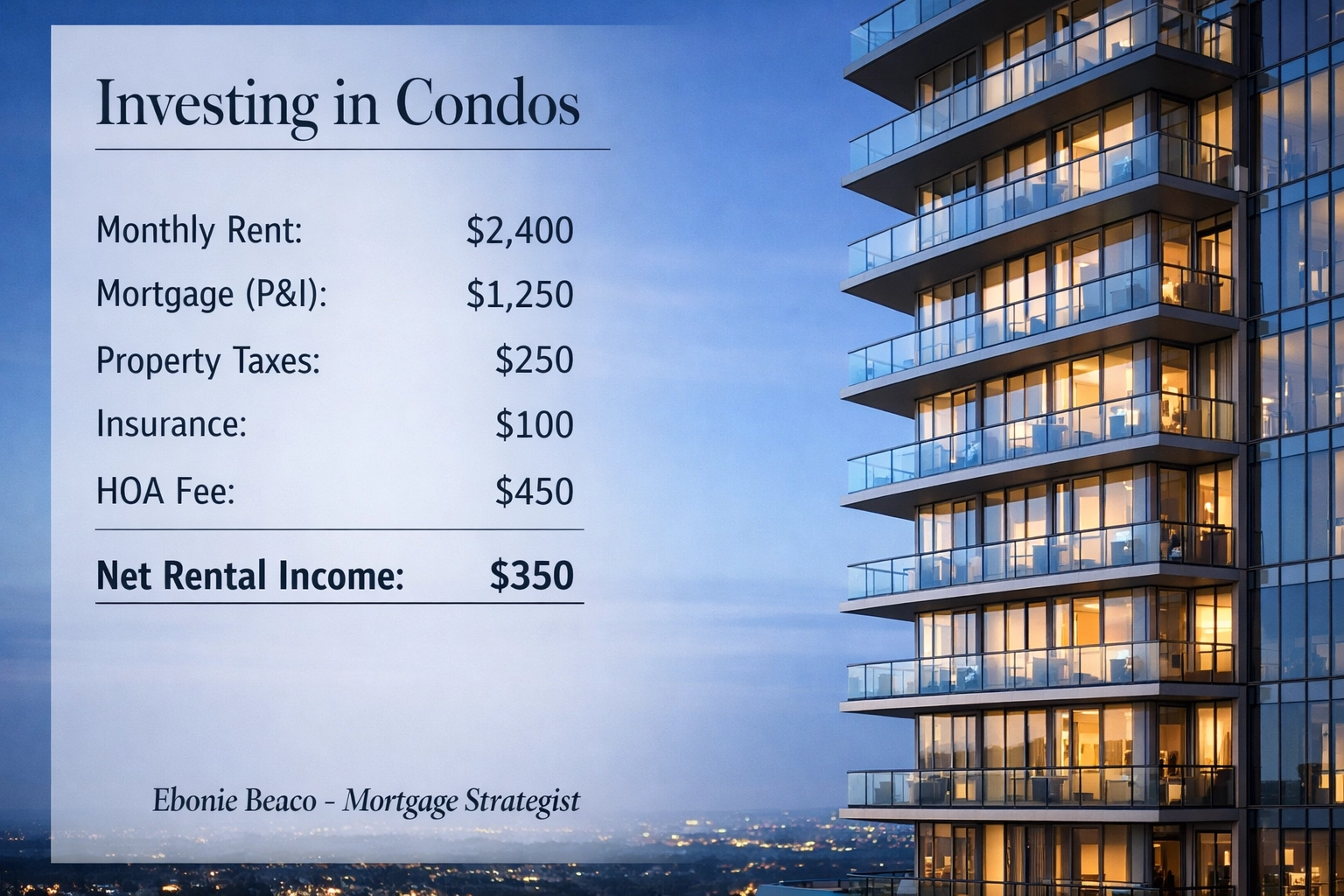 Visual Note: Image title "Investing in Condos" at the top. At the bottom: "Ebonie Beaco - Mortgage Loan Officer". The image displays the calculation:
Monthly Rent: $2,400
Mortgage (P&I): $1,250
Property Taxes: $250
Insurance: $100
HOA Fee: $450
Calculation: $2,400 - ($1,250 + $250 + $100 + $450) = $350 Net Rental Income.
No money or cash icons.
Visual Note: Image title "Investing in Condos" at the top. At the bottom: "Ebonie Beaco - Mortgage Loan Officer". The image displays the calculation:
Monthly Rent: $2,400
Mortgage (P&I): $1,250
Property Taxes: $250
Insurance: $100
HOA Fee: $450
Calculation: $2,400 - ($1,250 + $250 + $100 + $450) = $350 Net Rental Income.
No money or cash icons.
Calculating Your Real Returns
The most critical step in condo investing is the math. You cannot just look at the mortgage versus the rent. You must account for the "silent" expenses.
Let’s look at a real-world scenario for an investor in Michigan or Georgia:
- Gross Monthly Rent: $2,400
- Principal and Interest (Mortgage): $1,250
- Property Taxes: $250
- Landlord Insurance: $100
- HOA Fee: $450
To find your Net Rental Income, you subtract all those expenses from your gross rent: $2,400 - $1,250 - $250 - $100 - $450 = $350 per month.
If that HOA fee were to jump to $650 next year due to a budget shortfall, your profit drops to $150. This is why transparency in reviewing HOA meeting minutes and budgets is vital before you close on a deal. You can use mortgage calculators to run these scenarios yourself.
Financing Strategies for Condo Investors
Financing a condo is different than financing a house. Because the association's financial health is tied to your loan approval, you need to be strategic.
DSCR Investor Loans: These loans focus on the income generated by the property rather than your personal income. Practical Application: If the condo’s rent covers the debt (the mortgage, taxes, insurance, and HOA fees), you can often qualify without showing tax returns or pay stubs.
Non-QM Mortgage Loans: These are "Non-Qualified Mortgages" that offer more flexibility than Fannie Mae or Freddie Mac. Practical Application: If a condo building is "non-warrantable" (meaning it doesn't meet standard government guidelines), a Non-QM loan can often bridge the gap to get the deal closed.
Cash-Out Refinance: If you already own a home with equity in California or Arkansas, you can pull that cash out to purchase a condo. Practical Application: This allows you to buy the condo as a "cash buyer," making your offer much more attractive to sellers, and then you can finance it later. Explore more about cash-out refinance strategies to grow your portfolio.
Is It Right for You?
Investing in condos is a strategic choice. It works best for:
- Investors who want a "hands-off" approach to exterior maintenance.
- Those looking to invest in high-density urban areas where land is scarce.
- Landlords who value amenities as a tenant-retention tool.
However, if you want total control over your property, or if you are looking for the highest possible appreciation through land ownership, a single-family home or a small multi-unit building might be a better fit. You can read more about the loan process to see how different property types affect your borrowing power.
Before you sign a contract, always request the "Condo Doc Vault." This includes the last two years of meeting minutes, the current budget, and the reserve study. If the association hasn't updated their roof in 20 years and they have no money in savings, a special assessment is likely heading your way.
If you are looking for guidance on how to navigate these specific requirements in Alabama, Indiana, or Missouri, getting a professional perspective is key. Understanding the nuances of the local market and the specific lending guidelines for condos can save you from a costly mistake.
Jump in and compare your options. Whether you are looking for your first rental or adding a tenth unit to your portfolio, the financing structure is the foundation of your success.
Buying a condo as an investment? Contact Ebonie Beaco for specialized condo financing and mentoring.
Scedule a 1 on 1 at https://calendly.com/homeloansnetwork
Ebonie Beaco Mortgage Strategist | Senior Loan Officer Home Loans Network powered by Loan Factory Inc. NMLS #2389954 HomeLoansNetwork.com 312-392-0664