Indianapolis Life Sciences CRE Cooldown in 2026: What This Week’s Data Says and How to Navigate Lab Space Financing

If you’ve been watching the commercial real estate (CRE) headlines this week, you’ve probably seen the word "cooldown" splashed across every major report regarding the life sciences sector. As we sit here in mid-March 2026, the narrative is shifting. We aren't in the frantic, over-heated "space at any cost" era of 2021 anymore.
But as a mortgage strategist, I see "cooldown" and I think "entry point."
The data released over the last seven days shows a market that is finding its floor. For savvy buyers looking at Indiana investment property loans and Indiana rental property financing, especially in emerging hubs like Indianapolis, this is the time to understand the nuances of lab space financing and medical space lending.
Let's dive into what’s actually happening on the ground and how you can leverage current financing strategies to come out ahead.
The Reality Check: Vacancy and the Supply Cliff
The latest reports show that vacancy in life sciences across the U.S. has climbed to a staggering 23.1%. On the surface, that looks scary. However, the real story is in the construction pipeline.
For the first time in a decade, lab and R&D construction is projected to hit a 10-year low. We are seeing a massive contraction in new projects. Over 50% of what is currently being built has already shifted to a Build-to-Suit model.
Why this matters for your portfolio:
When supply stops, and the existing "glut" of space starts getting absorbed, the power shifts back to the landlord. If you are looking at a home purchase or a commercial acquisition in this space, you aren't just buying a building; you are buying into a supply-constrained future.
Trigger Word: Stabilization. We are moving from a period of "oversupply" to "stabilization."
The $240 Billion M&A Signal
While physical buildings might be seeing a temporary lull in occupancy, the companies that live inside them are flush with cash. Global Life Sciences M&A (Mergers and Acquisitions) hit $240 billion this past year.
When big pharma buys smaller biotech firms, they don't just consolidate talent; they consolidate real estate. This activity is a leading indicator. Where M&A goes, demand for high-end lab space follows.
Venture Capital (VC) has also held steady at roughly $49 billion. This tells me the "engine" of the industry is still running hot. The companies are being funded, the deals are being made, and they are going to need modern, specialized facilities to do the work.

Financing Strategies for 2026: Beyond the Big Banks
In a market with 23% vacancy, a traditional big-box bank might look at a Life Sciences deal and run for the hills. They see risk. I see a specialized asset class that requires a specialized loan structure.
As a strategist at Home Loans Network, I focus on how we can bridge the gap between where a property is today and its future value.
1. Build-to-Suit Financing
Since more than half of the current pipeline is build-to-suit, construction-to-permanent financing is king. This allows the developer to secure a tenant first, then finance the build specifically to that tenant's needs.
2. Bridge Loans for Repurposing
We are seeing a lot of traditional office space in markets like Chicago and Atlanta being converted into medical or life science "lite" spaces. A Bridge Loan can provide the short-term capital needed to handle the heavy TI (Tenant Improvements) required for labs before moving into a long-term commercial mortgage.
3. DSCR Loans for Medical Office Buildings (MOB)
For smaller medical suites or outpatient facilities, DSCR (Debt Service Coverage Ratio) Loans are a game changer. We look at the income the property generates rather than just your personal tax returns. If the lease from the medical group covers the mortgage and then some, you're in business.
Spotlight: Indianapolis, Indiana Opportunities in 2026
We aren't just seeing activity in the usual "Big Three" (Boston, SF, San Diego). The 2026 data shows that emerging hubs can create opportunity for investors who underwrite carefully.
What the life sciences cooldown means for Indy
Cooldown: A demand reset where leasing slows, sublease space increases, and pricing becomes more negotiable.
Practical use: You can often negotiate longer TI periods, better rent structures, or pricing that supports stronger long-term yields.
Indianapolis: Indy continues to be a dark horse in biotech manufacturing and research-adjacent industrial-flex, which is why many investors exploring Indiana rental property financing and Indiana investment property loans are also evaluating small-balance commercial assets tied to life sciences.
How to navigate lab space financing in Indianapolis
Lab space financing: Commercial loan structures designed for properties with specialized mechanical, electrical, and plumbing (MEP) and higher TI costs.
Practical use: You match the loan term, draw structure, and reserves to the reality that lab buildouts take time and cost more than standard office.
Tenant Improvements (TI) financing: Funding for buildout items like HVAC tonnage, specialty exhaust, clean power, and wet lab plumbing.
Practical use: You avoid starving the project mid-build by planning TI sources up front (landlord TI, tenant TI, draws, and reserves).
Underwriting focus: Lenders typically prioritize (1) tenant credit and lease term, (2) remaining TI scope, (3) takeout strategy after stabilization.
Practical use: You can reduce friction by presenting a clear plan: bridge to stabilize, then refinance into longer-term debt.
The Math: A Real-World Deal Breakdown
Let's look at a hypothetical acquisition of a specialized medical/lab facility in a secondary market like Birmingham, AL or a suburb of Chicago.
Scenario: An investor is looking at a 12,000 sq. ft. medical research building.
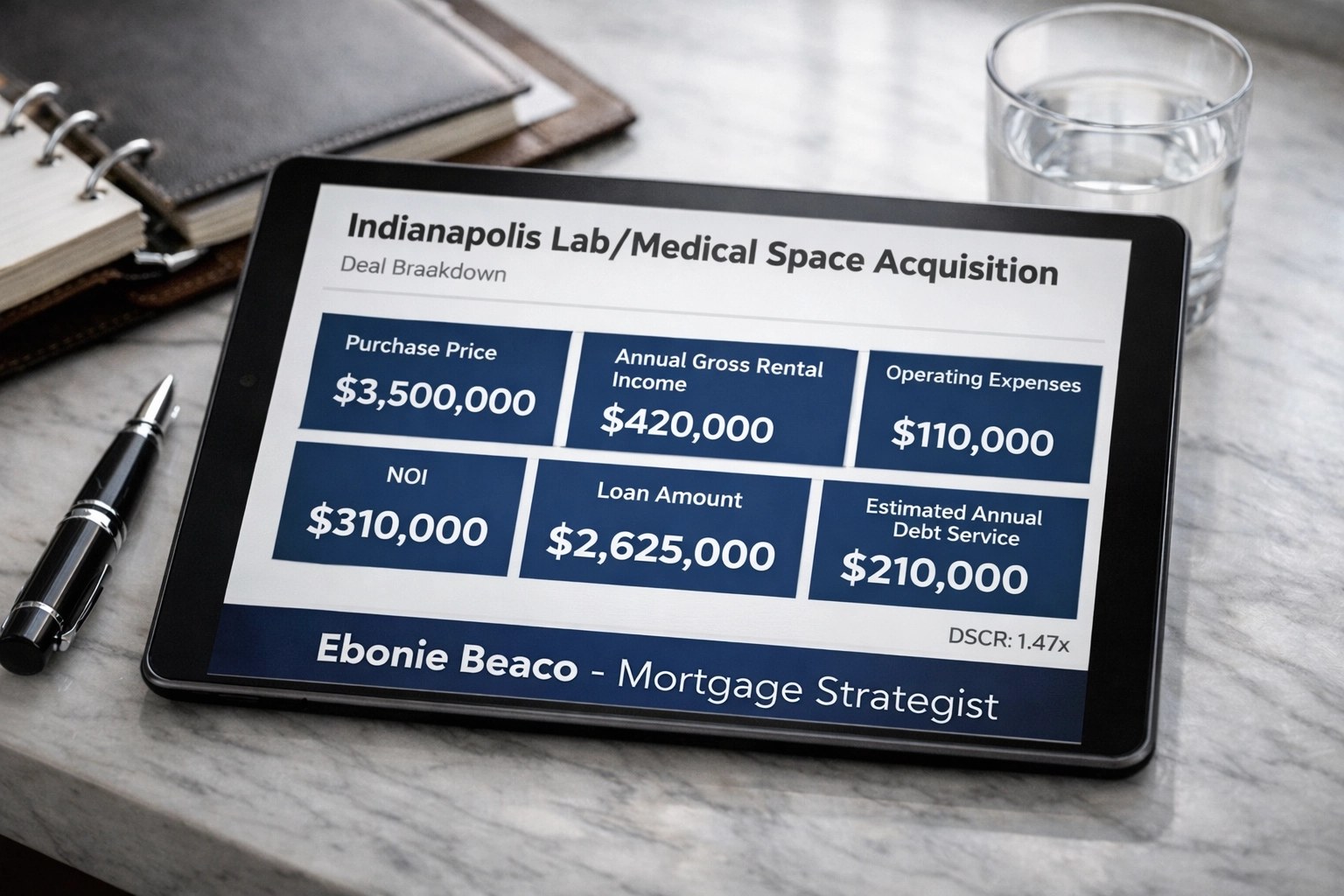
- Purchase Price: $3,500,000
- Annual Gross Rental Income: $420,000
- Operating Expenses: $110,000
- Net Operating Income (NOI): $310,000
If we are looking at a commercial loan with a 75% LTV (Loan to Value):
- Loan Amount: $2,625,000
- Estimated Annual Debt Service (Principal & Interest): $210,000
DSCR Calculation: $310,000 (NOI) / $210,000 (Debt Service) = 1.47x
In the world of CRE lending, a 1.47x DSCR is a strong "Yes." Most lenders look for 1.25x or higher. This deal shows that even with "softened" rents, the specialized nature of medical and lab space allows for high-margin returns compared to standard office space.
Key Terms for the 2026 Investor
- cGMP (Current Good Manufacturing Practice): These are the high-standard facilities used for drug manufacturing. They command the highest rents.
- TI (Tenant Improvements): In life sciences, TI can be $200+ per square foot. Understanding how to finance these improvements is as important as the purchase price.
- Absorption Rate: The rate at which vacant space is filled. With the 10-year low in construction, we expect absorption to accelerate by late 2026.
How Home Loans Network Can Map Your Strategy
The "cooldown" is simply a return to fundamentals. The "froth" is gone, and the real investors are left at the table. Whether you are looking for commercial real estate loans to acquire a lab, or you're a homeowner looking for a cash-out refinance to fund your first commercial down payment, we have the roadmap.
I don't just look at numbers; I look at the strategy behind the deal. We offer:
- Non-QM and Bank Statement Loans for self-employed investors.
- Jumbo Loans for high-value medical properties.
- Hard Money and Bridge options for quick-close opportunities.
The window for "stabilization" pricing won't stay open forever. As the construction pipeline empties out, the remaining space will become premium again.
Access the market now while others are waiting for the headlines to change.
Compare your current funding options with what a dedicated strategist can bring to the table.
Explore how specialized lending can turn a 23% vacancy market into your greatest portfolio gain.
Ready to talk numbers?
Scedule a 1 on 1 at https://calendly.com/homeloansnetwork Ebonie Beaco
Mortgage Strategist | Senior Loan Officer
Home Loans Network powered by Loan Factory Inc.
NMLS #2389954
HomeLoansNetwork.com
312-392-0664