How to Find Your Next Chicago Investment Property in 5 Minutes Using AI
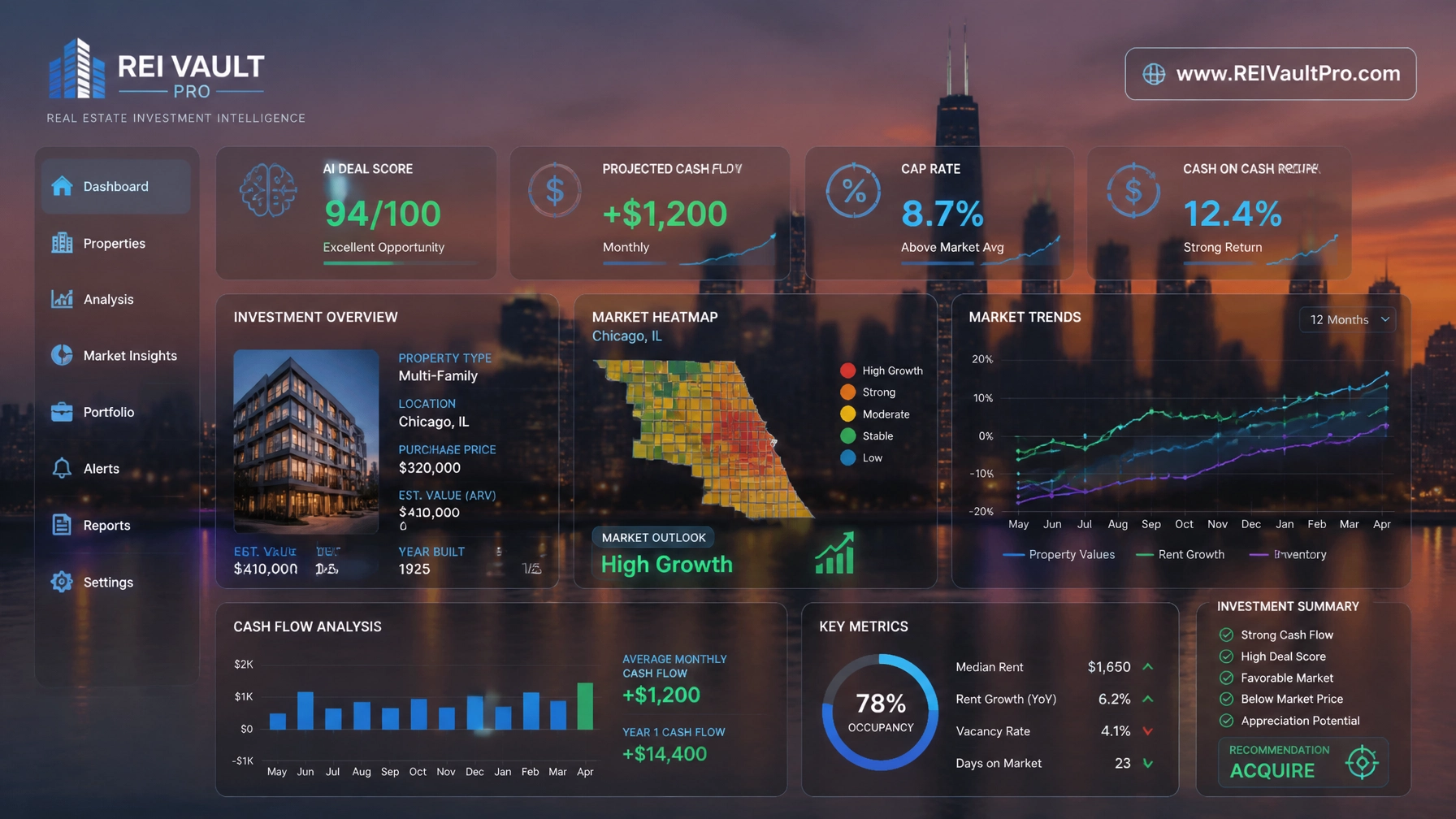
SEO Title: How to Find Your Next Chicago Investment Property in 5 Minutes Using AI
Meta Description: Learn how to leverage AI tools and data-driven strategies to find high-yield Chicago investment properties in neighborhoods like Pilsen and Logan Square.
URL Slug: chicago-investment-property-ai-search
Featured Image Recommendation: A high-tech real estate dashboard showing a Chicago skyline background with UI elements like "AI Deal Score: 92/100" and "Property Found: Pilsen, IL".
SEO Alt Text: AI real estate dashboard showing Chicago investment property analysis and deal scoring.
Social Media Excerpt: Stop spending weeks hunting for deals. Use AI to scan the Chicago market and find your next high-cash-flow rental in minutes.
SEO Tags: Chicago Real Estate, AI Real Estate Investing, DSCR Loans Chicago, Rental Property Search, REI Vault Pro, Logan Square Investing, Pilsen Real Estate, Real Estate Technology.
The Chicago real estate market in 2026 presents a unique landscape for investors who prioritize stability and rental growth. While other markets experience volatile swings, the Windy City continues to offer a "slow and steady" environment characterized by moderate appreciation and strong rental fundamentals. Finding a high-yield opportunity among thousands of listings used to take weeks of manual filtering and spreadsheet analysis. Today, Artificial Intelligence (AI) has compressed that timeline into minutes, allowing you to identify, analyze, and score potential deals with surgical precision.
By integrating AI into your search workflow, you can move past generic listing data and access deep-level insights into neighborhood momentum and property-specific profitability. This guide explores how to utilize advanced technology to secure your next Chicago investment property while the competition is still refreshing their browser.
Understanding the 2026 Chicago Investment Landscape
Before jumping into the technology, it is essential to understand the current market dynamics. As of mid-2026, the median sale price in Chicago sits around $370,000, with a steady year-over-year appreciation rate of roughly 3% to 5%. Mortgage rates have stabilized near the 6% mark, though strategic investors are keeping a close watch for potential dips toward 5.6% to lock in superior cash flow.
Inventory levels have improved slightly from previous years, but the most desirable properties, those that are updated and move-in ready, still move to "pending" status in fewer than 10 days. This speed necessitates a search strategy that is both proactive and data-driven. Whether you are looking for a multi-unit building in Pilsen or a value-add greystone in Logan Square, the ability to react instantly to market shifts is your greatest asset.
How AI Transforms the Property Search Workflow
Traditional property searching involves setting basic filters like price, bedroom count, and zip code. AI-driven platforms, such as the REI Vault Pro Deal Analyzer, go significantly deeper by processing millions of data points to predict how a property will perform as an investment.
AVM: Automated Valuation Model. A technology-driven service that uses mathematical modeling and database analysis to estimate the market value of a property.
Practical Application: You can use an AVM to instantly spot "underpriced" properties where the listing price is significantly lower than the algorithmic value estimate.
Natural Language Search: A search capability that allows users to find properties using conversational phrases rather than rigid drop-down menus.
Practical Application: You can search for "3-unit buildings in Bridgeport under $500k with a cap rate over 6%" and receive a curated list of matches in seconds.
Predictive Analytics: The use of historical data and machine learning to forecast future market trends, such as rent growth or neighborhood appreciation.
Practical Application: Predictive tools help you identify "border zones" where a neighborhood is about to experience spillover demand from a more expensive adjacent area.

Spotlight on Chicago Investment Neighborhoods
To maximize the effectiveness of AI search tools, you must point them toward neighborhoods with strong underlying fundamentals. In 2026, several Chicago submarkets stand out for their specific investment profiles:
Pilsen and University Village
Pilsen remains a powerhouse for appreciation and rental demand. With its proximity to the Illinois Medical District and UIC, the area attracts a steady stream of high-quality tenants. AI market analysis shows that "updated" properties in this zone command a significant rent premium, making it an ideal target for fix and flip financing or BRRRR strategies.
Logan Square and Uptown
Logan Square continues to see strong buyer activity for multi-unit buildings. Using the REI Vault Pro AI Market Analysis tool, investors can track the "absorption rate" of 2–4 unit buildings to determine how quickly inventory is turning over. Uptown is emerging as a top choice for value-add multifamily projects due to its excellent transit access and stable rental pool.
Bridgeport and McKinley Park
For investors seeking more affordable entry points without sacrificing cash flow, Bridgeport and McKinley Park offer compelling opportunities. Median home values here often sit below the city average, allowing for higher cash-on-cash returns. These areas are perfect for DSCR investor loans, which qualify based on the property’s rental income rather than your personal income.
Financial Example: Analyzing a 3-Unit Bridgeport Property
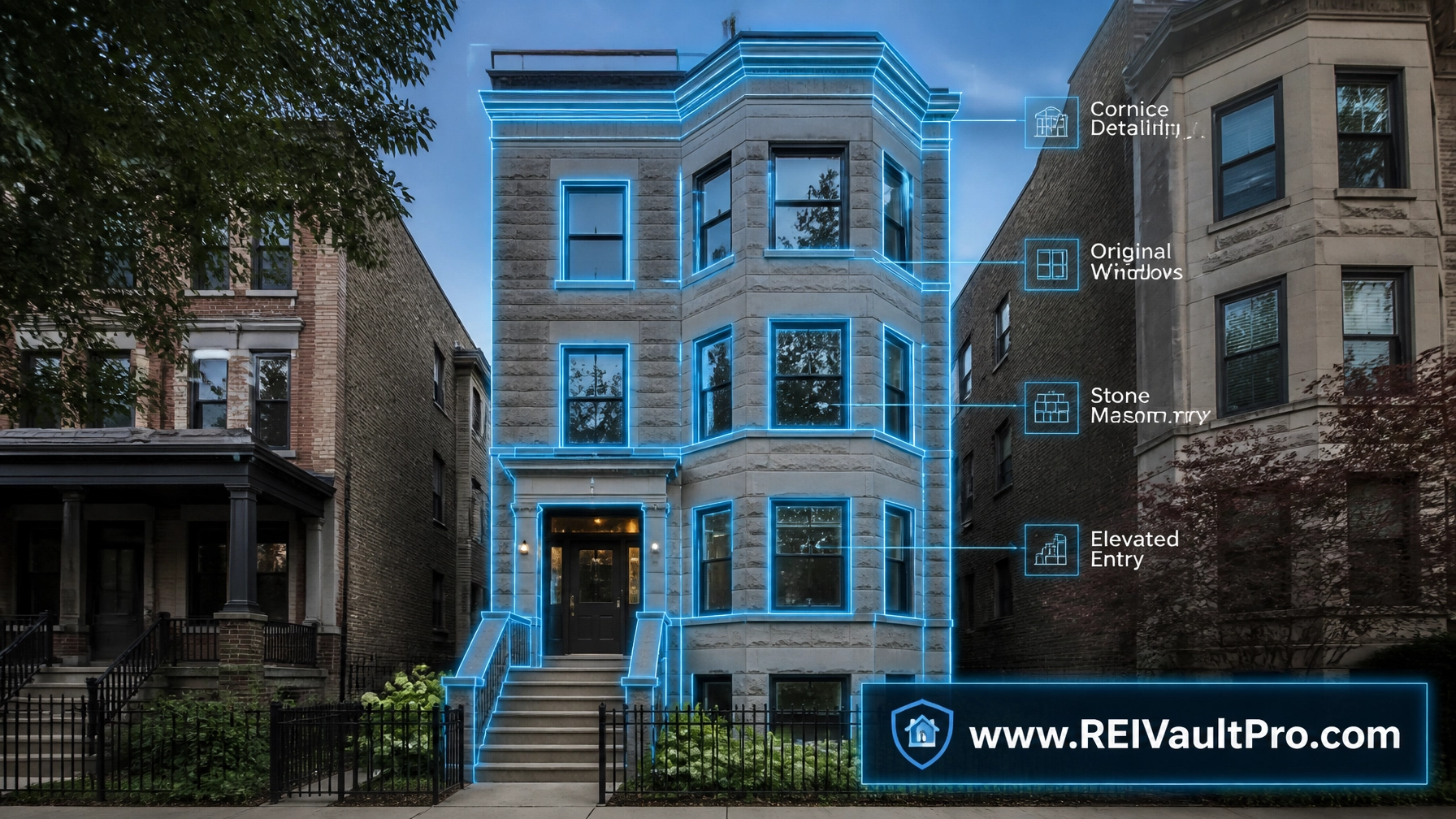
Let's look at a practical scenario of how an investor might use AI to validate a deal in the Bridgeport neighborhood. Imagine you find a brick 3-flat listed for $480,000. Using the REI Vault Pro AI Underwriting tool, you can instantly generate a full financial breakdown.
DSCR: Debt Service Coverage Ratio. A calculation that compares a property's annual net operating income (NOI) to its annual debt service.
Practical Application: Lenders use this to ensure the property generates enough income to pay the mortgage, often requiring a ratio of 1.20 or higher.
Cash-on-Cash Return: A rate of return that determines the cash income earned on the cash invested in a property.
Practical Application: This helps you compare the performance of different real estate assets relative to the initial capital you put down.
The Numbers:
- Purchase Price: $480,000
- Down Payment (25%): $120,000
- Loan Amount: $360,000
- Interest Rate (2026): 6.0%
- Monthly Rental Income: $5,400 ($1,800 per unit)
- Operating Expenses (35%): $1,890
- Net Operating Income (NOI): $3,510
- Monthly Mortgage (P&I): $2,158
- Monthly Cash Flow: $1,352
- Annual Cash Flow: $16,224
- Cash-on-Cash Return: 13.5%
- DSCR: 1.62
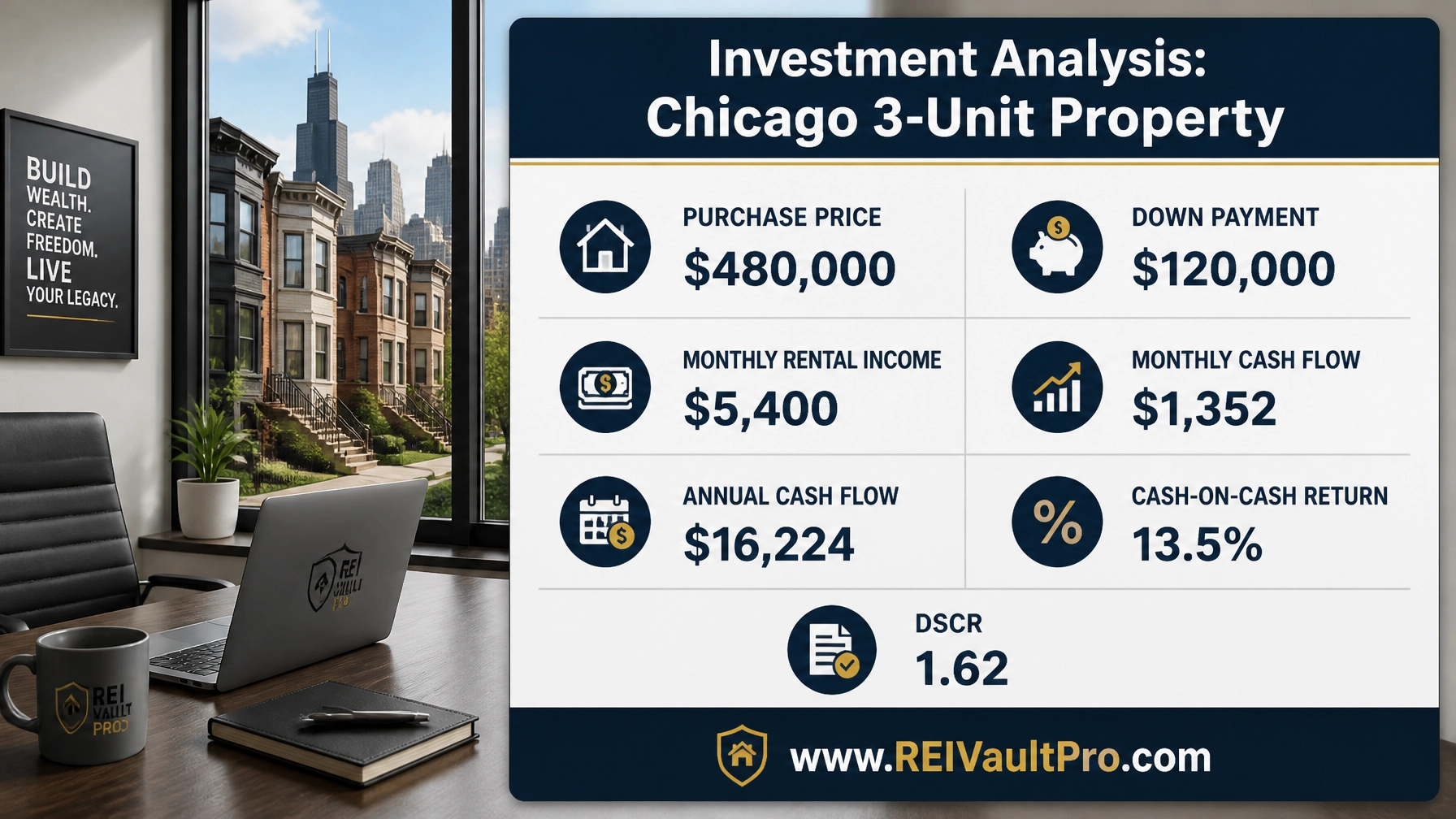
In this example, the property achieves a DSCR of 1.62, which is well above the typical lender requirement. The 13.5% cash-on-cash return indicates a high-performing asset for a long-term hold strategy. AI tools allow you to run these scenarios for hundreds of properties simultaneously, highlighting only the ones that meet your specific yield requirements.
Step-by-Step AI Search Guide for Investors
To find your next Chicago property in 5 minutes, follow this optimized workflow:
- Define Your Buy Box: Clearly state your goals. Are you looking for short-term rental financing opportunities or long-term multi-unit stability?
- Input Natural Language Queries: Use an AI-enabled search bar to filter by performance metrics rather than just aesthetics. Try: "Find 2-4 units in 60608 with rent-to-price ratio above 1%."
- Analyze Rehab Potential: For distressed properties, use the AI Rehab Estimator to get instant cost projections based on local Chicago labor and material rates.
- Check the AI Deal Score: Platforms like REI Vault Pro assign a score to every listing based on risk, potential ROI, and market stability. Focus only on deals scoring 85 or higher.
- Verify with AI Rent Analyzer: Ensure the listed rents are realistic by running an AI Rent Analysis that compares real-time lease data from the immediate area.
Navigating the Financing Process
Once you have identified a high-scoring property, securing the right funding is the final piece of the puzzle. Chicago investors often leverage Non-QM mortgage loans or bank statement loans, especially if they are self-employed or have multiple properties in their portfolio. If you are looking to tap into existing equity to fund a new acquisition, a cash-out refinance or a HELOC can provide the necessary liquidity.
The goal of using AI is to remove the guesswork. When you approach a lender with a deal that has been vetted through rigorous AI underwriting, you present a much stronger case. You aren't just presenting a house; you are presenting a data-backed financial asset.
Related REI Vault Pro Resources
- AI Deal Analyzer: This tool provides a comprehensive breakdown of any property's investment potential, including cash flow projections and cap rate analysis. It helps you decide in seconds if a Chicago listing is worth your time.
- AI Rent Analyzer: By pulling real-time rental data across Chicago neighborhoods, this tool ensures your income projections are accurate and competitive within the local market.
- AI Rehab Estimator: Essential for fix-and-flip or BRRRR investors, this tool calculates renovation costs based on current Chicago material and labor pricing.
- AI Deal Scoring: This feature ranks listings based on your personalized investment criteria, allowing you to ignore the noise and focus on the most profitable opportunities.
- AI Market Analysis: Use this to track macro-level trends in Chicago submarkets, such as inventory shifts in Logan Square or price growth in Bridgeport.
By leveraging these advanced technologies, you transform from a casual searcher into a data-driven real estate professional. The Chicago market moves fast, but with the right AI tools, you can move faster.
Are you ready to see how AI can streamline your investment strategy? Watch a Demo today and discover the properties your competitors are missing.
FAQ Section
How accurate are AI rent estimates in Chicago?
AI rent estimates are highly accurate because they pull from thousands of real-time lease data points, including active listings and recently rented properties. However, it is always recommended to cross-reference AI data with a local property manager to account for building-specific amenities or block-by-block nuances.
Can I use AI to find off-market deals in Chicago?
Yes, many AI platforms analyze public records, tax liens, and ownership data to identify properties with a high "propensity to sell." This allows investors to reach out to owners before a property ever hits the MLS.
What is the best neighborhood for a DSCR loan in Chicago?
Neighborhoods with strong rent-to-price ratios are best for DSCR loans. In 2026, areas like Bridgeport, McKinley Park, and parts of Uptown are excellent candidates because the rental income often significantly exceeds the monthly mortgage payment.
Does AI account for Chicago-specific property taxes?
Advanced AI underwriting tools, like those found at REI Vault Pro, integrate local tax data. Since Cook County property taxes can be complex, using a tool that automatically pulls current assessments and projects future increases is critical for accurate cash flow analysis.
How do I get started with AI real estate investing?
The best way to start is by joining the REI Vault Pro platform. You can begin by running a few properties through the Deal Analyzer to see the depth of data available and how it can improve your decision-making process.