How to Choose the Best Real Estate Deal Analyzer (Compared)
- Best Real Estate Deal Analyzer Tools for Investors in 2026
- Compare the top real estate deal analyzer software and AI tools for 2026. Learn how to evaluate rental properties, fix and flips, and commercial deals with accuracy and speed.
- best-real-estate-deal-analyzer-comparison
- https://cdn.marblism.com/ds-PUkyUwn-.webp
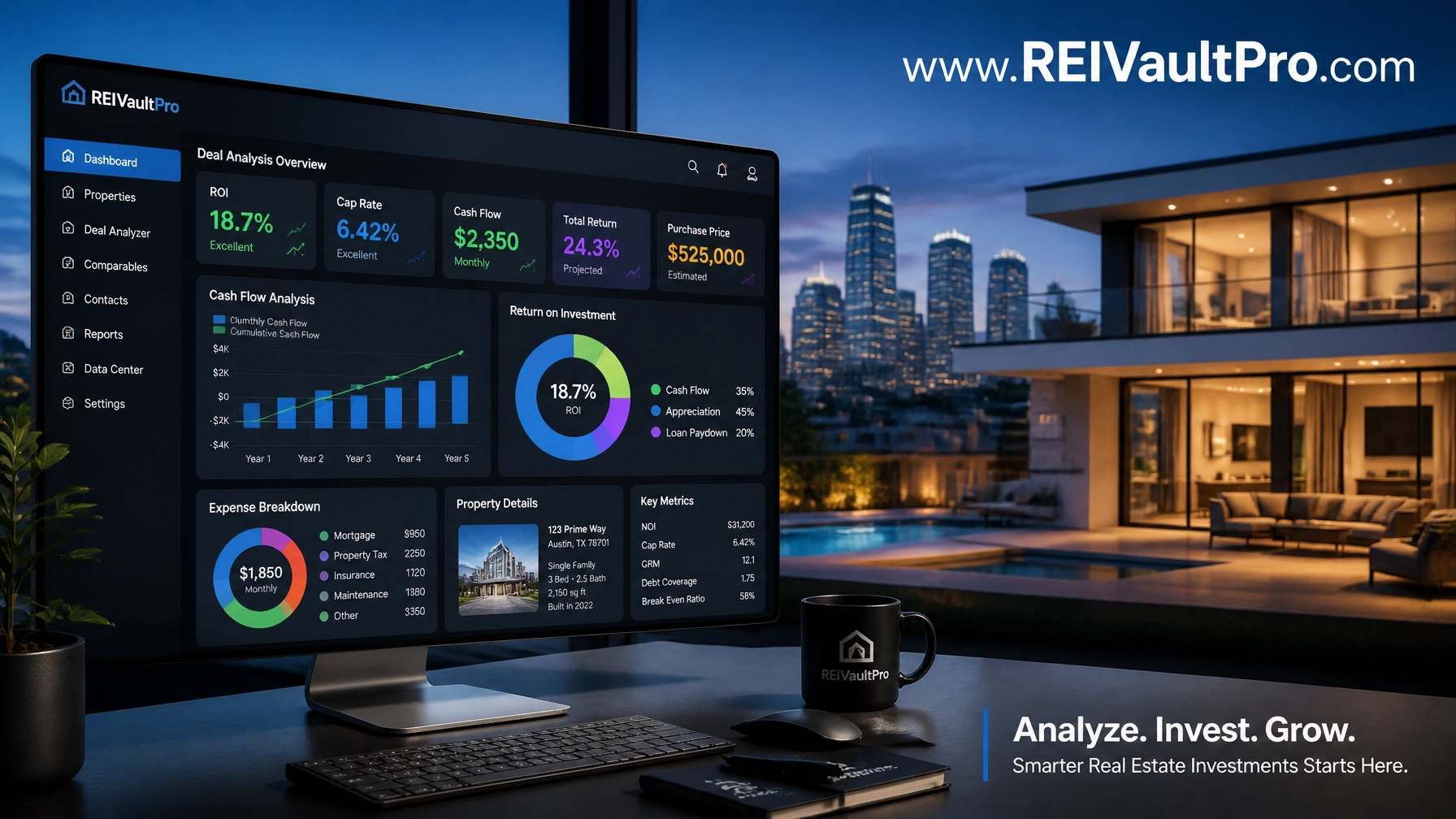
- A professional real estate investment dashboard showing financial metrics like ROI and Cap Rate with a luxury home in the background and the REI Vault Pro website URL.
- Ready to scale your portfolio? Choosing the right deal analyzer is the difference between a high-performing asset and a costly mistake. Explore our 2026 guide to the best tools for investors.
- Real Estate Investing, Deal Analysis, DSCR Loans, Rental Property Software, REI Vault Pro, ROI Calculator, Real Estate Finance

Finding a profitable real estate investment requires more than just a gut feeling or a quick look at a listing. In the competitive 2026 housing markets across Florida, California, Illinois, and Georgia, the speed and accuracy of your underwriting can determine whether you secure a high-yield property or miss out to a faster buyer. A real estate deal analyzer is a specialized software tool designed to calculate the financial viability of a property by processing purchase price, financing costs, operating expenses, and projected income.
Using an advanced analyzer allows you to filter through hundreds of potential leads to find the few that actually align with your wealth-building goals. Whether you are a first-time homebuyer looking for a house-hack in Chicago or an experienced investor scaling a short-term rental portfolio in Miami, having a reliable way to run the numbers is essential.
Why You Need a Dedicated Deal Analyzer
Many investors begin their journey using manual spreadsheets. While spreadsheets offer customization, they are prone to human error and often lack real-time data integration. In 2026, the industry has shifted toward AI-driven platforms that provide automated rent comps and rehab estimates. These tools help you avoid the common trap of overestimating cash flow or underestimating repair costs.
A professional analyzer helps you compare different financing strategies, such as using a DSCR (Debt Service Coverage Ratio) loan versus a traditional conventional loan. It also allows you to visualize how a cash-out refinance might look three years down the road, helping you plan your exit strategy before you even close on the acquisition.
Key Metrics Every Analyzer Should Calculate
Before comparing specific platforms, it is important to understand the technical terms and metrics that a high-quality deal analyzer must provide.
Cap Rate (Capitalization Rate)
The ratio of Net Operating Income (NOI) to the property purchase price.
Practical Application: Use this to compare the relative value of different properties in a specific market like Atlanta or Indianapolis without considering financing.
Cash-on-Cash Return
A percentage that measures the annual pre-tax cash flow relative to the total amount of cash invested.
Practical Application: This helps you understand exactly how much "cash" your "cash" is earning, which is critical for investors using leverage.
Debt Service Coverage Ratio (DSCR)
A measure of the cash flow available to pay current debt obligations.
Practical Application: Most DSCR investor loans require a ratio of 1.20 or higher to qualify for financing.
Internal Rate of Return (IRR)
A metric used to estimate the profitability of potential investments over a specific holding period.
Practical Application: This is vital for long-term buy-and-hold investors in stable markets like Virginia or Michigan.
Practical Example: Analyzing a Single-Family Rental
To understand how these numbers work in a real scenario, let’s look at a typical investment property analysis in Birmingham, Alabama.
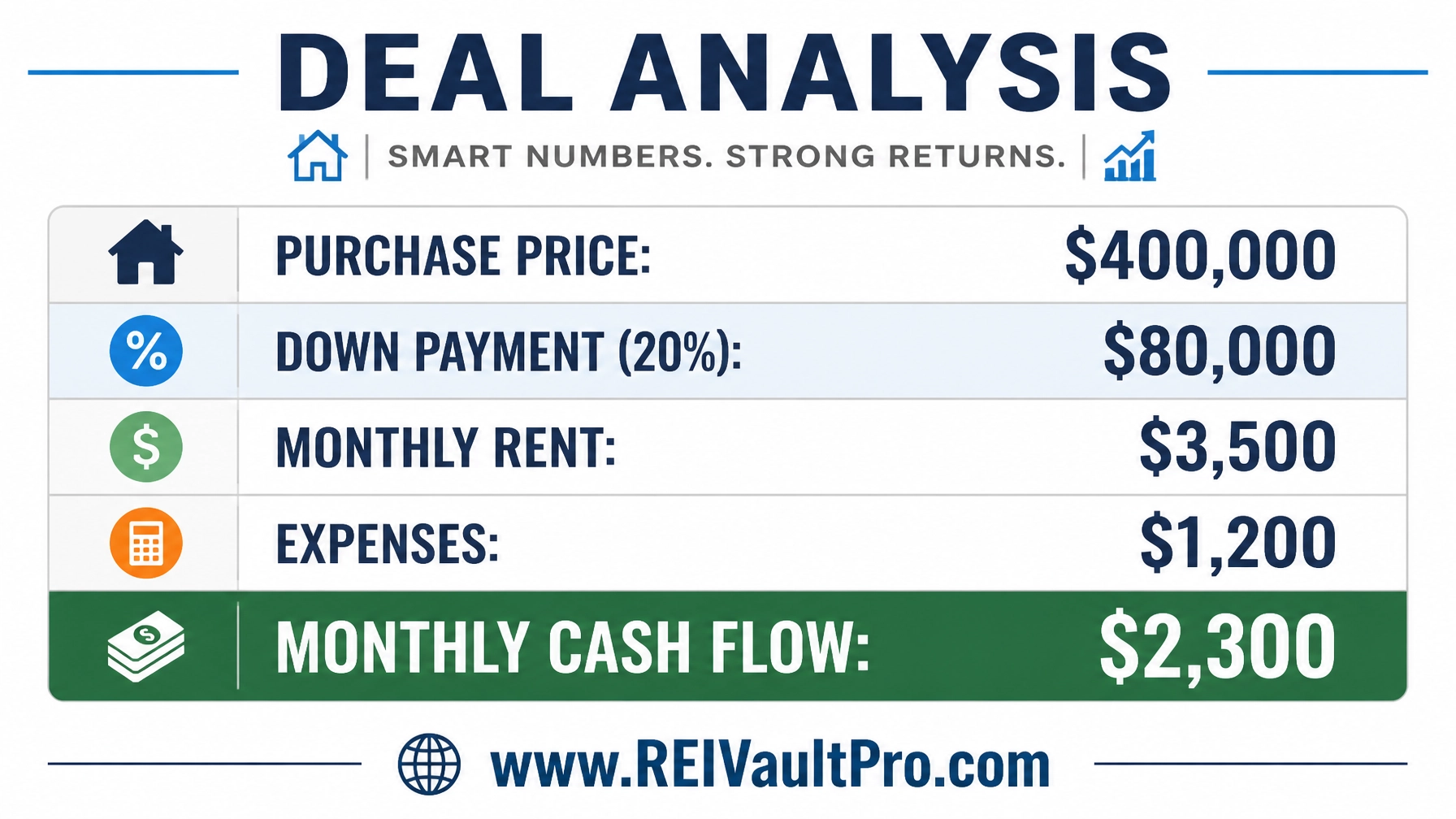
- Purchase Price: $400,000
- Down Payment (20%): $80,000
- Loan Amount: $320,000
- Interest Rate: 6.5%
- Monthly Mortgage Payment (P&I): $2,022
- Monthly Rental Income: $3,500
- Monthly Expenses (Taxes, Insurance, HOA, Vacancy): $1,200
In this scenario, your Monthly Cash Flow is calculated as:
$3,500 (Income) - $2,022 (Mortgage) - $1,200 (Expenses) = $278 per month.
Your Annual Cash Flow would be $3,336. To find your Cash-on-Cash Return, you divide that annual profit by your initial $80,000 investment, resulting in a 4.17% return. If your goal is a 10% return, this analyzer quickly shows you that you either need to negotiate a lower purchase price or find a property with higher rent potential.
Comparing Top Deal Analyzers for 2026
When choosing a tool, you must align the software’s features with your specific investment strategy. Here is how the top options compare in today's market.
1. REI Vault Pro AI Deal Analyzer
The REI Vault Pro AI Deal Analyzer is built for investors who need speed and comprehensive data. It integrates directly with local market data across states like Missouri, Kentucky, and Arkansas. It is specifically designed to handle complex scenarios like the BRRRR (Buy, Rehab, Rent, Refinance, Repeat) method and fix-and-flip projects.
- Best for: Investors who want an all-in-one suite that includes AI-driven rent comps and rehab estimation.
- Key Advantage: Seamlessly calculates eligibility for specialized loan products like Non-QM loans and bridge loans.
2. Mashvisor
Mashvisor is well-known for its focus on market-wide data. It allows users to search for properties and see projected returns based on existing Airbnb and traditional rental data.
- Best for: Short-term rental (STR) and Airbnb operators looking for new markets.
- Key Advantage: Strong visual heatmaps for identifying high-performing neighborhoods.
3. DealCheck
DealCheck is a versatile calculator that works well for both mobile and desktop users. It allows for quick data entry and produces professional reports that you can send to lenders when applying for fix-and-flip financing.
- Best for: Wholesalers and investors who need to run quick numbers while in the field.
- Key Advantage: User-friendly interface with pre-built templates for different asset types.

Analyzing Commercial and Multi-Unit Properties
If you are moving into the commercial space or purchasing multi-unit buildings in cities like Chicago or Los Angeles, your analysis becomes more complex. You are no longer just looking at individual "comps"; you are underwriting an entire business.
For a 12-unit apartment building, your analyzer needs to account for professional property management fees, utility RUBS (Ratio Utility Billing System), and staggered lease expirations. This is where the DSCR calculation becomes the primary focus for lenders.
Calculation Example for a Multi-Unit Building:
- Net Operating Income (NOI): $5,000 per month
- Monthly Debt Service: $4,000
- DSCR Calculation: $5,000 / $4,000 = 1.25
A 1.25 DSCR indicates that the property generates 25% more income than is required to cover the mortgage. This is a healthy ratio that many lenders in Florida and Virginia look for when approving landlord loans.
The Role of AI in 2026 Deal Analysis
Artificial intelligence has transformed how investors evaluate risk. Modern tools can now predict maintenance issues based on the age of the property or estimate the cost of a kitchen remodel in St. Louis versus San Francisco with high precision.
The AI Rehab Estimator within the REI Vault Pro suite allows you to input the square footage and condition of a property to receive a localized repair quote. This prevents the "budget creep" that often ruins the profitability of a fix-and-flip deal.

Choosing the Right Tool for Your Strategy
Your choice should depend on where you are in your investment journey.
- For the New Investor: Look for a tool that offers education and simple layouts. You want to learn the "why" behind the numbers.
- For the Experienced Landlord: Prioritize portfolio management features and the ability to track "actuals" versus "projections."
- For the Scale-Focused Investor: Choose a platform that offers team collaboration and API integrations with your CRM or property management software.
Using a tool like the Wholesaling Calculator can be a game-changer if you are trying to determine the Maximum Allowable Offer (MAO) to ensure there is enough meat on the bone for your end-buyer.
Related REI Vault Pro Resources
- AI Deal Analyzer: A comprehensive tool that automates the underwriting process for rentals and flips, helping you make data-backed decisions in seconds.
- AI Rent Analyzer: Access real-time rental comparisons to ensure your cash flow projections are based on current market realities rather than outdated estimates.
- AI Rehab Estimator: Get localized repair estimates to accurately budget for renovations and protect your investment margins.
- Membership Options: Explore different tiers of access to our full suite of investment tools, from the Investor Starter to the Pro level.
- Watch a Demo: See these tools in action and learn how to navigate the platform to find your next profitable deal.
Conclusion
Selecting the best real estate deal analyzer is about finding the balance between depth of data and ease of use. In today's market, relying on outdated methods can be a significant disadvantage. By utilizing advanced AI tools and professional-grade calculators, you can navigate the complexities of financing, from HELOC loans to hard money, with confidence.
The right analysis does more than just predict profit; it provides a roadmap for your entire investment lifecycle. Whether you are looking to tap into home equity for your next down payment or you are ready to acquire a multi-family complex, let the data guide your path.
Jump in and explore how the right tools can transform your investment strategy. Start a Free Trial or Watch a Demo today to see the difference for yourself.
FAQ Section
What is a good cash-on-cash return for a rental property?
While this varies by market, many investors in states like Indiana and Missouri target a cash-on-cash return of 8% to 12%. However, in high-appreciation markets like California, investors may accept a lower initial return in exchange for long-term equity growth.
Can I use a deal analyzer for Airbnb properties?
Yes. Specialized analyzers like the AI Rent Analyzer can help you compare projected short-term rental income against long-term rental rates to determine the highest and best use for a property.
How do I factor in closing costs?
A professional deal analyzer will have a dedicated section for acquisition costs, including loan origination fees, appraisal costs, and title insurance. Typically, these range from 2% to 5% of the purchase price.
Is it possible to analyze a property for a DSCR loan?
Absolutely. Many modern analyzers include a specific DSCR calculator that tells you exactly what the debt coverage ratio will be based on your projected rents and financing terms, which is essential for qualifying for landlord loans.
Do these tools work for self-employed borrowers?
Yes. While the tool analyzes the property, the data it produces can be used to support your application for bank statement loans or other Non-QM mortgage products designed for self-employed individuals.