How This California Mixed-Use Deal Saved a Fortune in Capital Gains Taxes

April 2, 2026
If you own high-value real estate in California, you already know the Golden State takes its cut. When you decide to sell a commercial residential mixed-use property that has appreciated significantly, the tax bill can feel like a punch to the gut. We are talking about federal capital gains taxes, depreciation recapture, and California's own hefty state tax rates which can climb as high as 13.3 percent.
For high net worth investors, selling a property without a plan is a recipe for a massive equity drain. But there is a way to keep your capital working for you instead of handing it over to the government. It is called the 1031 exchange, and when applied to complex mixed-use assets, it is the ultimate wealth-building tool.
The High Stakes of California Real Estate
In cities like Los Angeles, San Diego, and San Francisco, property values have skyrocketed over the last decade. A building purchased for a few million dollars years ago might be worth triple that today. While that sounds like a win, the tax liability grows alongside the value.
Capital Gains Tax: A tax levied on the profit made from the sale of an asset. In real estate, this is the difference between the sale price and the adjusted basis.
For an investor in a high tax bracket, the combined tax hit can easily exceed 30 to 40 percent of the total gain. Imagine losing nearly half of your profit before you even look for your next investment. This is why sophisticated investors use the Internal Revenue Code Section 1031 to defer these payments indefinitely.
The Case Study: A $9.5 Million Mixed-Use Transformation
Let’s look at a real-world scenario involving an investor we will call Arthur. Arthur owned a large commercial residential mixed-use building in a prime coastal California neighborhood. The ground floor consisted of high-end retail spaces, while the upper floors featured twelve luxury residential units.
Arthur had owned the property for twelve years. He was tired of the intensive management required for retail tenants and wanted to pivot into a larger, purely residential 48-unit apartment complex.
The Financial Breakdown
Here is what Arthur's situation looked like before we structured the exchange:
- Original Purchase Price: $4,000,000
- Improvements Made: $500,000
- Depreciation Taken: $1,200,000
- Current Sale Price: $9,500,000
- Closing Costs on Sale: $475,000
To understand the savings, we first have to calculate the Adjusted Basis.
Adjusted Basis: The net cost of an asset after adjusting for various tax-related items. It is calculated as (Purchase Price + Improvements) - Depreciation.
In Arthur’s case: ($4,000,000 + $500,000) - $1,200,000 = $3,300,000 Adjusted Basis.
Now, let’s calculate the Realized Gain: $9,500,000 (Sale Price) - $475,000 (Closing Costs) - $3,300,000 (Adjusted Basis) = $5,725,000 Realized Gain.
The Tax Hit Without a 1031 Exchange
If Arthur simply sold the property and took the cash, he would owe:
- Federal Capital Gains (20%): $905,000 (on the portion above depreciation)
- Depreciation Recapture (25%): $300,000
- Net Investment Income Tax (3.8%): $217,550
- California State Tax (13.3%): $761,425
Total Estimated Tax Bill: $2,183,975
Arthur would have seen over $2.1 million of his equity vanish. By using a 1031 exchange, he deferred that entire amount, allowing him to reinvest the full proceeds into his new $15 million 48-unit project.
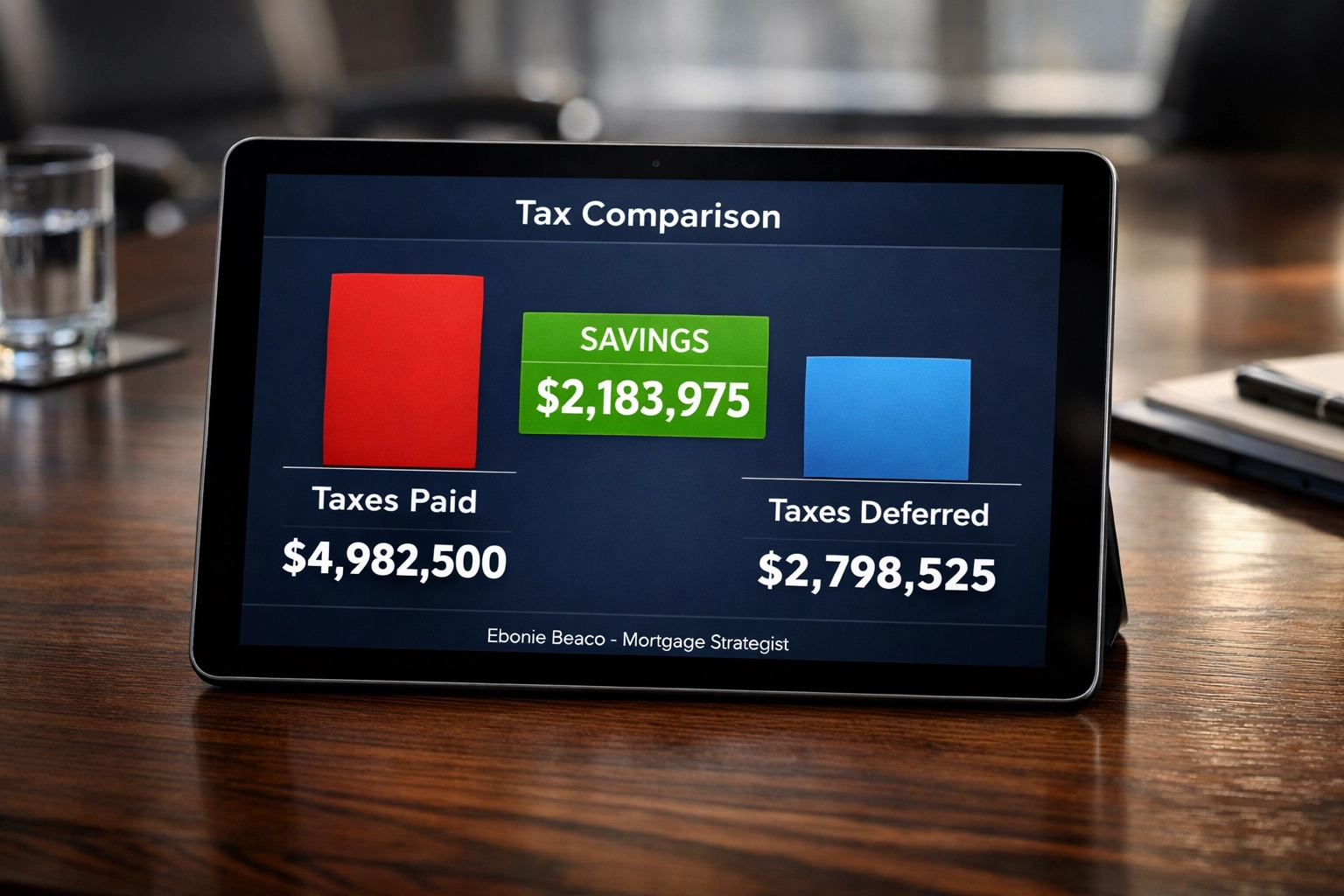 Visual Breakdown: Table comparing "Taxes Paid" vs "Taxes Deferred" showing the $2,183,975 savings for a $9.5M sale.
The 1031 Exchange Process: Rules You Cannot Ignore
A 1031 exchange is not a "do-it-yourself" project. It requires strict adherence to IRS timelines and the use of a Qualified Intermediary (QI).
Qualified Intermediary: A third party that holds the funds from the sale of the relinquished property and uses them to purchase the replacement property, ensuring the investor never has "constructive receipt" of the money.
The 45-Day Identification Period
The clock starts the moment you close the sale of your property. You have exactly 45 days to identify potential replacement properties in writing to your QI. This is often where investors feel the most pressure. If you miss this window by even a minute, the exchange fails and the tax bill becomes due.
The 180-Day Exchange Period
You must close on your replacement property within 180 days of the sale of your original property. For a high net worth investor looking at large-scale multifamily or mixed-use assets, due diligence and financing can take time. You must move quickly.
Explore our loan process page to see how we streamline financing to meet these tight deadlines.
Financing the Replacement Property
Arthur didn't just need a 1031 exchange; he needed a sophisticated mortgage strategy to acquire his new $15 million asset. Since he was moving from a mixed-use building to a 48-unit residential complex, we looked at DSCR Investor Loans.
DSCR (Debt Service Coverage Ratio): A metric used by lenders to measure a property's ability to cover its debt payments. It is calculated by dividing the Net Operating Income (NOI) by the annual debt service.
For Arthur’s new property, the NOI was projected at $1,050,000. If his annual mortgage payments were $750,000, his DSCR would be: $1,050,000 / $750,000 = 1.4 DSCR.
Most lenders look for a DSCR of 1.2 or higher. Because the property itself produced strong income, Arthur was able to secure a fixed rate mortgage that provided stability for his long-term hold strategy.
 A realistic photo of a modern 48-unit apartment complex in California with a professional investor reviewing financial documents.
Pro-Tips for California Mixed-Use Investors
When dealing with mixed-use properties, the 1031 exchange can get complicated if you also lived in one of the units.
Tip 1: The Section 121 Split If you occupied one of the residential units as your primary residence, you might be able to combine a Section 121 exclusion ($250k or $500k tax-free gain) with a 1031 exchange for the commercial and rental portions. This is a powerful "double dip" strategy that requires expert tax guidance.
Tip 2: Watch Out for "Boot" If the replacement property costs less than the sold property, or if your mortgage balance on the new property is lower than the old one, the difference is considered "boot" and is taxable. To fully defer all taxes, you must reinvest all cash proceeds and replace or increase your debt.
Tip 3: Use Bridge Loans if Needed Sometimes the perfect replacement property isn't ready to close exactly when you need it. In these cases, bridge loans can provide temporary capital to bridge the gap between transactions.
Why This Strategy Wins
By utilizing the 1031 exchange, Arthur didn't just "save" $2.1 million in taxes; he used that $2.1 million as a down payment for more real estate. That is the power of leverage. If he had paid the tax, he would have had $2.1 million less to invest, which, at a 75% loan-to-value ratio, means he would have lost out on $8.4 million in purchasing power.
Real estate investing is as much about tax management as it is about property management. When you play at this level, your mortgage strategist is one of the most important people on your team.
Jump in and check out our mortgage calculators to see how different loan amounts impact your cash flow and DSCR.
Ready to Scale Your Portfolio?
Whether you are looking at a 12-unit building, a 48-unit complex, or a massive commercial residential mixed-use portfolio, the rules of the game remain the same: preserve your equity at all costs. California's market is fast-paced, and 1031 deadlines wait for no one.
You need a partner who understands the nuances of non-QM mortgage loans and commercial financing. We help investors navigate the complexities of high-value exchanges so they can focus on finding their next great deal.
Access the guidance you need to keep your wealth growing. Contact Ebonie Beaco today for California mortgage solutions that align with your 1031 exchange goals.
Schedule a 1 on 1 at https://calendly.com/homeloansnetwork
Ebonie Beaco Mortgage Strategist | Senior Loan Officer Home Loans Network powered by Loan Factory Inc. NMLS #2389954 HomeLoansNetwork.com 312-392-0664
 Landscape image of a luxury mixed-use building in a California city with a diverse group of professionals in the foreground. Text: How This California Mixed-Use Deal Saved a Fortune in Capital Gains Taxes. Ebonie Beaco - Mortgage Strategist.