How Much Will I Actually Pay at Closing? A Guide to Closing Costs
So, you have navigated the house hunting process, survived the bidding wars in competitive markets like Chicago or Florida, and finally have a signed contract in hand. You have likely spent weeks obsessing over the purchase price and your monthly mortgage payment. But there is one final hurdle standing between you and the keys to your new property: closing costs.
Closing costs are the collection of fees, taxes, and administrative expenses that must be paid at the end of a real estate transaction. Whether you are a first-time homebuyer in Virginia or a seasoned real estate investor looking for a DSCR rental property loan in Michigan, these costs are a reality for everyone. Transparency is our priority at Home Loans Network, so let’s break down exactly what you should expect to see on your Closing Disclosure.
Defining Closing Costs
Closing Costs: The processing fees you pay to your lender and various third parties to finalize your mortgage. These costs are separate from your down payment and usually represent a significant portion of your upfront cash requirement.
Closing Disclosure (CD): A five-page document provided by your lender three days before closing that outlines the final terms and costs of your loan. Reviewing this document against your initial Loan Estimate is a vital step in ensuring there are no surprises at the closing table.
The 2% to 5% Rule of Thumb
While every deal is unique, a standard benchmark for estimating closing costs is between 2% and 5% of the total purchase price. This range covers the wide variety of fees associated with different loan types, such as Non-QM Mortgage Loans or traditional home purchase financing.
For example, if you are purchasing a rental property in Georgia for $350,000, your closing costs could range anywhere from $7,000 to $17,500. Factors such as your specific state’s transfer taxes and the complexity of the loan will determine where you fall in that range.
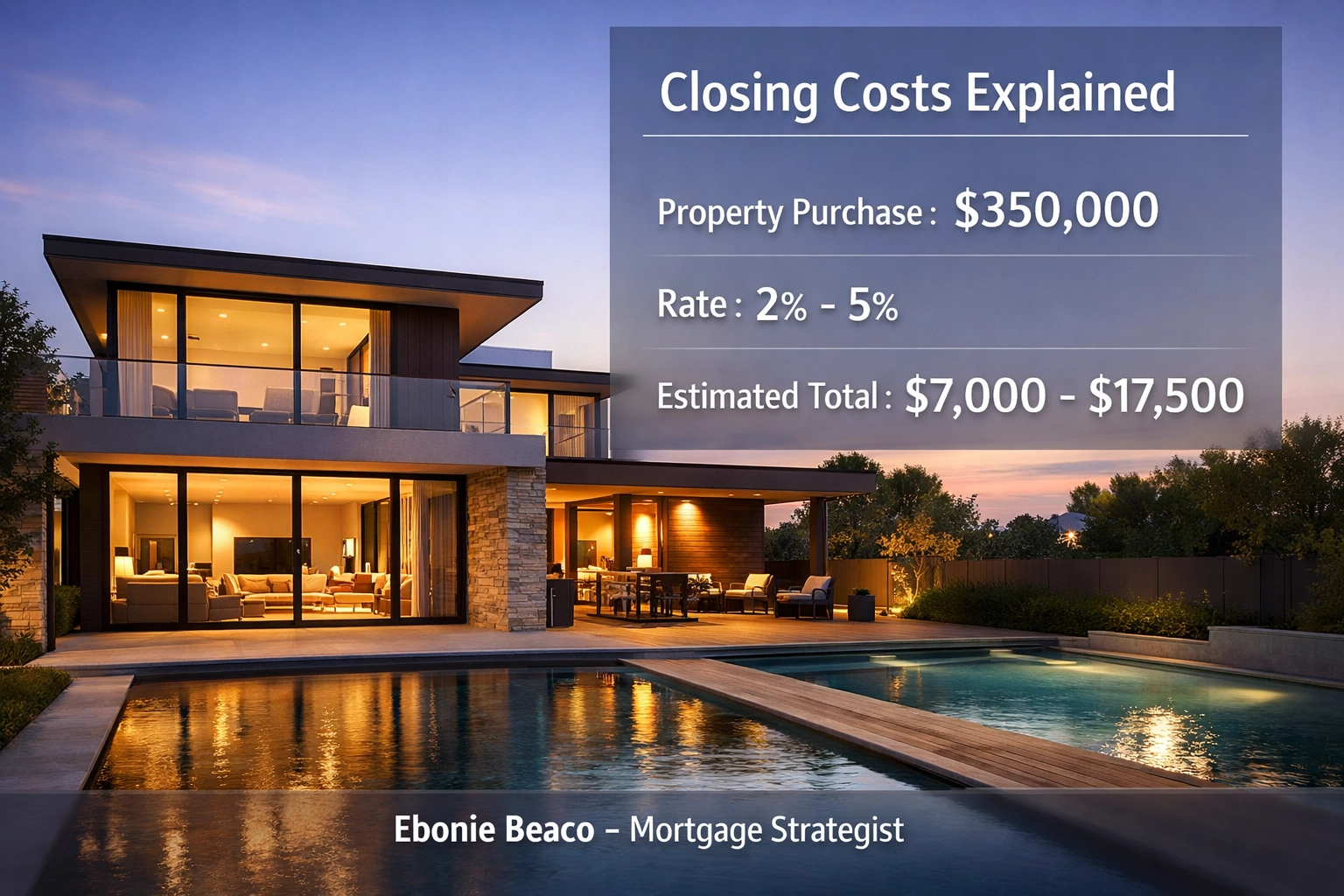 Title: Closing Costs Explained
Calculation Example:
Property Purchase Price: $350,000
Estimated Closing Cost Rate: 2% - 5%
Low-End Estimate (2%): $7,000
High-End Estimate (5%): $17,500
Ebonie Beaco - Mortgage Loan Officer
Title: Closing Costs Explained
Calculation Example:
Property Purchase Price: $350,000
Estimated Closing Cost Rate: 2% - 5%
Low-End Estimate (2%): $7,000
High-End Estimate (5%): $17,500
Ebonie Beaco - Mortgage Loan Officer
Breaking Down the Fees: Where Does the Money Go?
When you look at your settlement statement, you will see a long list of line items. It can feel overwhelming, but most of these charges fall into four main categories.
1. Lender Fees
These are the costs your mortgage company charges to process and fund the loan.
- Loan Origination Fee: A fee charged by the lender for evaluating and preparing your mortgage.
- Application Fee: Covers the initial cost of processing your request.
- Underwriting Fee: Paid to the lender for the work involved in determining your creditworthiness and risk.
- Discount Points: Optional fees paid upfront to lower your long-term interest rate.
2. Third-Party Services
These are services required by the lender but performed by outside companies.
- Appraisal Fee: Pays for a professional to estimate the fair market value of the home. This is essential for both Fix and Flip Loans and traditional purchases.
- Title Search and Insurance: Ensures the seller actually owns the property and that there are no liens against it. This protects your ownership rights.
- Home Inspection: While usually paid outside of closing, it is a critical part of the due diligence process for any buyer.
- Credit Report Fee: A small charge for the lender to pull your credit history from the three major bureaus.
3. Government Taxes and Recording Fees
The local government wants its share when property changes hands.
- Recording Fees: Charged by the city or county for updating public land records.
- Transfer Taxes: Taxes paid when the title passes from the seller to the buyer. These vary wildly by state: locations in Florida and Illinois may have very different tax structures.
4. Prepaid Items and Escrows
These are not necessarily "fees" but rather advance payments for items you would have to pay anyway.
- Prepaid Interest: Interest that accrues on your loan between the day you close and the end of the month.
- Homeowners Insurance: Lenders typically require the first year’s premium to be paid upfront.
- Property Tax Escrow: Funds set aside in an account to ensure your future tax bills are paid on time.
Closing Costs for Investors vs. Homeowners
If you are a real estate investor using a DSCR Investor Loan or a Bridge Loan, your closing costs might look a little different than a standard homeowner's. Investors often pay slightly higher origination fees or may need to pay for specialized environmental reports for commercial properties.
On the other hand, if you are a current homeowner looking to tap into your equity, you might consider a Cash-Out Refinance or HELOC Loans. Refinancing generally has lower closing costs because you aren't paying transfer taxes or recording fees to the same extent as a new purchase. You can jump in and use our mortgage calculators to see how these costs impact your overall return on investment.
How Geography Impacts Your Bottom Line
Where you buy property has a huge influence on your final bill. For instance:
- Florida: Often involves higher title insurance costs and specific state-level taxes.
- Chicago/Illinois: Known for specific transfer stamps that vary by municipality.
- Virginia and Maryland: May have unique recordation taxes that add to the total.
Because we operate in states like Alabama, Arkansas, California, Georgia, Indiana, Kentucky, Michigan, and Missouri, we understand the local nuances that can shift your closing costs by thousands of dollars. Accessing local expertise is the best way to avoid being blindsided at the finish line.
Strategies to Reduce Your Out-of-Pocket Costs
If you find that your estimated closing costs are higher than expected, you have options. Here are a few strategies to explore:
- Negotiate Seller Concessions: In some markets, you can ask the seller to pay a portion of your closing costs. This is a common tactic for investors and first-time buyers alike.
- Lender Credits: You can sometimes opt for a slightly higher interest rate in exchange for a credit from the lender to cover your closing costs.
- Shop for Title Services: You are often allowed to choose your own title company. Comparing quotes can save you hundreds.
- No-Closing-Cost Refinance: While the costs are usually rolled into the loan balance rather than truly disappearing, it can help you keep cash in your pocket today.
To learn more about the specifics of the loan journey, you can visit our loan process page.
Final Thoughts for the Prepared Buyer
Understanding closing costs is about more than just knowing the final number. It is about transparency and feeling confident that you are making a sound financial decision. Whether you are scaling a rental portfolio or moving into your forever home, knowing your numbers is the key to a successful transaction.
Compare your options and look at the fine print. If you have questions about how these fees apply to your specific situation, we are here to provide clear, human guidance. Explore our FAQ for more common questions or reach out to us directly.
Get a clear picture of your closing costs. Contact Ebonie Beaco for mortgage financing.
Scedule a 1 on 1 at https://calendly.com/homeloansnetwork
Ebonie Beaco Mortgage Strategist | Senior Loan Officer Home Loans Network powered by Loan Factory Inc. NMLS #2389954 HomeLoansNetwork.com 312-392-0664