Home Prices Crawling Higher: The 2026 Outlook

As we move further into March 2026, the housing market is sending a clear signal: the days of wild price swings and bidding wars are largely behind us. According to a recent report from Reuters, U.S. home prices are expected to rise by a modest 1.8% this year. This "crawl" toward higher valuations comes even as 30-year mortgage rates remain stubbornly close to the 6% mark.
For anyone who has been waiting for a massive crash or a return to 3% interest rates, the current data offers a reality check. We are entering what many experts call the "most balanced" market we have seen since before the pandemic. For homeowners in Chicago, investors in Florida, and buyers in Virginia, understanding these subtle shifts is the key to making a smart move this year.
The National Forecast: Growth at a Snail's Pace
The consensus among major financial institutions suggests that national home price growth will be minimal. J.P. Morgan is currently projecting 0% growth, while others like Realtor.com see a slightly higher bump at 2.2%. When you average these out, we land at that 1.8% figure.
Why is growth so slow? It comes down to the relationship between mortgage rates and inventory. While more homes are hitting the market: inventory is up nearly 9% year-over-year: the cost of borrowing continues to limit how much buyers can offer.
 Visual: A chart showing the steady 1.8% national price growth forecast for 2026. Text at bottom: Home Prices Crawling Higher in 2026 | Ebonie Beaco - Mortgage Strategist
Mortgage Rates and the New Normal
For the better part of two years, the industry has been waiting for rates to drop significantly. However, the 30-year fixed rate is sticking near 6%. While this is lower than the peaks we saw in 2024, it is high enough to keep the "lock-in effect" somewhat active.
Many homeowners who secured 3% or 4% rates years ago are still hesitant to trade up or down because it means doubling their interest expense. This keeps the supply of existing homes tighter than it would be in a lower-rate environment. However, for those looking at a Cash-Out Refinance or a HELOC, the stability of the 6% range provides a predictable baseline for planning equity-based projects.
Regional Divergence: A Tale of Two Markets
While the national average is 1.8%, the real story is found in the regional data. We are seeing a massive split between different parts of the country.
The Cooling Zones: Certain areas that saw a construction boom over the last few years are now seeing prices dip. This is most evident in Florida. Cities like Cape Coral, Fort Lauderdale, and Sarasota are forecast to see price drops as high as 10.2%. This is a direct result of increased supply catching up with: and in some cases exceeding: demand.
The Steady Climbers: In about 78 of the 100 largest U.S. cities, prices are still expected to rise, with a median gain of around 4%. Markets in the Midwest, including cities like Chicago and parts of Michigan and Indiana, tend to remain more resilient because they did not experience the same level of overbuilding seen in the Sun Belt.
If you are a real estate investor, this regional split is your roadmap. Buying in a declining market requires a different strategy than buying in a steady-growth market. In Florida, you might have more negotiating power with sellers. In Virginia or Georgia, you may need to move more quickly to secure a deal.
Real vs. Nominal Price Changes
There is a transparent truth that often gets lost in these headlines: real price declines are happening even if nominal prices stay flat. Inflation is currently projected to exceed 3% in 2026. If home prices only go up by 1.8%, that means the "real" value of the home, when adjusted for inflation, is actually dropping slightly.
For a homeowner, this might sound discouraging, but for a buyer, it is a sign that affordability is finally starting to heal. For the first time since the financial crisis, wages are growing faster than home prices. This shift is essential for the long-term health of the real estate market.
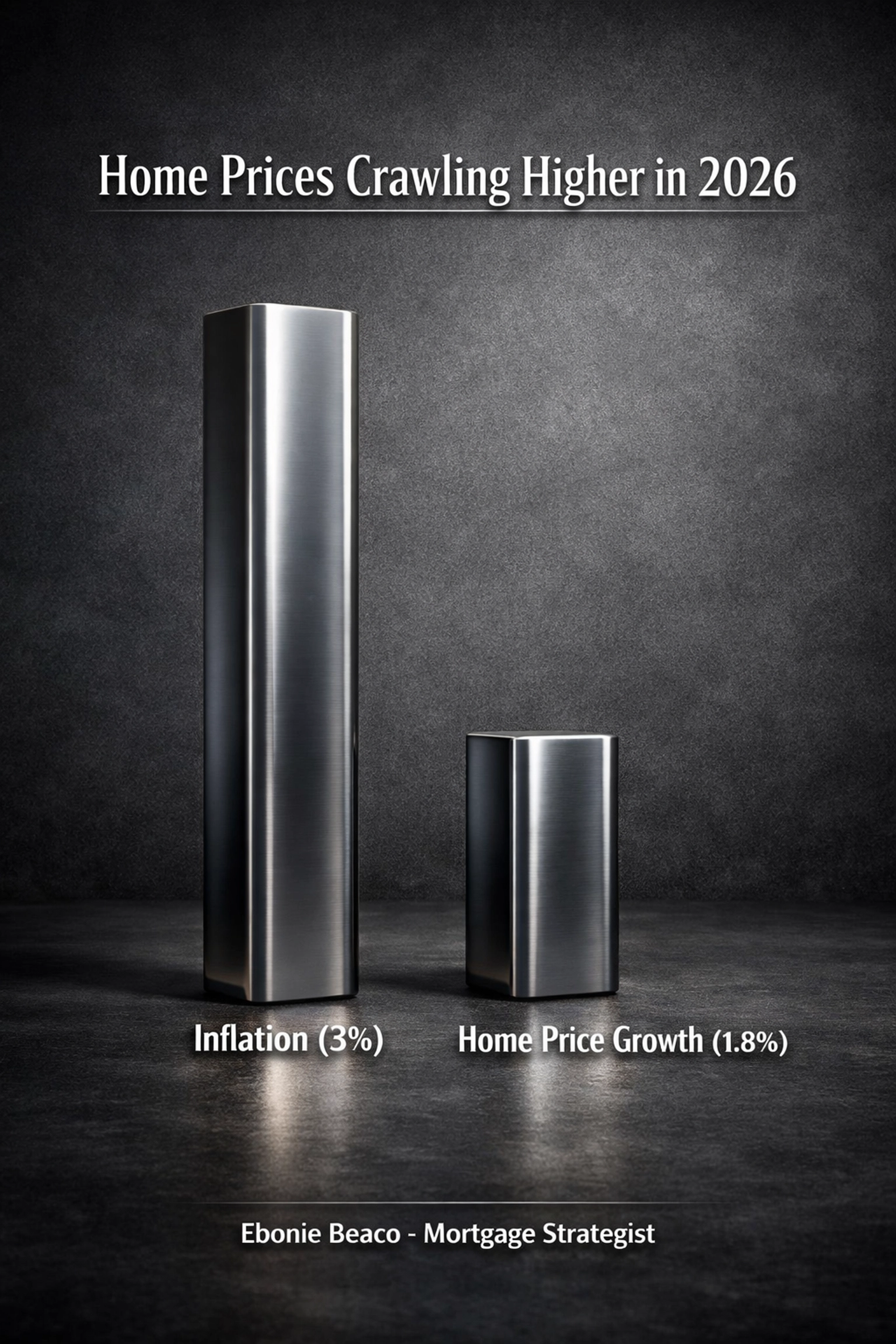 Visual: A comparison graphic showing 3% inflation vs. 1.8% home price growth, highlighting the gap. Text at bottom: Home Prices Crawling Higher in 2026 | Ebonie Beaco - Mortgage Strategist
Investment Strategies for a Balanced Market
In a market where prices are crawling, the strategy shifts from banking on "appreciation" to focusing on "cash flow." This is where specialized financing like DSCR Investor Loans becomes a powerful tool for landlords.
DSCR (Debt Service Coverage Ratio): A mortgage program where qualification is based on the rental income generated by the property rather than the borrower’s personal income or tax returns.
Investors use DSCR loans to scale their portfolios quickly without being limited by their personal debt-to-income ratios. In 2026, where prices are stable, the focus is on finding properties where the rent comfortably covers the mortgage, taxes, and insurance.
Case Study: The Florida Rental Play
Imagine an investor looking at a duplex in a Florida market where prices have softened.
- Purchase Price: $450,000
- Down Payment (25%): $112,500
- Loan Amount: $337,500
- Estimated Monthly PITI (at 6.5%): $2,650
- Total Monthly Rent (both units): $3,400
To calculate the DSCR, you divide the gross rent by the monthly debt payment: $3,400 / $2,650 = 1.28 DSCR
Lenders typically look for a ratio of 1.20 or higher. In this scenario, the property qualifies easily because it generates 28% more income than the cost of the debt. This allows the investor to secure the property and benefit from the long-term stability of the rental market while others are waiting on the sidelines for prices to drop further.
 Visual: A deal breakdown graphic showing the 1.28 DSCR calculation. Text at bottom: Home Prices Crawling Higher in 2026 | Ebonie Beaco - Mortgage Strategist
Accessing Equity: HELOCs vs. Cash-Out Refinance
Current homeowners who bought or refinanced prior to 2022 likely have a significant amount of equity. Even with prices "crawling," that equity remains a massive financial asset. If you need funds for home renovations, debt consolidation, or a down payment on a second property, you have two primary paths.
HELOC (Home Equity Line of Credit): A revolving line of credit that allows you to borrow against your equity without replacing your existing low-interest primary mortgage.
Cash-Out Refinance: Replacing your current mortgage with a new, larger loan and taking the difference in cash.
In 2026, the HELOC is often the preferred choice for those with primary rates under 4%. It allows you to access the money you need while keeping your low rate on the bulk of your debt. However, if your current rate is already in the 5% or 6% range, a full Cash-Out Refinance might be more efficient for consolidating high-interest credit card debt or funding a Fix and Flip project.
 Visual: A comparison chart showing when to choose a HELOC vs. a Cash-Out Refinance based on current interest rates. Text at bottom: Home Prices Crawling Higher in 2026 | Ebonie Beaco - Mortgage Strategist
The Impact on Fix and Flip Investors
A balanced market is actually a gift for fix and flip investors. When prices are skyrocketing, it is easy to overpay for a property and rely on the market to bail you out. When prices are stable, your profit is determined by the work you do and the value you add.
Success in 2026 requires precise budgeting and reliable Fix and Flip Financing. Since prices are not jumping 10% or 20% a year, you must ensure your "After Repair Value" (ARV) is realistic. Short-term bridge loans or hard money options remain the go-to for these transactions, allowing you to close quickly and start construction.
Looking Ahead
The 2026 housing market is about stability. It is about slow growth, recovered inventory, and a return to normal negotiating conditions. Whether you are a first-time buyer in Chicago, a seasoned landlord in Alabama, or a homeowner in California looking to tap into your equity, the data suggests that now is a time for calculated, strategic moves rather than impulsive ones.
Analyze the regional trends, compare your financing options, and look at the long-term potential of the real estate you hold or hope to buy. In a market that crawls, the person who stays patient and understands the math is the one who wins.
Explore your options with a professional who understands these market shifts.
Schedule a 1 on 1 at https://calendly.com/homeloansnetwork
Ebonie Beaco Mortgage Strategist | Senior Loan Officer Home Loans Network powered by Loan Factory Inc. NMLS #2389954 HomeLoansNetwork.com 312-392-0664