HELOC Secrets Revealed: What Experts Don’t Want You to Know About Tapping Your Equity in Alabama and Georgia

Home equity in the Southeast is at an all-time high. Whether you are watching home values climb in the Rocket City of Huntsville, Alabama, or navigating the bustling suburbs of Atlanta, Georgia, your home is likely sitting on a mountain of untapped cash.
Lenders are flooding mailboxes with Home Equity Line of Credit (HELOC) offers, promising easy access to funds with low interest-only payments. They make it sound like a magic ATM attached to your front porch.
While a HELOC is a powerful financial tool, there is a "hidden" side that most banks and high-volume lenders rarely discuss in their glossy brochures. Transparency is the foundation of a solid mortgage strategy, and you deserve to know exactly what happens behind the scenes before you sign on the dotted line.
Explore the reality of tapping into your equity and learn how to navigate the pitfalls that catch most homeowners off guard.
The Hidden Motivation: Why Banks Are Aggressively Pushing HELOCs
Have you ever wondered why every bank from Birmingham to Savannah is suddenly desperate to give you a line of credit? It is not just because they want to help you build a new deck or pay for college.
HELOCs are incredibly profitable for financial institutions because they carry variable rates. Unlike a fixed-rate mortgage, the interest rate on a HELOC is typically tied to the Prime Rate plus a margin.
When the Federal Reserve adjusts rates, your lender does not have to renegotiate with you; your payment simply goes up. This creates a massive upside for the lender while shifting all the interest rate risk onto your shoulders.
Lenders also know that once you have a revolving line of credit, you are statistically more likely to use it for non-essential lifestyle spending. They are betting on the "credit card effect": the tendency to treat home equity like a recurring bank account rather than a serious debt secured by your primary residence.
The 90% LTV Illusion: Is Your Lender Setting You Up for a Fall?
You might see advertisements in Alabama claiming you can borrow up to 90% of your home’s value. On paper, this sounds like a win because it maximizes the cash in your pocket for major projects.
Loan-to-Value (LTV): A financial term representing the ratio of a loan to the value of an asset purchased.
In practical terms, a high LTV means you have very little "skin in the game" left in your property.
If you tap into 90% of your equity and the housing market in markets like North Alabama or Central Georgia experiences even a minor dip, you could instantly find yourself underwater. Being underwater means you owe more than the house is worth, which makes it nearly impossible to sell or refinance without bringing cash to the closing table.
Most conservative mortgage strategists suggest staying at or below 80% combined LTV. This provides a safety cushion for market fluctuations and ensures you still have options if you need to pivot your financial strategy later.
Interest-Only Today, Financial Shock Tomorrow? The Brutal Truth About Payment Shock
The "Interest-Only Draw Period" is the most seductive feature of a HELOC. For the first 5 to 10 years, you are often only required to pay the interest on the amount you have borrowed.
This keeps your monthly obligation low and manageable, but it is a temporary state. Many homeowners in Georgia and Alabama are currently reaching the end of their draw periods from loans taken out years ago, and they are facing a massive "payment shock."
When the draw period ends, the loan enters the "Repayment Period." At this point, you must start paying back both the principal and the interest over a fixed term, usually 10 to 20 years.
Jump in and look at a quick comparison:
- Draw Period: You owe $50,000 at an 8% interest rate. Your interest-only payment is roughly $333 per month.
- Repayment Period: The same $50,000 at 8% amortized over 10 years jumps to approximately $606 per month.
That is nearly double the payment, assuming rates stay the same. If rates have risen during that decade, your payment could triple. Always ask your lender to show you the "fully amortized" payment schedule before you commit.
The Tax Deduction Myth: Why Your Kitchen Reno Might Not Be Free Money
A common pitch for HELOCs is that the interest is tax-deductible. While this used to be a blanket rule, the tax laws changed significantly with the Tax Cuts and Jobs Act.
Under current federal rules, HELOC interest is generally only deductible if the funds are used to buy, build, or substantially improve the home that secures the loan. If you use the money to pay off credit cards, buy a car, or fund a vacation, that interest is likely not deductible.
Many lenders gloss over this detail because the "tax-deductible" label is a powerful selling point. Before you move forward, confirm your plans with a tax professional to see if the math still works in your favor.
Debt Consolidation: The Secret Way You Could Lose Your House Over a Credit Card
Using a HELOC to consolidate high-interest debt is a popular strategy in states like Michigan and Virginia. As a Michigan HELOC lender, we see many clients looking to roll 20% interest credit card debt into a HELOC at 8% or 9%.
The math makes sense on the surface, but there is a major structural risk. You are converting unsecured debt (credit cards) into secured debt (your home).
If you fail to pay your credit card bill, the credit card company cannot take your house. If you fail to pay your HELOC, the lender absolutely can.
Furthermore, many people consolidate their debt but fail to change their spending habits. They pay off the cards with the HELOC, then run the credit cards back up again. Now they have a maxed-out HELOC and maxed-out cards, putting their home at extreme risk.

Alabama vs. Georgia: Subtle Regional Risks You Need to Know
While the mechanics of a HELOC are similar across the country, local laws in the Southeast create specific risks. Both Alabama and Georgia are "recourse" states.
This means that if you default on your loans and the foreclosure sale does not cover the total amount you owe, the lender can potentially pursue a deficiency judgment against you. They can go after your other assets or garnish your wages to make up the difference.
In fast-growing markets like Huntsville or the Atlanta metro area, equity can feel like a guaranteed upward trajectory. However, over-leveraging in a hot market is exactly what caused the most pain during the last housing downturn.
Finding the Right Partner: Why Local Expertise Wins
Whether you are looking for a Virginia HELOC lender or exploring options in Indiana or Illinois, the institution you choose has a massive impact on your terms.
Local credit unions in Alabama and Georgia often offer lower introductory rates and fewer fees, but they may have strict membership requirements. They might also include "cross-collateralization" clauses. This means if you have a car loan and a HELOC at the same credit union, defaulting on the car loan could technically trigger a default on your HELOC.
National lenders might offer higher LTVs, but they often lack the local market knowledge to provide a truly tailored strategy. Working with a mortgage strategist who understands the nuances of loan programs across multiple states ensures you are getting a deal that fits your long-term wealth-building goals.

The "Apply Before You Need It" Strategy
The best time to get a HELOC is when you do not actually need the money. Lenders approve applications based on your current stability.
If you wait until you have a medical emergency, a job loss, or your credit score has dipped due to high utilization, you will likely be denied or offered predatory rates. Smart homeowners in places like Florida and California set up a HELOC as a "just in case" safety net while their income and credit are at their peak.
You do not pay interest on the line until you actually draw funds. Having a $50,000 or $100,000 line of credit sitting at zero is one of the best emergency funds a homeowner can have.
How to Protect Your Equity While Tapping Into It
If you decide to move forward with a HELOC in any of our service states: from Kentucky to Missouri: follow these three rules to stay safe:
- Set a Personal LTV Cap: Just because a lender offers 90% does not mean you should take it. Stick to 80% to keep a safety buffer.
- Create an Artificial Repayment Plan: Do not wait for the draw period to end. Start paying back a portion of the principal from month one.
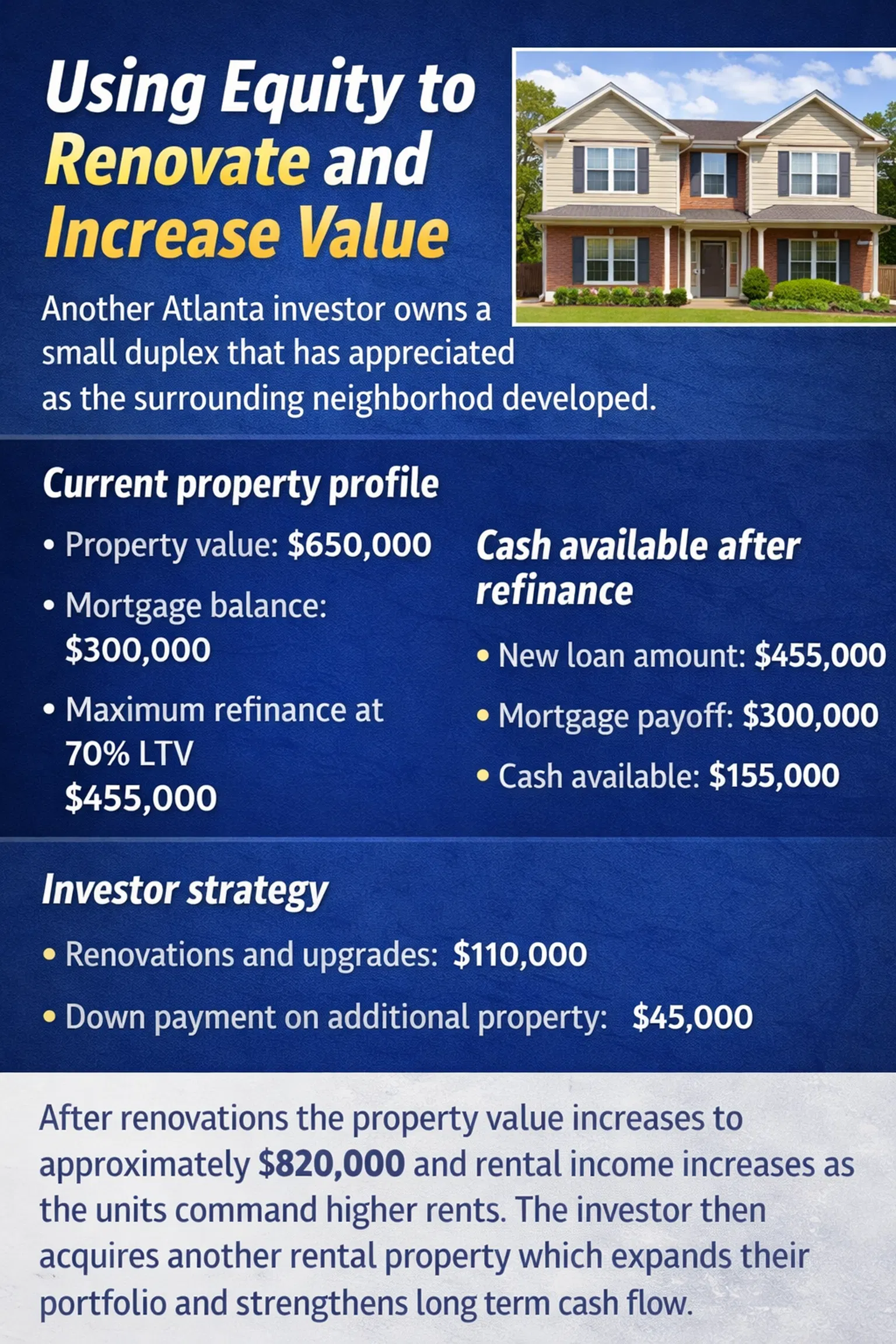
- Use it for Value-Add Only: Focus the funds on projects that increase your home's value or high-ROI investments like DSCR rental properties.
Accessing your equity should be a move toward financial freedom, not a trap that keeps you tethered to a bank for the next thirty years. Compare your options using mortgage calculators to see how different rates impact your monthly budget.

Your Next Steps Toward Strategic Equity
Tapping into your home equity is a major decision that requires more than just looking at an interest rate. It requires a strategy that considers your tax situation, your long-term property goals, and your local market conditions in Alabama, Georgia, and beyond.
If you are ready to stop guessing and start strategizing, let's look at your specific scenario. Whether you are a fix-and-flip investor in Chicago or a homeowner in Virginia looking to renovate, we can help you navigate the fine print.
Schedule a 1 on 1 at https://calendly.com/homeloansnetwork
Ebonie Beaco
Mortgage Strategist | Senior Loan Officer
Home Loans Network powered by Loan Factory Inc.
NMLS #2389954
HomeLoansNetwork.com
312-392-0664
