Ground-Up Construction Financing in Michigan
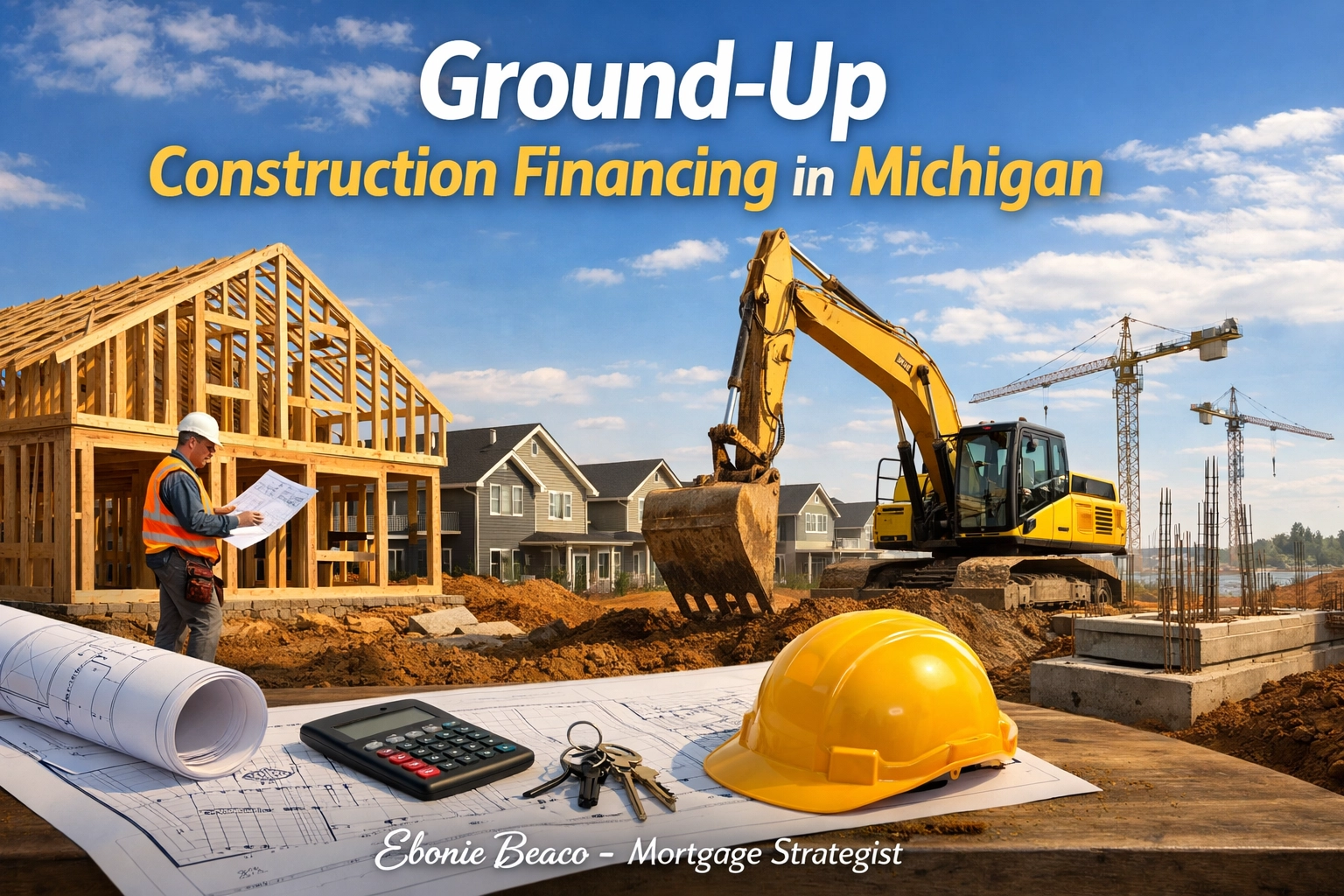
Building a home or an investment property from the dirt up is a massive undertaking, but in a market like Michigan, it is often the best way to get exactly what you want. Whether you are looking at a vacant lot in Grand Rapids or planning a multi-unit project in Detroit, understanding how to fund the project is the first hurdle. Ground-up construction financing is a specialized niche in the mortgage world that functions differently than a standard purchase loan.
When you buy an existing home, the bank hands over the cash, and you move in. With construction, the bank releases funds in stages, ensuring the work is actually being done before the next check is cut. This guide explores the mechanics of these loans, the specific options available in the Great Lakes State, and how you can leverage these tools to build your portfolio.
Defining Ground-Up Construction
Ground-Up Construction: The process of building a structure on a piece of land that is currently vacant or has been cleared of previous structures.
In the world of real estate finance, ground-up means you are starting from zero. You aren't just fixing a kitchen or adding a deck (which would fall under renovation or fix-and-flip financing). You are dealing with permits, foundations, framing, and finishing. Because the collateral (the house) doesn't exist yet, lenders view these loans as higher risk, which is why the structure of the deal is so specific.
Types of Construction Loans
Choosing the right loan structure depends on your long-term goals. Are you building a "forever home," or are you an investor looking to sell or rent the property once it is finished?
Construction-to-Permanent (Single-Close)
This is a popular choice for homeowners. It combines the construction financing and the long-term mortgage into one single loan. You close once, pay one set of closing costs, and during the build phase, you typically make interest-only payments on the amount disbursed. Once the home is finished, the loan automatically converts into a standard 15-year or 30-year fixed mortgage.
Stand-Alone Construction
If you already have a primary mortgage or prefer to shop for a better permanent rate later, a stand-alone construction loan covers just the build phase. Once the building is complete, you will need to pay off the construction loan, usually by getting a new "end loan" or permanent mortgage. This requires two separate closings.
Hard Money and Private Lending for Investors
For real estate investors, traditional bank timelines often move too slow. Private lenders and hard money lenders offer faster closings, sometimes in as little as 48 hours. These loans focus more on the value of the finished project (ARV) rather than just your personal income. While interest rates are higher, the flexibility allows investors to move quickly on prime Michigan land deals.
How the Construction Draw Process Works
You do not receive the full loan amount on day one. Instead, the lender uses a Draw Schedule.
Draw Schedule: A detailed payment plan that outlines when the lender will release portions of the loan proceeds to the builder based on specific milestones.
Typically, a project will have five to seven draws. For example:
- Draw 1: Foundation and site prep.
- Draw 2: Framing and roofing.
- Draw 3: Plumbing, electrical, and HVAC.
- Draw 4: Drywall and interior trim.
- Draw 5: Final finishes and landscaping.
Before each draw is released, an inspector visits the site to verify that the work has been completed to professional standards. This protects both you and the lender from paying for work that hasn't happened.
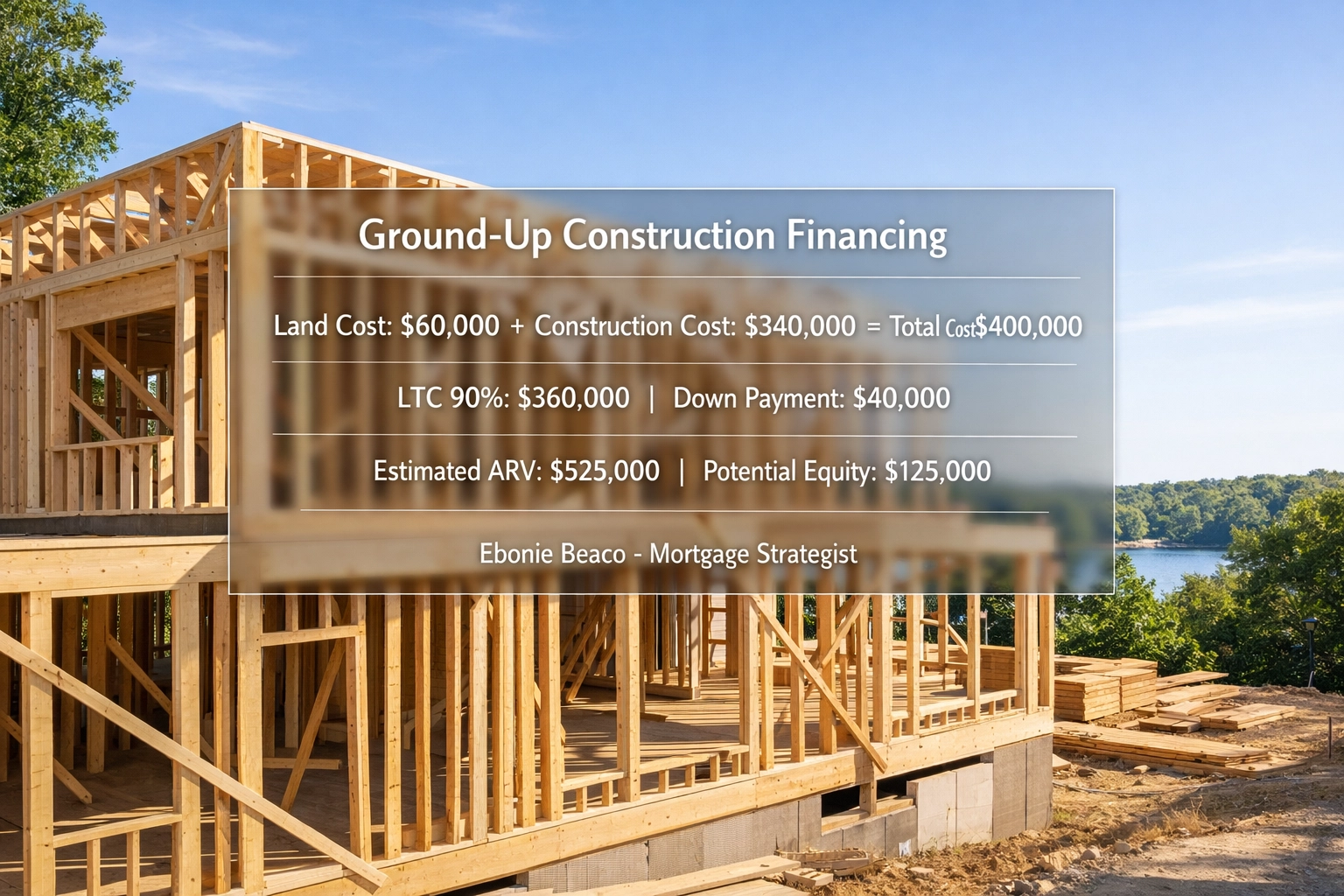 Instruction: Title 'Ground-Up Construction Financing' on the image. Include the following calculation: Land Cost: $60,000 + Construction Cost: $340,000 = Total Cost: $400,000. Loan-to-Cost (LTC) 90%: $360,000. Down Payment Required: $40,000. Estimated After Repair Value (ARV): $525,000. Potential Equity: $125,000. Add 'Ebonie Beaco - Mortgage Loan Officer' at the bottom. No money or cash in the image.
Qualifying for Construction Financing in Michigan
Getting approved for a ground-up build requires more documentation than a standard purchase. Lenders aren't just vetting you; they are vetting the project and the builder.
The Borrower (You)
For traditional construction-to-perm loans in Michigan, most lenders look for a credit score of 700 or higher. You will also need to demonstrate a stable Debt-to-Income (DTI) ratio. If you are an investor using a DSCR rental property loan strategy for the end-finance, the lender will focus on the projected rental income of the finished property.
The Builder
The builder must be licensed and insured in the state of Michigan. Lenders often require a builder’s resume, references, and proof of several years of experience. If you plan to act as your own general contractor (self-build), your options are more limited, though some institutions like Kalamazoo County State Bank have specialized programs for this.
The Plans and Appraisal
You need a "bluebook" or a detailed set of specs and plans. The appraiser will conduct a "subject-to-completion" appraisal. They look at your plans and compare them to similar homes in the area to determine what the house will be worth once it's finished.
Michigan-Specific Lending Insights
Michigan has a unique landscape for construction. In cities like Grand Rapids or Ann Arbor, inventory is tight, making new construction a very attractive option. Here are a few local nuances to keep in mind:
- Credit Unions: Institutions like Consumers Credit Union offer competitive new construction loans with as little as 5% down (95% LTV) and rate locks for up to 12 months. This is a huge benefit in a changing interest rate environment.
- Private Lenders: For those looking at "fix and flip" or "build and hold" strategies, private lenders in the region often finance up to 90% of the total cost and 100% of the construction budget.
- Vacant Land: If you are buying land first and building later, be prepared for different terms. Land loans usually require a higher down payment (20-35%) and have shorter terms than a residential mortgage.
Explore your options early by visiting our FAQ section or using our mortgage calculators to estimate your potential payments.
Strategies for Investors: Building to Rent
Many investors are moving away from buying old houses and toward ground-up builds for their rental portfolios. This is often part of a modified BRRRR strategy: Build, Rent, Refinance, Repeat.
The benefit of building new is lower maintenance costs and higher energy efficiency, which appeals to high-quality tenants. By using a DSCR loan for the final permanent financing, you can often pull your initial capital out of the deal if the property appraises high enough.
For instance, if your total cost to build is $350,000 but the finished value is $450,000, a cash-out refinance at 75% LTV would give you $337,500. This nearly replaces all your initial capital, allowing you to move on to the next project.
Potential Challenges to Watch Out For
Construction is rarely a perfectly smooth road. Being prepared for these hurdles will keep your project on track:
- Cost Overruns: Prices for lumber, steel, and labor fluctuate. Always include a 10-15% contingency fund in your budget.
- Permit Delays: Michigan winters and local municipality backlogs can stall a project. Ensure your loan term is long enough (12-18 months) to account for these delays.
- Interest Rate Risk: If you aren't using a single-close loan with a rate lock, your permanent mortgage rate could be higher by the time the house is finished.
Take the Next Step
Whether you are dreaming of a custom lakeside home or a new addition to your investment portfolio, ground-up construction financing is the engine that makes it happen. Navigating the draw schedules, builder approvals, and appraisal requirements is much easier with an expert guide by your side.
Reach out to Ebonie Beaco for construction financing or mentoring at www.homeloansnetwork.com.
Scedule a 1 on 1 at https://calendly.com/homeloansnetwork
Ebonie Beaco Mortgage Strategist | Senior Loan Officer Home Loans Network powered by Loan Factory Inc. NMLS #2389954 HomeLoansNetwork.com 312-392-0664