From 6 Units to Freedom: The Virginia 1031 Exchange You Can't Ignore
April 2, 2026
You have worked hard to build your real estate portfolio. You have spent years managing tenants, fixing leaky faucets, and watching the Virginia market climb. Now, you are sitting on a goldmine. Your property has appreciated significantly, and you are ready to scale up. But there is a massive obstacle standing between you and your next big move: the tax man.
When you sell an investment property, the IRS typically wants a huge cut of your hard earned profit. We are talking about capital gains taxes that can eat up twenty percent or more of your equity. For a mid-tier investor looking to grow, that loss of capital is devastating.
There is a way to keep your money working for you. It is called a 1031 Exchange.
This strategy allows you to sell your current property and reinvest the proceeds into a new property without paying a single cent in capital gains taxes today. It is the ultimate tool for building generational wealth. If you are holding a 6-unit courtyard style property in Virginia and wondering how to reach the next level, this guide is for you.
What is a 1031 Exchange?
A 1031 Exchange, named after Section 1031 of the Internal Revenue Code, is a swap of one investment property for another. While most sales are taxable, a 1031 transaction is viewed as a continuation of the initial investment. This allows you to defer the tax liability indefinitely.
To qualify, the properties must be "like-kind." In the eyes of the IRS, almost any real estate held for investment or business use is like-kind to other investment real estate. You could trade your 6-unit residential building for a larger 12-unit complex, an office building, or even a portfolio of single family homes.
Explore our loan programs to see how we can help you finance the replacement property in your exchange.
The Virginia Advantage
Virginia is a prime location for the 1031 strategy. From the bustling streets of Arlington to the steady rental markets in Richmond and Norfolk, the state offers diverse opportunities. Virginia investors benefit from a legal environment that understands real estate growth.
However, the clock starts ticking the moment you close your sale. You have exactly 45 days to identify a replacement property and 180 days to close on it. If you miss these deadlines by even one hour, the IRS will come knocking for their check.
Case Study: The 6-Unit Courtyard Transformation
Let us look at a real-world scenario. Meet Marcus. Marcus is a mid-tier investor who bought a charming 6-unit courtyard style apartment building in Alexandria, Virginia, back in 2016.
Marcus bought the property for $900,000. Over the last decade, the area has boomed. He has kept the property in great shape, but he is tired of the high maintenance that comes with older courtyard layouts. He wants to move into a newer, more efficient 12-unit building in a growing submarket.
Marcus finds a buyer willing to pay $1,600,000 for his 6-unit building.
The Tax Trap (Selling Without a 1031)
If Marcus simply sells the property, here is what his "tax bill" might look like:
- Sale Price: $1,600,000
- Original Purchase Price: $900,000
- Depreciation Recapture: ~$150,000 (Taxed at 25%) = $37,500
- Capital Gain: $550,000 (Taxed at 20% Fed + 5.75% VA) = $141,625
- Total Estimated Tax Bill: $179,125
Without a 1031 Exchange, Marcus loses nearly $180,000. That is money that could have been a down payment on his next building.
The 1031 Freedom Path
By utilizing a 1031 Exchange, Marcus keeps that $179,125 in his pocket. He uses a Qualified Intermediary (QI) to hold the funds from the sale. He then identifies a 12-unit building priced at $2,200,000.
Because he deferred his taxes, Marcus has significantly more leverage. He can use the full equity from his sale as a down payment. This allows him to qualify for better terms on a fixed-rate mortgage or a specialized investor loan.
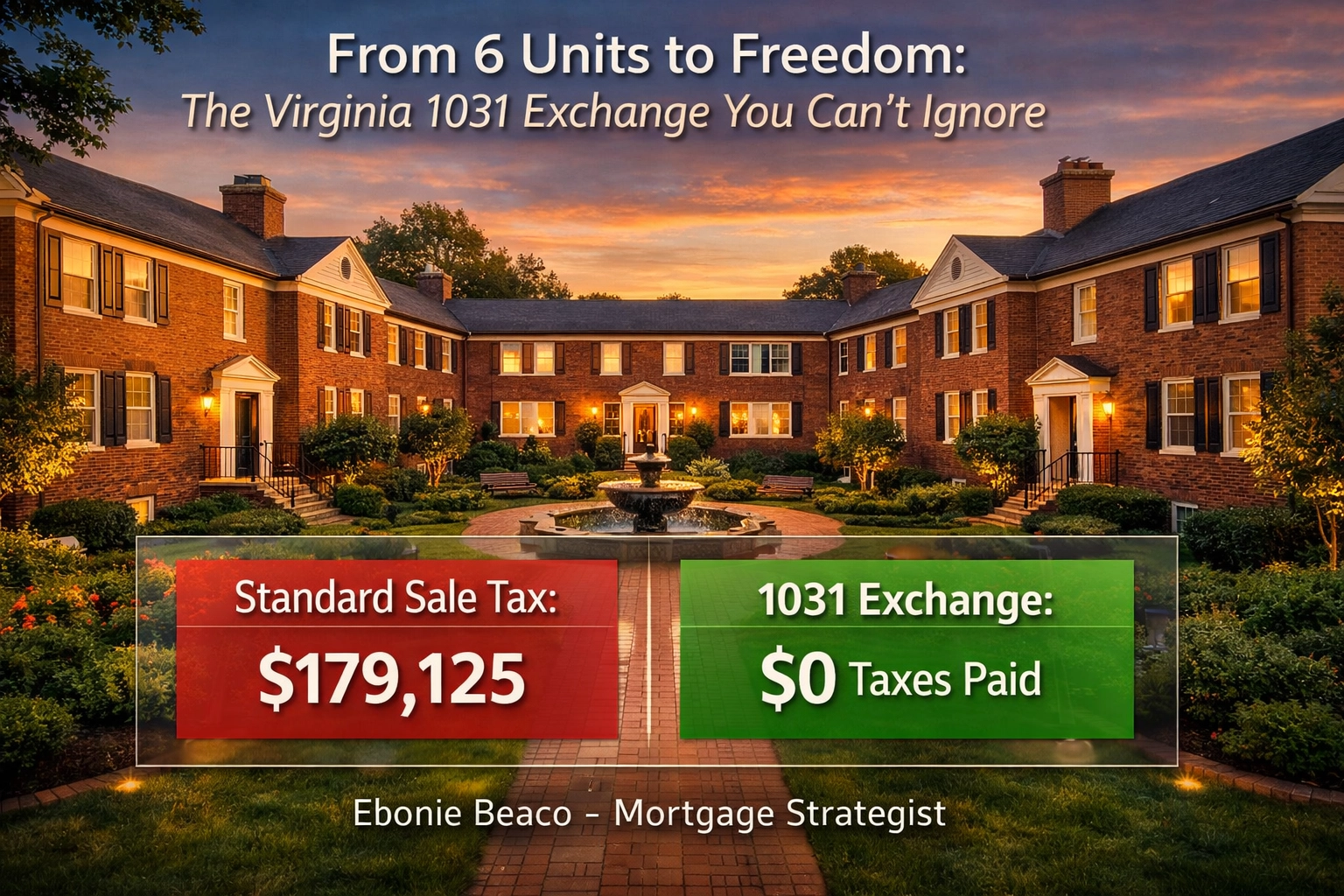 Visualizing the Math: $1,600,000 Sale vs. $179,125 Tax Savings for Marcus. Ebonie Beaco - Mortgage Strategist
Triggering Your Growth: Why Now?
Waiting to scale your portfolio can be a costly mistake. Interest rates fluctuate, and property values in Virginia continue to shift. By using a 1031 Exchange today, you lock in your gains and move them into a higher cash-flowing asset.
Many investors use DSCR investor loans to facilitate these exchanges. A Debt Service Coverage Ratio (DSCR) loan focuses on the income generated by the property rather than your personal income. For a mid-tier investor like Marcus, this is the key to breaking through the ceiling of traditional lending.
Rules You Must Follow
You cannot touch the money. If the proceeds from the sale hit your personal bank account for even a second, the exchange is disqualified. You must hire a Qualified Intermediary to facilitate the transfer of funds.
You must also ensure that the "boot" is zero. "Boot" is any fair market value or cash you receive in an exchange that isn't like-kind property. If you decrease your debt or take cash out at closing, you will be taxed on that specific amount. To fully defer all taxes, your replacement property must be of equal or greater value than the property you sold, and you must reinvest all the net proceeds.
The Hidden Cliffhanger: What If You Fail?
The 1031 Exchange is a high-stakes game. Imagine you are on day 44 of your identification period. You have scouted five properties, but two went under contract with other buyers, and one has major foundation issues found during inspection.
If day 45 passes and you have not formally identified your replacement properties in writing to your QI, the deal is dead. You will owe the full tax amount. This is why having a mortgage strategist on your team is vital. We help you run the numbers before you even list your property for sale.
Use our mortgage calculators to estimate your potential payments on a larger replacement property.
Financing Your 1031 Replacement
Financing a 1031 Exchange requires precision. You need a lender who understands the strict timelines and the specific requirements of the IRS. At Home Loans Network, we specialize in helping Virginia investors navigate these complex waters.
Whether you are looking at a residential mix used property or a standard multi-family building, we offer a variety of loan programs tailored to investors. We can help you transition from that 6-unit courtyard into a 12-unit, 36-unit, or even a 48-unit complex.
Final Tips for Virginia Investors
- Plan Ahead: Do not wait until you have a buyer to start looking for your replacement property.
- Know Your Basis: Work with your CPA to determine your exact adjusted basis and potential tax liability.
- Choose the Right QI: Your Qualified Intermediary is your most important partner in this process.
- Analyze the Cash Flow: Ensure the new property has a strong DSCR to make financing easy.
The path from 6 units to total financial freedom is paved with smart tax strategies. Do not let capital gains taxes stop your momentum. Leverage the power of the 1031 Exchange to keep your wealth growing in the Great Dominion.
Are you ready to see how much you can save? Let's look at your specific scenario and find the best financing path for your Virginia investment.
Scedule a 1 on 1 at https://calendly.com/homeloansnetwork
Ebonie Beaco Mortgage Strategist | Senior Loan Officer Home Loans Network powered by Loan Factory Inc. NMLS #2389954 HomeLoansNetwork.com 312-392-0664