Financing Your First Flip: What You Need to Know

Getting into the house flipping game is an exciting move. You see the potential in a distressed property, you have a vision for the renovation, and you are ready to make a profit. But before you pick up a sledgehammer or pick out subway tile, you have to solve the most important piece of the puzzle: the money.
Financing a fix and flip is different than getting a mortgage for a home you plan to live in. Traditional banks usually aren't interested in properties that have boarded-up windows or outdated electrical systems. This is why successful investors in markets like Chicago, Illinois, or the growing suburbs of Virginia and Georgia rely on specialized funding.
In this guide, we will break down how to fund your first project without getting overwhelmed. We will look at the different types of loans available, what lenders are looking for, and how to calculate if a deal is actually worth your time.
Key Terms for New Flippers
Before we jump into the loan types, let's get the vocabulary straight. Using the right terms helps you communicate clearly with lenders and contractors.
After Repair Value (ARV): The estimated market value of a property after all renovations and repairs are finished. Practical Application: Lenders use this number to determine how much they are willing to lend you, often capping the loan at 70% or 75% of the ARV.
Hard Money Loan: A short-term loan secured by real estate, typically issued by private investors or companies rather than banks. Practical Application: These loans close fast, which is essential when you are competing for a hot property in competitive markets like Florida or California.
Bridge Loan: A short-term financing option used to "bridge" the gap between the purchase of a property and the long-term financing or sale. Practical Application: Use this if you need to buy a new property quickly while waiting for another deal to close or for your permanent financing to kick in.
Points: Fees paid directly to the lender at closing, where one point equals 1% of the loan amount. Practical Application: Factor these into your closing costs so you aren't surprised by the amount of cash needed at the start.
Why Traditional Mortgages Usually Don't Work
If you try to buy a "fixer-upper" with a standard 30-year fixed mortgage, you might run into a brick wall. Conventional lenders have strict habitability requirements. If the kitchen is missing or the roof has a massive hole, the appraiser will flag it, and the loan will be denied.
Furthermore, traditional loans take 30 to 45 days to close. In the world of real estate investing, speed is a huge advantage. If a wholesaler in Michigan or Alabama has a great deal, they want a buyer who can close in a week. This is where investor-focused financing becomes your best friend.
Fix and Flip Loan Options
There isn't a one-size-fits-all loan for every investor. Your choice depends on your credit score, how much cash you have on hand, and your level of experience.
Hard Money Loans
Hard money is the go-to for many beginners. These lenders are less concerned with your personal income and more concerned with the property’s potential. They look at the equity and the ARV. While interest rates are higher than a standard home loan, the speed and flexibility are worth it. You can often get funded in 7 to 10 days.
Cash-Out Refinance
If you currently own a home in a place like Indiana or Arkansas and have a lot of equity, you might consider a cash-out refinance. You replace your current mortgage with a larger one and take the difference in cash. This gives you the capital to buy a flip property outright or cover the renovation costs.
HELOC (Home Equity Line of Credit)
A HELOC works like a credit card backed by your home. You only pay interest on what you spend. This is a great tool for covering renovation costs as they come up, rather than taking a huge lump sum and paying interest on the whole amount from day one.
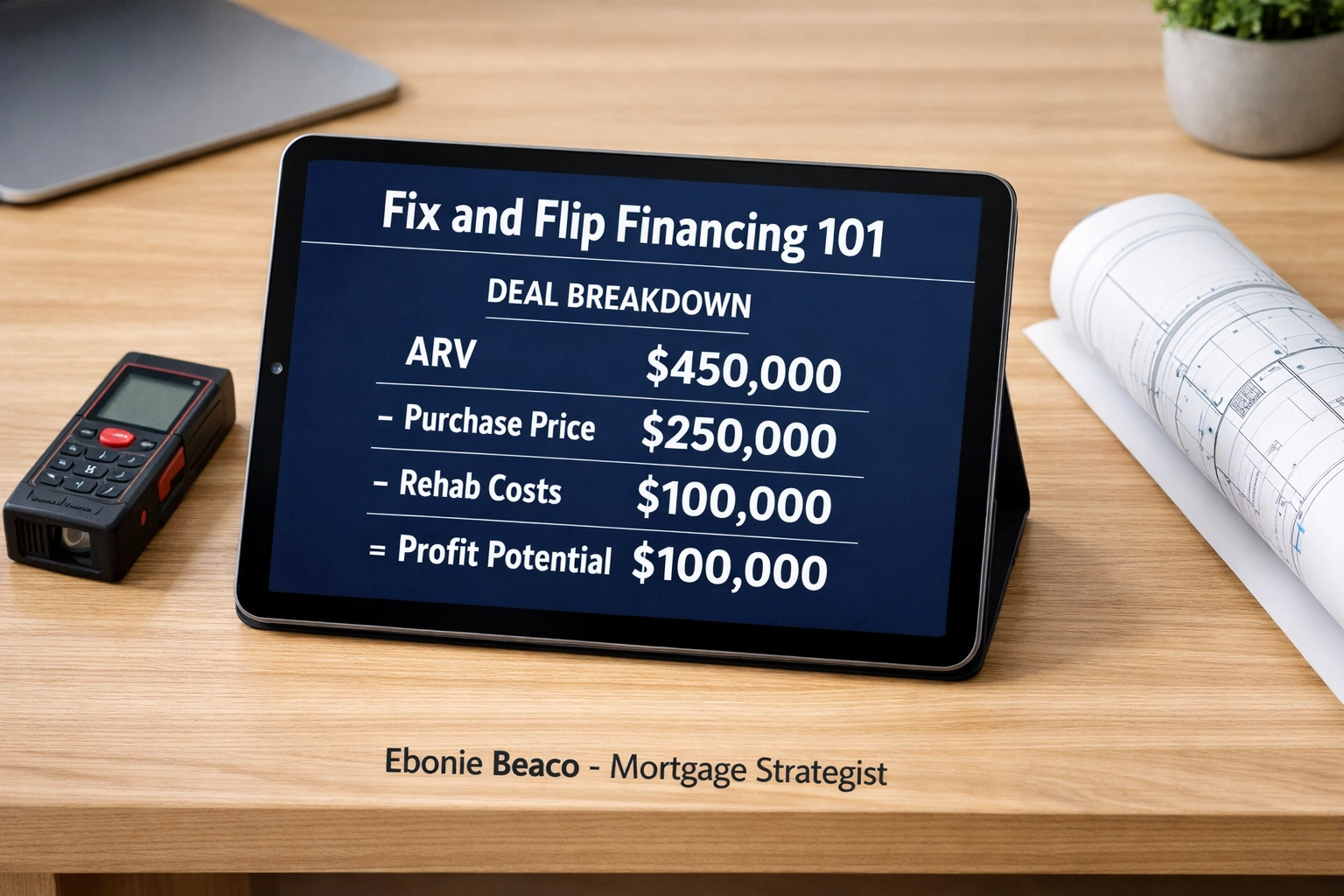
Image Instructions: Title: "Fix and Flip Financing 101". At the bottom, include "Ebonie Beaco - Mortgage Loan Officer". Include the calculation: Profit Potential = ARV ($450,000) - Purchase Price ($250,000) - Rehab Costs ($100,000) = $100,000. Use a clean, professional layout without any images of money or cash.
Analyzing the Deal: The Profit Potential
You should never buy a property just because it looks like a "good deal." You need to run the numbers. In the industry, we use a simple formula to see if the project has legs. We call this the Profit Potential.
Let's look at a real-world scenario. You find a distressed property in a nice neighborhood in Virginia.
- Purchase Price: $250,000
- Rehab Costs (Repairs, Labor, Materials): $100,000
- After Repair Value (ARV): $450,000
To find your potential profit, you subtract the purchase price and the rehab costs from the final value.
The Calculation: $450,000 (ARV) - $250,000 (Purchase) - $100,000 (Rehab) = $100,000 Profit Potential
Keep in mind, this is your "gross" profit. You still have to account for "holding costs" like interest payments on your loan, property taxes, insurance, and utilities while the house is being worked on. You also have "selling costs," like real estate agent commissions.
The Importance of the Appraisal
When you apply for a fix and flip loan, the lender will order an "As-Complete" appraisal. This is different from a standard appraisal. The appraiser looks at your renovation plan (your "scope of work") and estimates what the house will be worth once that work is done.
If your contractor says the kitchen will cost $20,000, but the appraiser thinks those upgrades only add $10,000 in value, it could change your loan amount. Transparency with your lender about your plans is vital here. You can learn more about how we handle these scenarios on our FAQ page.
What Lenders Look For in a New Investor
Even though the property is the star of the show, you still play a role. Lenders want to see that you have a plan.
- Credit Score: While some hard money lenders are flexible, having a score above 620 or 640 will unlock better interest rates.
- Cash Reserves: Lenders want to know you have some "skin in the game." They usually expect you to cover the down payment (often 10% to 20%) and have some extra cash for unexpected repairs.
- A Solid Team: If this is your first flip, having a licensed and insured contractor is a big plus. Lenders are more comfortable when they know a professional is swinging the hammer.
- A Realistic Timeline: Most fix and flip loans are for 6 to 12 months. If your project takes 18 months, your profits will be eaten up by interest.
Choosing Your Market
Where you flip is as important as how you flip. We see a lot of activity in different regions, each with its own rhythm.
- Chicago, IL: High demand for updated vintage homes and condos.
- Florida Cities: A hot market for vacation rentals and retirees looking for move-in-ready homes.
- Georgia and Virginia: Suburban growth is driving a need for modern family homes.
Understanding the local buyer’s preferences in these areas helps you decide where to spend your renovation budget. Don't put a luxury marble countertop in a neighborhood where buyers prefer durable laminate. Align your rehab with the market expectations to ensure a quick sale.
Moving Toward Your First Deal
If you are a homeowner looking to leverage your equity or an aspiring landlord wanting to build a portfolio, the fix and flip strategy is a powerful way to generate capital. It requires discipline, a good eye for property, and the right financial partner.
We help investors navigate the loan process every day. Whether you need a bridge loan to secure a property quickly or a long-term DSCR loan to keep the property as a rental after the rehab is done, we have options to fit your strategy.
Looking for bridge financing or fix-and-flip loans? Contact Ebonie Beaco at Home Loans Network.
Explore your options and get your questions answered by booking a session below. We are here to help you navigate the complexities of real estate finance with clarity.
Scedule a 1 on 1 at https://calendly.com/homeloansnetwork
Ebonie Beaco Mortgage Strategist | Senior Loan Officer Home Loans Network powered by Loan Factory Inc. NMLS #2389954 HomeLoansNetwork.com 312-392-0664