Financing Property Renovations: FHA 203k vs. Private Money
You found the perfect property. Maybe it is a historic brownstone in Chicago or a distressed single family home in a growing Florida neighborhood. The price is right, but the condition is not. It needs a new kitchen, updated plumbing, or perhaps a complete structural overhaul.
Navigating the world of renovation financing can feel overwhelming. You have two primary paths to consider: the government backed FHA 203k loan or the fast paced world of private money. Choosing the right one impacts your budget, your timeline, and your long term investment strategy.
Explore the mechanics of these two programs to see which fits your specific project.
Understanding the FHA 203k Loan
FHA 203k Loan: A mortgage insured by the Federal Housing Administration that covers both the purchase price of a property and the cost of repairs in a single loan. This program allows you to bundle your renovation costs into your monthly mortgage payment.
The FHA 203k is designed primarily for owner occupants. This means you must plan to live in the property as your primary residence. It is a powerful tool for first time homebuyers or families looking to move into a neighborhood they otherwise could not afford.
The Two Versions of the 203k
There are two distinct paths within this program:
Limited 203k: A streamlined version for cosmetic repairs and non structural updates totaling $75,000 or less. You can use this for new appliances, painting, or roof repair.
Standard 203k: A comprehensive loan for major structural changes, additions, or projects exceeding $75,000. This version requires a HUD approved consultant to manage the project.
Jump in to the mortgage basics to understand how government backing changes your borrowing power.
Understanding Private Money
Private Money: Short term funding provided by private individuals or specialized lending firms, often referred to as hard money when used for real estate. These loans prioritize the value of the asset over the creditworthiness of the borrower.
Private money is the lifeblood of the professional real estate investor. Whether you are executing a fix and flip in Virginia or building a rental portfolio in Michigan, private money provides the speed and flexibility that traditional banks cannot match.
After Repair Value (ARV): The estimated market value of a property after all planned renovations and improvements are completed. Private lenders use this figure to determine your maximum loan amount.
Private lenders care more about the deal than your personal debt to income ratio. If the property has strong potential for profit, they are likely to fund it.
FHA 203k vs. Private Money: The Core Differences
Compare these two options based on how they function in the real world.
1. Intended Use and Occupancy
FHA 203k loans are strictly for primary residences. If you are an investor looking to flip a house and sell it in six months, this is not the loan for you. Private money is almost exclusively for non owner occupied investment properties.
2. Down Payment Requirements
One of the biggest draws for the FHA 203k is the low down payment. You can often get started with as little as 3.5% down. Private money usually requires more "skin in the game," typically ranging from 10% to 25% of the purchase price or total project cost.
3. Speed of Funding
Private money is fast. You can often close a deal in 7 to 14 days. An FHA 203k involves a lot of red tape, inspections, and contractor approvals, often taking 45 to 60 days to close.
4. Cost of Capital
FHA 203k rates are generally 0.5% to 1% higher than standard FHA rates but are still very low compared to private money. Private money interest rates can range from 8% to 12% or higher, plus "points" (origination fees) paid at closing.
Access our mortgage calculators to compare how different interest rates affect your monthly carry costs.
Practical Scenario: The Homeowner’s FHA 203k Calculation
Imagine you are buying a fixer upper in a suburb of Atlanta, Georgia. The house is listed for $200,000, but it needs $60,000 in work to make it livable and modern.
Property Purchase Price: $200,000
Renovation Budget: $60,000
Contingency Reserve (15%): $9,000
Total Acquisition Cost: $269,000
FHA Down Payment (3.5%): $9,415
Total Loan Amount: $259,585
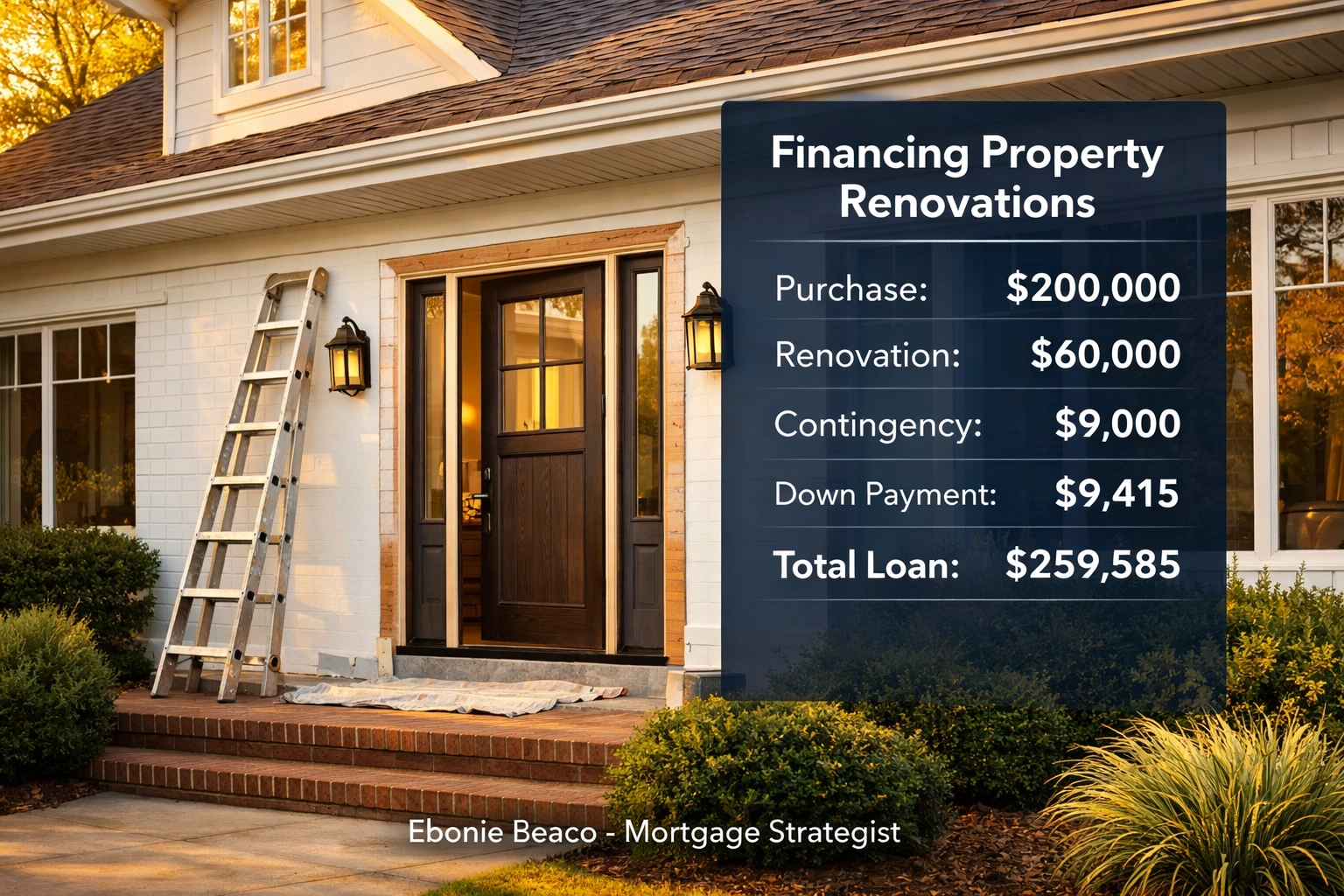 Visualizing the FHA 203k breakdown: $200k purchase + $60k rehab + $9k contingency. Down payment: $9,415. Total Loan: $259,585. Ebonie Beaco - Mortgage Loan Officer.
In this scenario, the homeowner is only out of pocket less than $10,000 for the down payment to secure a fully renovated $269,000 home. This strategy is excellent for those looking to build instant equity in their own home.
Practical Scenario: The Investor’s Private Money Calculation
Now, consider an investor in Chicago looking at a distressed multi unit building. They plan to use the BRRRR strategy (Buy, Rehab, Rent, Refinance, Repeat). Speed is essential because they are competing with cash buyers.
Purchase Price: $150,000
Renovation Budget: $80,000
Projected After Repair Value (ARV): $350,000
Private Money Loan (75% of ARV): $262,500
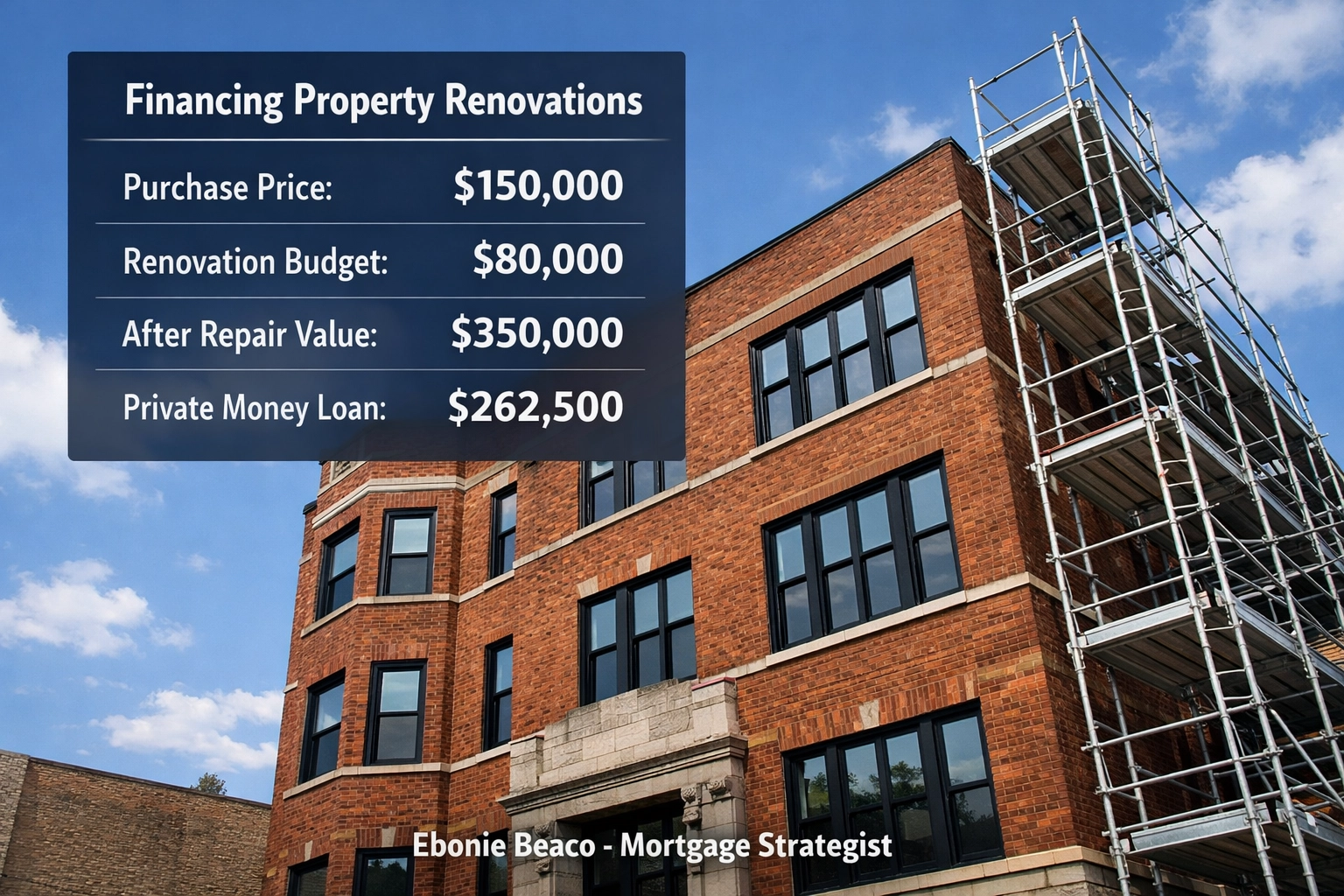 Visualizing the Private Money Deal: $150k purchase + $80k rehab. ARV: $350k. Loan Amount (75% ARV): $262,500. This covers the purchase and all rehab costs. Ebonie Beaco - Mortgage Loan Officer.
The investor uses private money to cover the entire purchase and all of the renovation costs. Once the work is done and the building is rented, they will transition to a DSCR rental property loan to pay off the expensive private money and hold the property long term.
The Role of the HUD Consultant
If you choose the Standard FHA 203k path, you will work with a HUD consultant. This professional acts as an independent project manager. They inspect the property, verify the contractor's bids, and ensure the work is done according to code before funds are released from the escrow account.
While this adds a layer of bureaucracy, it also provides a safety net. For a homeowner who has never managed a renovation, having a HUD consultant ensures the contractor doesn't take the money and run.
The Flexibility of Private Money
Private lenders are less concerned about the specific type of repair. If you want to change the layout, add a deck, or install luxury finishes that don't strictly "meet code" in the traditional sense, a private lender is usually fine with it as long as it increases the ARV.
This flexibility allows investors in markets like California or Virginia to move quickly on deals that would never qualify for a traditional government loan due to the property's initial condition (e.g., missing flooring or a non functional kitchen).
Which One Should You Choose?
The decision rests on your goals and your role in the transaction.
Choose FHA 203k if:
- You are a homeowner or a first time buyer.
- You want to live in the property.
- You have a limited down payment.
- You are looking for the lowest possible interest rate for a long term mortgage.
Choose Private Money if:
- You are an investor or house flipper.
- You need to close within days to beat out other buyers.
- The property is in such poor condition that a bank won't touch it.
- You plan to refinance or sell the property within 6 to 12 months.
If you are unsure where you fit, you can book an appointment to discuss your specific property and financial profile.
Transitioning from Renovation to Long Term Holding
For investors, private money is just the first step. Once the renovation is complete, the goal is often to move into a cash out refinance or a DSCR loan. This allows you to pull your initial capital back out and use it for the next project.
At Home Loans Network, we specialize in helping you bridge that gap. We understand how to structure the initial renovation financing so that the "take out" loan (the long term mortgage) is seamless.
Compare your options and look at the loan process to see how we guide you from the initial application to the final inspection.
Final Thoughts on Renovation Financing
Financing property renovations requires a clear strategy. Whether you are using the FHA 203k to build your dream home in a quiet Michigan town or leveraging private money to scale your investment business in Virginia, the right loan structure is the foundation of your success.
The FHA 203k offers stability and low costs for homeowners. Private money offers speed and scale for investors. Both are essential tools in the modern real estate market.
If you have questions about which path is right for your next project, reach out for a strategy session. We provide the transparency you need to make an informed decision for your financial future.
Schedule a 1 on 1 at https://calendly.com/homeloansnetwork
Ebonie Beaco
Mortgage Strategist | Senior Loan Officer
Home Loans Network powered by Loan Factory Inc.
NMLS #2389954
HomeLoansNetwork.com
312-392-0664