Financing Multi-Family Properties with DSCR Loans
If you are looking to scale your real estate portfolio, multi-family properties often represent the most efficient path to increasing door count and monthly cash flow. However, as many experienced landlords in markets like Chicago or Atlanta know, traditional financing for these properties can be a hurdle. Conventional lenders often scrutinize your personal debt-to-income (DTI) ratio, your tax returns, and your employment history.
This is where the DSCR loan enters the picture. This specific type of Non-QM mortgage focuses on the property itself rather than your personal paycheck. If the rental income covers the mortgage payment, you are often halfway to an approval.
Explore how investors use DSCR financing to acquire duplexes, fourplexes, and even larger apartment complexes without the red tape of traditional banking.
Defining the DSCR Loan
Debt Service Coverage Ratio (DSCR): A financial metric used by lenders to measure a property's ability to cover its own debt obligations using its rental income.
In practical terms, a DSCR loan allows you to qualify based on the cash flow of the investment property you are buying or refinancing. Instead of asking for your W2s or personal tax returns, the lender looks at the Net Operating Income (NOI) and compares it to the annual debt service (the total mortgage payment including principal, interest, taxes, insurance, and association fees).
Can You Use DSCR for Multi-Family Properties?
A common question among those starting their investment journey is whether this program applies to larger buildings. The answer is a firm yes. DSCR loans are highly flexible and cover a wide range of multi-family assets.
Residential Multi-Family (2-4 Units)
For properties with two to four units, DSCR loans offer a streamlined alternative to FHA or Conventional loans. Many investors in Florida and Virginia use these to bypass the strict limit on the number of financed properties that conventional lenders often impose.
Commercial Multi-Family (5+ Units)
Once you move into five units or more, the property is classified as commercial. DSCR remains the primary tool for financing these assets. Lenders look at the historical rent rolls and the local market vacancy rates to ensure the building can sustain its own weight.
 Title: Multi-Family DSCR Financing
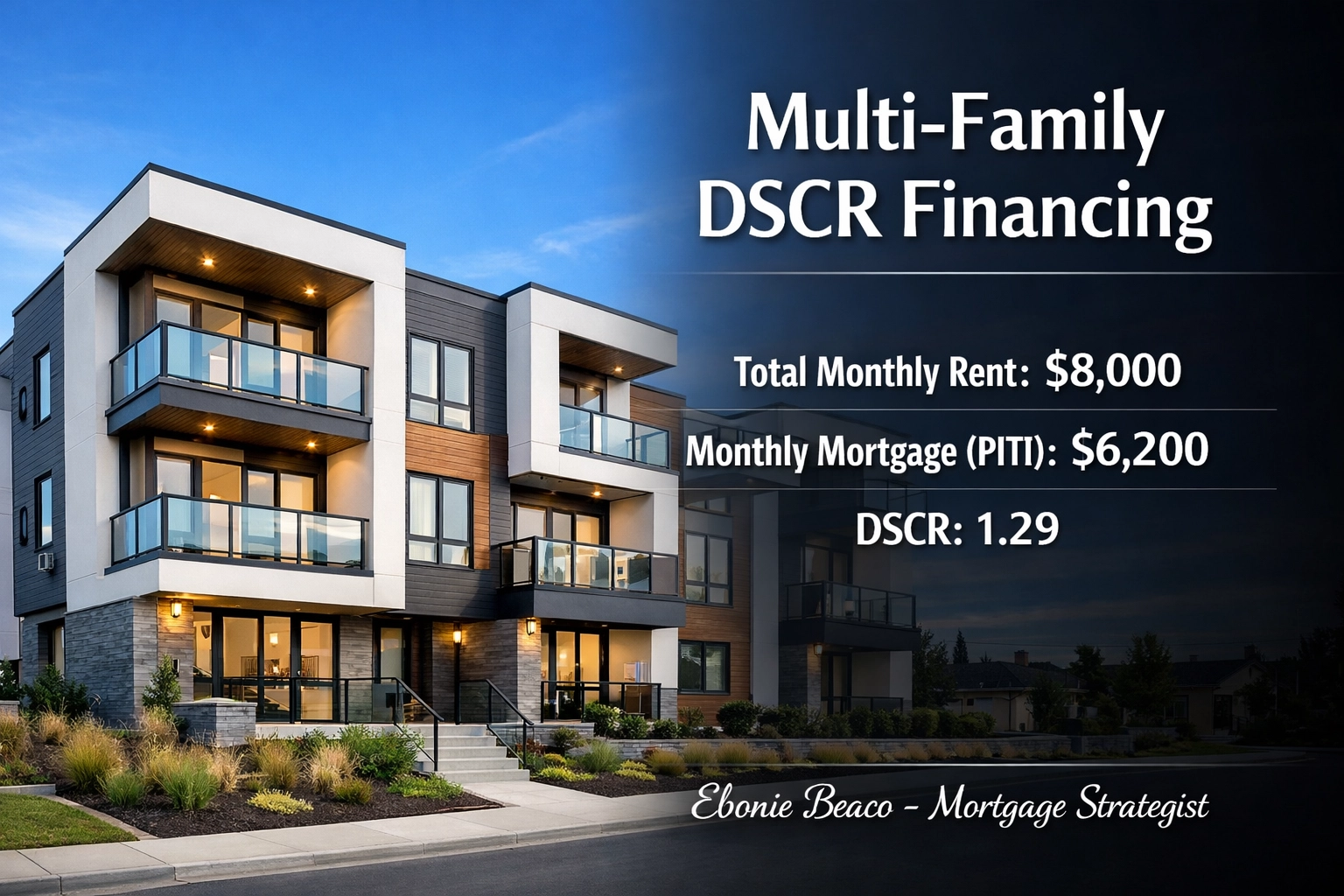
Calculations: 4-Unit Property Example. Total Monthly Rent: $8,000. Monthly Mortgage Payment (PITI): $6,200. DSCR Calculation: $8,000 / $6,200 = 1.29 DSCR.
Ebonie Beaco - Mortgage Loan Officer
Title: Multi-Family DSCR Financing
Calculations: 4-Unit Property Example. Total Monthly Rent: $8,000. Monthly Mortgage Payment (PITI): $6,200. DSCR Calculation: $8,000 / $6,200 = 1.29 DSCR.
Ebonie Beaco - Mortgage Loan Officer
How the DSCR Calculation Works
Understanding the math behind the loan is the best way to prepare your deal for a lender. Most lenders prefer a DSCR ratio of 1.20 or higher. This indicates that the property generates 20% more income than the cost of the debt, providing a safety net for maintenance and vacancies.
The Formula: DSCR = Gross Rental Income / Debt Service (PITI)
Let's look at a real-world scenario for a landlord in Michigan looking at a triplex:
- Monthly Rent: $4,500
- Principal & Interest: $2,800
- Taxes: $400
- Insurance: $150
- HOA Fees: $50
- Total Monthly Debt: $3,400
In this case, the calculation is $4,500 divided by $3,400, resulting in a DSCR of 1.32. This property is a strong candidate for a DSCR loan because it comfortably exceeds the typical 1.20 or 1.25 threshold. You can explore more scenarios using mortgage calculators to see how your potential deal stacks up.
Why Multi-Family Investors Choose DSCR
There are several strategic reasons why seasoned pros and new investors alike opt for this path over traditional financing.
No Personal Income Verification
Since the loan is based on the property’s performance, your personal income is not the primary factor. This is a game-changer for self-employed investors or those who have significant write-offs on their tax returns that might disqualify them from a conventional loan.
Faster Closing Times
Traditional loans often take 45 to 60 days to close due to the extensive documentation required. Because DSCR loans focus on a smaller set of variables: the property’s appraisal and your credit score: the loan process is often much faster, sometimes closing in as little as 21 days.
Scalability
There is usually no limit to the number of DSCR loans an investor can have. If you find a 10-unit building in Indiana and then a duplex in Kentucky, you can finance both using DSCR without hitting a "financed property limit."
LLC Vesting
Most DSCR lenders allow, and sometimes require, you to close the loan in the name of an LLC. This provides an added layer of asset protection that is often difficult to achieve with standard residential loans.
 Title: Multi-Family DSCR Financing
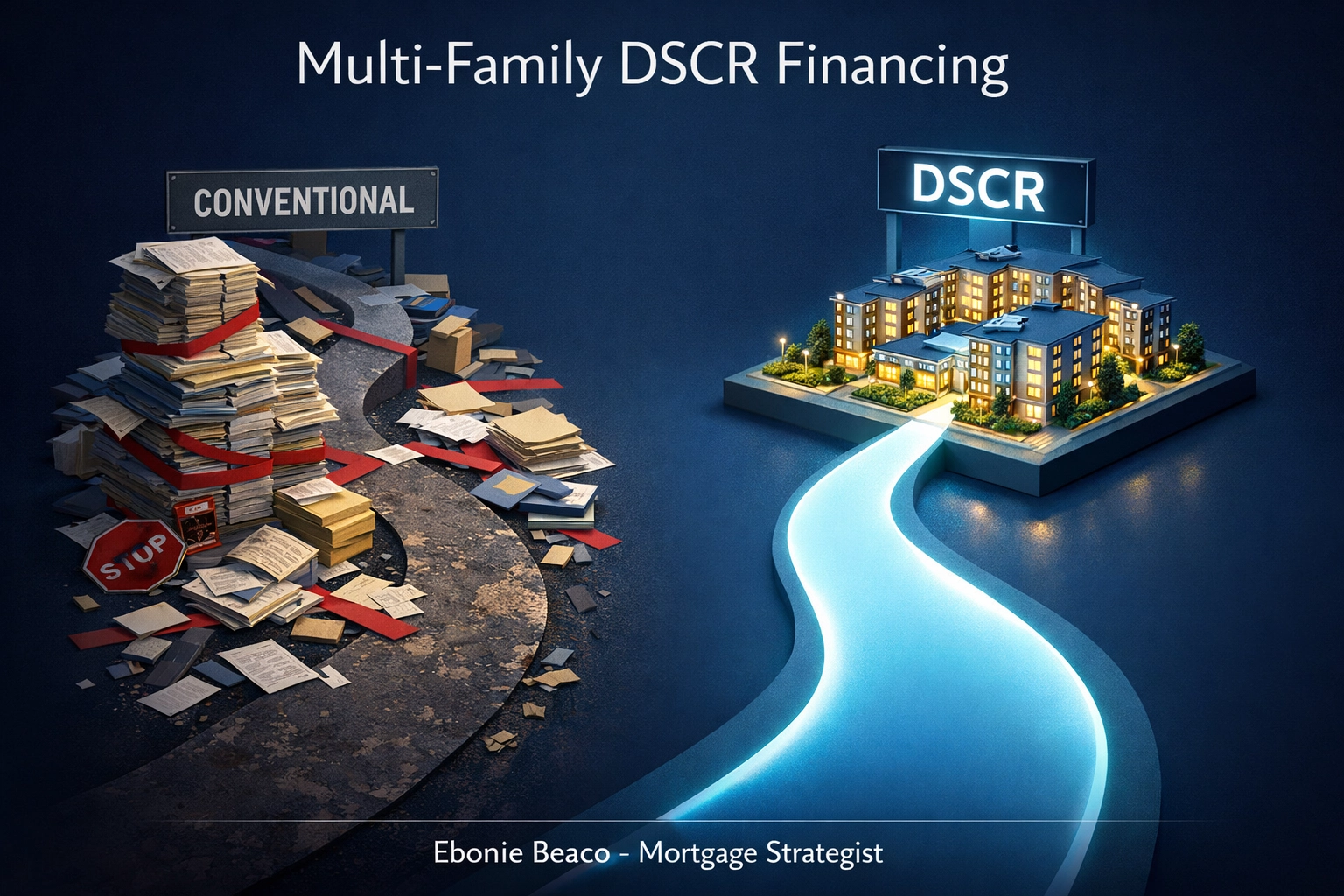
Comparison: Conventional vs. DSCR. Conventional: DTI Required, Tax Returns Needed, Max 10 Properties. DSCR: No DTI, No Tax Returns, Unlimited Properties.
Ebonie Beaco - Mortgage Loan Officer
Title: Multi-Family DSCR Financing
Comparison: Conventional vs. DSCR. Conventional: DTI Required, Tax Returns Needed, Max 10 Properties. DSCR: No DTI, No Tax Returns, Unlimited Properties.
Ebonie Beaco - Mortgage Loan Officer
Key Requirements for Multi-Family DSCR Loans
While the property is the star of the show, there are still basic requirements you need to meet to secure the best rates.
- Credit Score: Most programs require a minimum score of 660, though the best terms are usually reserved for those with a 720 or higher.
- Down Payment: For multi-family properties, expect to put down between 20% and 25%. Larger apartment complexes (5+ units) may sometimes require 30% depending on the location and your experience level.
- Appraisal and Rent Schedule: The lender will order an appraisal that includes a "Form 1007" or a comparable rent schedule to verify the market rent for the units.
- Cash Reserves: Lenders want to see that you have "skin in the game" and enough liquidity to cover 3 to 6 months of mortgage payments in case of an unexpected vacancy.
Regional Market Insights: Where to Use DSCR
In high-growth states like Florida, Georgia, and California, multi-family properties are in high demand. In markets like Chicago, the prevalence of older 2-4 unit buildings makes them perfect candidates for the BRRRR strategy (Buy, Rehab, Rent, Refinance, Repeat).
An investor might buy a distressed duplex in Illinois, renovate it to increase the rents, and then use a home refinance through a DSCR loan to pull their initial capital out. This "cash-out refinance" strategy is a staple for building wealth in the real estate world.
 Title: Multi-Family DSCR Financing
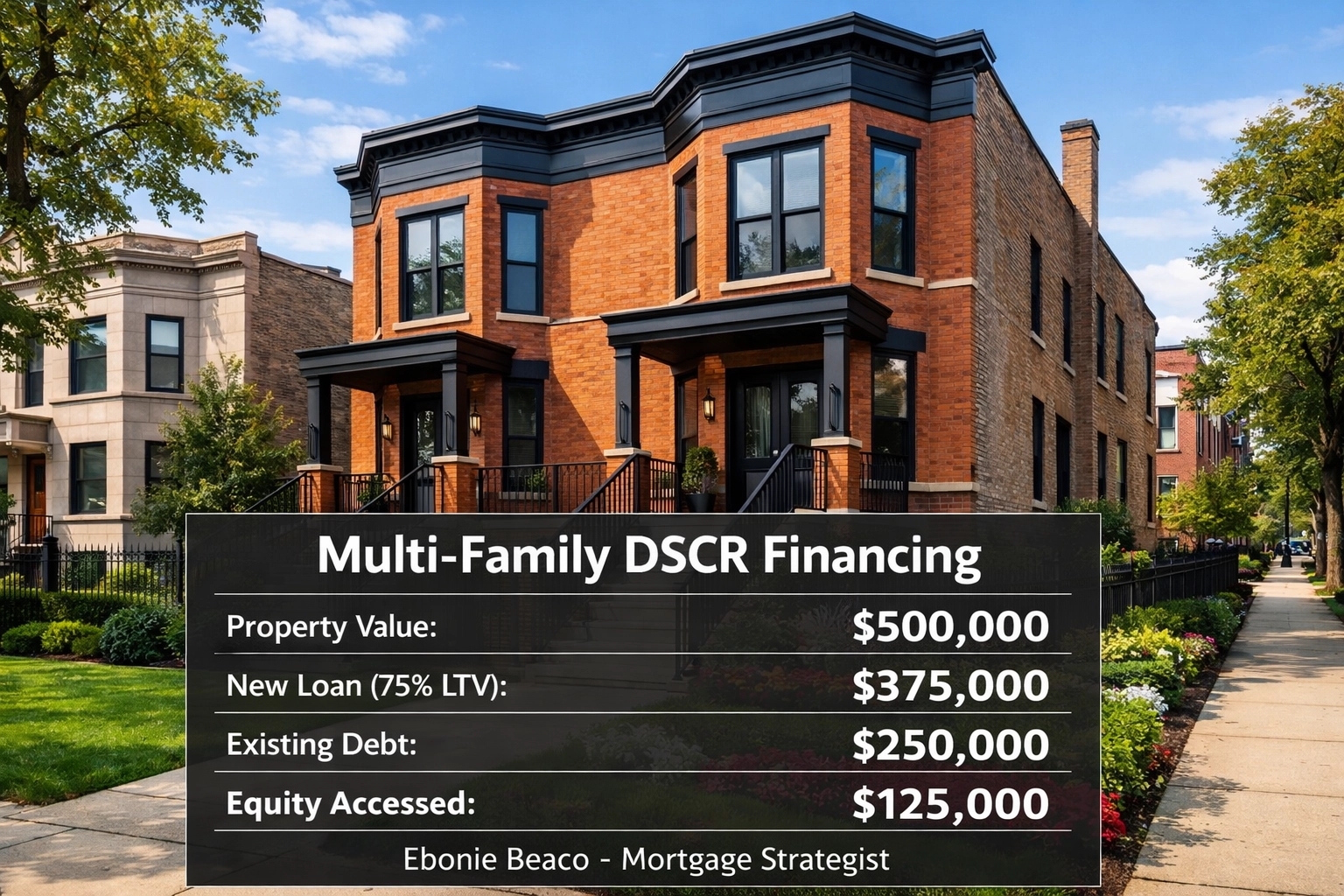
Calculations: Cash-Out Refinance Strategy. Current Value: $500,000. New Loan Amount (75% LTV): $375,000. Existing Debt: $250,000. Cash to Investor: $125,000.
Ebonie Beaco - Mortgage Loan Officer
Title: Multi-Family DSCR Financing
Calculations: Cash-Out Refinance Strategy. Current Value: $500,000. New Loan Amount (75% LTV): $375,000. Existing Debt: $250,000. Cash to Investor: $125,000.
Ebonie Beaco - Mortgage Loan Officer
Navigating the Challenges
While DSCR loans are powerful, they do come with trade-offs. The interest rates are typically 1% to 2% higher than conventional rates. There may also be a prepayment penalty, which is a fee charged if you pay off or refinance the loan within the first few years (typically 1 to 5 years).
However, for most investors, the ability to acquire an income-producing asset that pays for itself outweighs the slightly higher interest cost. The goal is the spread between the interest rate and the yield the property provides.
Jump In: Taking the Next Step
If you are a current landlord looking to expand or a homeowner wanting to transition into the world of multi-family investing, understanding your options is the first step. You can review our faq for more details on specific programs or check out our about-us page to see how we help investors navigate these complex markets.
Whether you are looking at a small duplex in Michigan or a larger complex in Virginia, DSCR financing provides the leverage you need to grow without the constraints of traditional banking.
Ready to see if your multi-family deal qualifies for a DSCR loan? Let’s look at the numbers together and find a strategy that fits your portfolio goals.
Contact Ebonie Beaco for multi-family financing or mentoring at www.homeloansnetwork.com.
Scedule a 1 on 1 at https://calendly.com/homeloansnetwork
Ebonie Beaco Mortgage Strategist | Senior Loan Officer Home Loans Network powered by Loan Factory Inc. NMLS #2389954 HomeLoansNetwork.com 312-392-0664