Financing Mixed-Use Properties: What You Need to Know
Investors and business owners often look for properties that offer more than one way to generate revenue.
A mixed-use property fits this description perfectly by combining residential and commercial spaces into a single structure.
Think of a storefront on the ground floor with several apartments upstairs or a boutique office building that includes residential lofts.
Financing these properties requires a unique approach because they do not fit the standard mold of a single-family home or a strictly commercial warehouse.
Exploring the world of mixed-use financing allows you to tap into diversified income streams and maximize the utility of urban and suburban real estate.
This guide breaks down exactly how you can navigate the loan process to secure funding for these versatile assets.
What Defines a Mixed-Use Property?
A Mixed-Use Property is a real estate asset that incorporates multiple functional uses, typically blending residential units with commercial, retail, or office spaces.
This hybrid nature provides a hedge against market volatility because you are not relying on just one type of tenant.
Lenders view these properties through a specific lens, often categorizing them based on the percentage of the building dedicated to each use.
If a property is more than 50 percent residential, some lenders might lean toward residential-style financing, while those with a larger commercial footprint require commercial loan structures.
Primary Financing Options for Mixed-Use Assets
There is no one-size-fits-all loan for a mixed-use building.
The strategy you choose depends on your goals, the property's income, and how much of the building you plan to occupy yourself.
DSCR Loans for Mixed-Use Properties
DSCR Loan: A Debt Service Coverage Ratio loan is a financing tool that qualifies a borrower based on the cash flow of the property rather than personal income tax returns.
These are excellent for investors who want to avoid the headache of traditional income documentation.
For mixed-use properties, DSCR loans typically apply to buildings with up to eight units.
Rates often start around 7.75 percent, and you can access 30-year fixed terms or interest-only options for the first decade of the loan.
Explore the Home Loans Network loan process to see how these streamlined investor options can work for your portfolio.
SBA 7(a) and 504 Loans
SBA Loan: A government-backed loan program designed to help small business owners purchase or improve real estate for their operations.
If you are a business owner in a city like Chicago or Los Angeles and you plan to occupy at least 51 percent of the mixed-use building, the SBA programs are hard to beat.
The SBA 504 program allows for a down payment as low as 10 percent, with long-term fixed rates that provide massive stability for your business.
The SBA 7(a) program offers more flexibility for general business needs alongside the real estate purchase.
Traditional Commercial Mortgages
Commercial Mortgage: A debt instrument secured by a lien on commercial real estate rather than residential property.
These are the standard for larger mixed-use projects that exceed the limits of residential or DSCR programs.
Lenders like JPMorgan Chase or local banks in markets like Florida and Virginia evaluate these based on the property’s overall Net Operating Income (NOI) and the borrower's credit profile.
Expect amortization periods of 20 to 30 years and potentially higher down payment requirements, often starting at 25 percent.
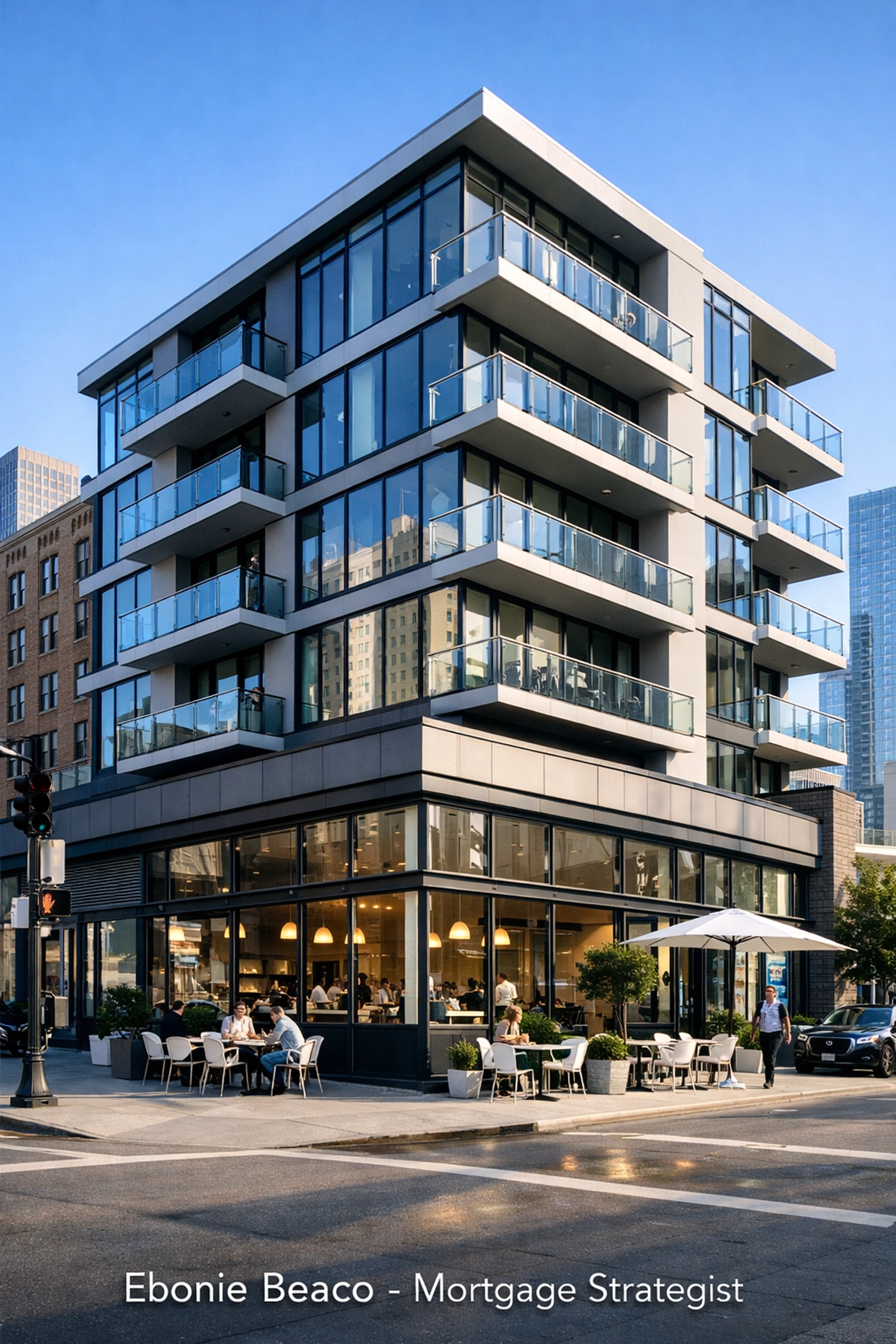 Visual: A breakdown showing a Mixed-Use Building structure. Title: 'Financing Mixed-Use Properties'. Bottom text: 'Ebonie Beaco - Mortgage Loan Officer'. No money or cash shown.
Key Qualification Metrics
Lenders want to see that the property can pay for itself and that you have enough skin in the game.
The Debt Service Coverage Ratio (DSCR)
The DSCR is a calculation used by lenders to determine if the property generates enough income to cover the monthly mortgage debt.
To calculate this, you take the Net Operating Income and divide it by the total annual debt service.
Most mixed-use lenders look for a ratio of 1.20 or higher, meaning the property brings in 20 percent more than the cost of the mortgage.
Loan-to-Value (LTV) and Down Payments
LTV: The ratio of a loan to the value of an asset purchased, expressed as a percentage.
For mixed-use properties, lenders are generally more conservative than they are with single-family homes.
You should prepare for a 75 percent LTV, meaning a 25 percent down payment is standard.
In some cases, such as with SBA 504 loans or very strong commercial profiles, you might be able to push the LTV higher.
Access our mortgage calculators to run these numbers based on your specific purchase price.
Real-World Scenario: Financing a Chicago Mixed-Use Building
Let's look at how an investor might structure a deal for a mixed-use building in a neighborhood like Logan Square in Chicago.
Suppose you find a building priced at $1,000,000.
The ground floor is a coffee shop, and there are three residential apartments upstairs.
The Numbers:
- Purchase Price: $1,000,000
- Down Payment (25%): $250,000
- Loan Amount: $750,000
- Total Monthly Income (Rent): $9,500
- Total Monthly Expenses (Taxes, Insurance, Utilities): $2,500
- Net Operating Income (NOI): $7,000 per month ($84,000 annually)
- Estimated Mortgage Payment: $5,400 per month ($64,800 annually)
The DSCR Calculation: $84,000 (NOI) / $64,800 (Debt Service) = 1.29 DSCR
Since the ratio is above 1.25, this property would likely qualify for a DSCR mixed-use loan easily.
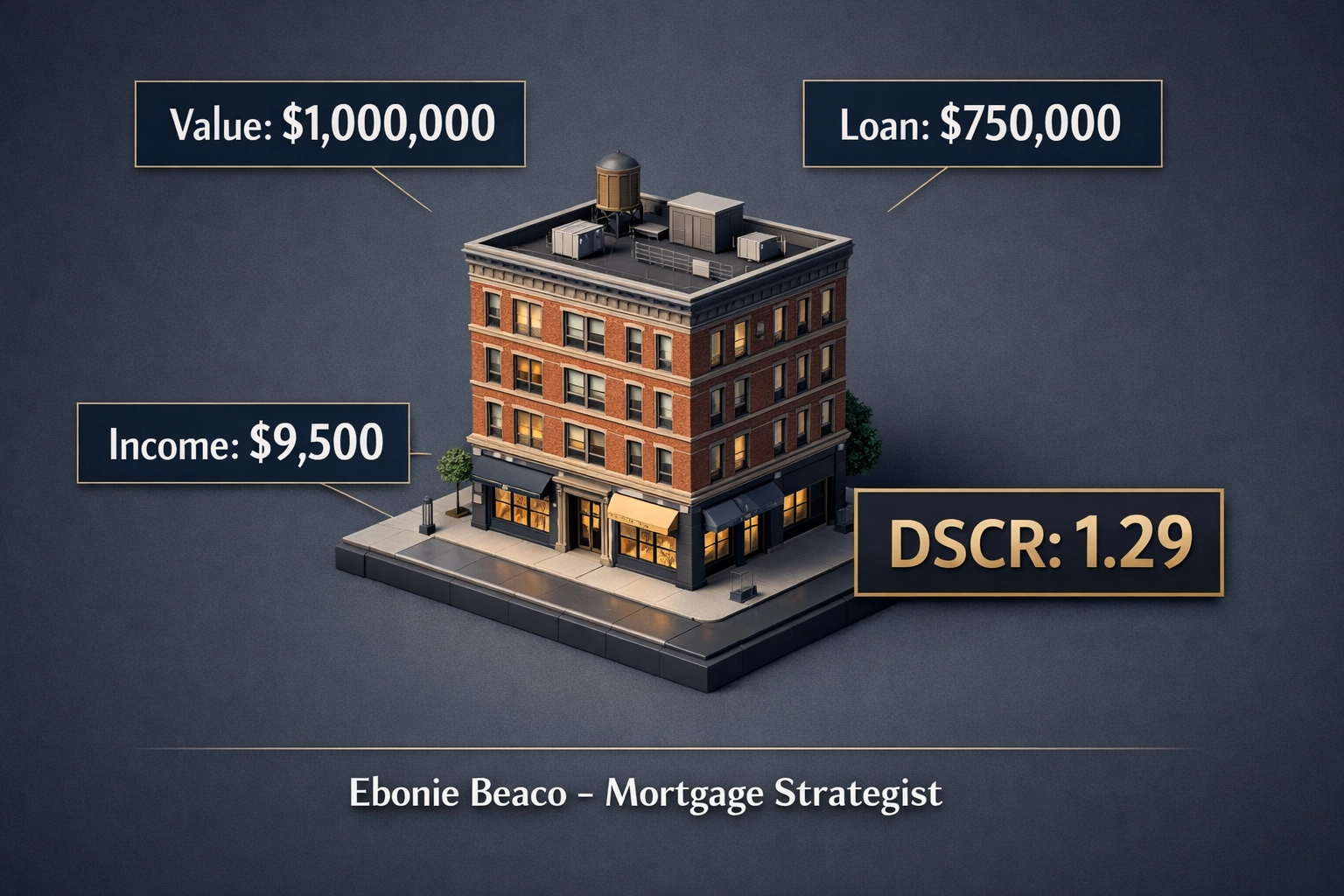 Visual: Financial Deal Breakdown for a $1M Mixed-Use Property. Property Value: $1,000,000. Loan Amount: $750,000. Monthly Income: $9,500. Monthly Expenses: $2,500. Monthly Debt: $5,400. DSCR: 1.29. Title: 'Financing Mixed-Use Properties'. Bottom text: 'Ebonie Beaco - Mortgage Loan Officer'.
Why Invest in Mixed-Use Properties?
There are several reasons why investors in states like California, Florida, and Georgia are flocking to mixed-use assets.
Diversified Income Streams
If the retail market slows down, your residential tenants still pay rent.
If one apartment is vacant, the income from the commercial storefront helps keep the mortgage paid.
This balance reduces the overall risk of the investment.
Urban Revitalization and Demand
Many cities are focusing on "walkable urbanism," where people want to live, work, and shop in the same area.
Mixed-use properties are the backbone of these communities.
Owning a property that serves multiple needs in a high-demand area often leads to faster appreciation and higher rental rates over time.
Creative Financing Flexibility
You can often use Bridge Loans to acquire a distressed mixed-use property, renovate it, and then refinance into a long-term DSCR or commercial loan once the building is stabilized.
Bridge Loan: A short-term loan used until a person or company secures permanent financing or removes an existing obligation.
This strategy is common for investors using the BRRRR method (Buy, Rehab, Rent, Refinance, Repeat) on mixed-use buildings.
Understanding the Tenant Mix
The type of commercial tenant in your building is very important to a lender.
A stable, long-term tenant like a doctor's office or an established retail brand is viewed more favorably than a brand-new startup with no track record.
Lenders also look at the lease terms.
Triple Net Lease (NNN): A lease agreement where the tenant is responsible for all expenses, including real estate taxes, building insurance, and maintenance.
If your commercial tenant is on an NNN lease, it significantly reduces your risk as a landlord and makes the property more attractive for financing.
Market Focus: Where to Look
From the busy streets of Chicago to the growing coastal towns in Florida, mixed-use opportunities are everywhere.
In California, the focus is often on high-density residential over small-scale retail.
In Florida, investors look for mixed-use properties that can capitalize on both the booming tourism industry and the steady influx of new residents.
In Virginia and Georgia, suburban town centers are seeing a rise in mixed-use developments that blend office spaces with luxury lofts.
No matter where you are looking, having a mortgage strategist who understands these local dynamics is vital for success.
Get Started with Your Mixed-Use Investment
Financing a mixed-use property is a sophisticated move that requires clear guidance and a transparent approach to the loan process.
Whether you are looking for your first mixed-use asset or adding a multi-unit commercial building to your portfolio, the right financing structure makes all the difference.
Compare your options and analyze your property's potential to ensure you are maximizing your return on investment.
If you are unsure where to begin or need help running the numbers on a potential deal, expert mentoring and specialized loan programs are available to help you move forward.
Reach out to Ebonie Beaco for mixed-use property financing or mentoring at www.homeloansnetwork.com.
Scedule a 1 on 1 at https://calendly.com/homeloansnetwork
Ebonie Beaco
Mortgage Strategist | Senior Loan Officer
Home Loans Network powered by Loan Factory Inc.
NMLS #2389954
HomeLoansNetwork.com
312-392-0664