Financing Foreclosures and REO Properties
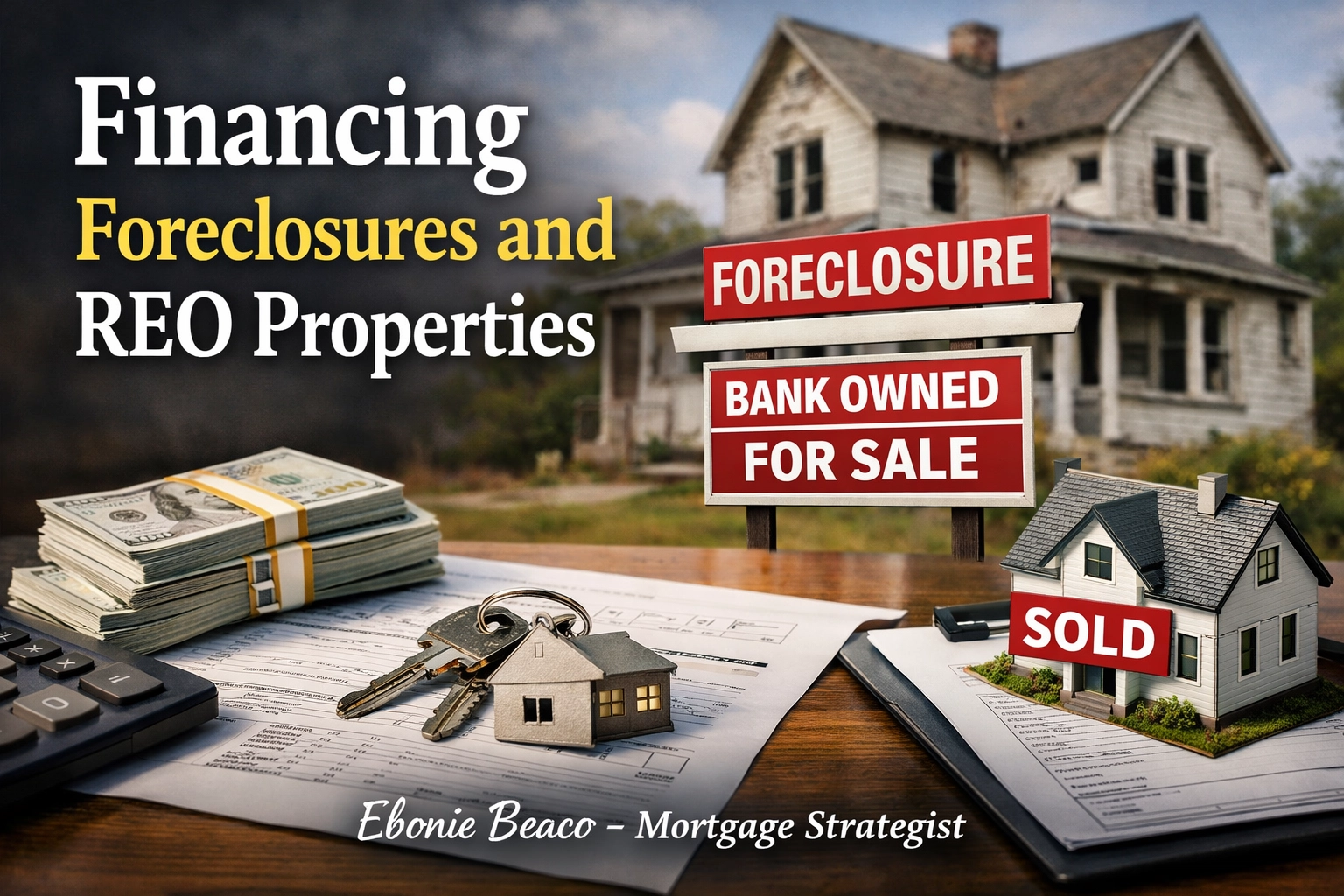
The idea that you need a suitcase full of cash to buy a foreclosed home is one of the most persistent myths in real estate. While it is true that many foreclosure auctions require immediate payment, the reality for most buyers is much more flexible.
In today’s market, whether you are looking at a distressed bungalow in Chicago, a suburban REO in Georgia, or a coastal fixer-upper in Florida, financing is not only possible but often preferred by savvy investors who want to keep their liquidity.
Approximately 60% of foreclosed homes are actually purchased using some form of financing. The trick is knowing which stage of the foreclosure process the property is in and which loan product matches the property's condition.
Understanding the Foreclosure Timeline
Before you look at loan programs, you need to identify where the property sits in the legal timeline. The financing options change drastically depending on the stage.
Pre-Foreclosure (Short Sales)
This is the period where the owner is behind on payments but still owns the home. You can often use traditional financing here, like a Conventional home purchase loan, because the property is still being sold by a private individual.
The Auction (Sheriff’s Sale)
This is the actual foreclosure event. In many states like Michigan, Indiana, and Virginia, these sales require cash or a cashier’s check on the spot. Standard mortgages typically do not work here because there isn't enough time for an appraisal or traditional underwriting.
REO (Real Estate Owned)
If no one buys the home at auction, it goes back to the bank. These are "Bank-Owned" or REO properties. This is the sweet spot for many buyers. Banks want these assets off their books and are usually very willing to work with buyers using mortgage financing.
Traditional Financing for REO Properties
If the property is in relatively good shape (meaning it is "habitable"), you can access the same loan programs used for any other home purchase.
Conventional Mortgages These are the most popular choice for REO properties. Lenders look at your credit score, income, and debt-to-income (DTI) ratio. If the home meets basic safety standards, a conventional loan is often the most cost-effective path.
FHA Loans Federal Housing Administration loans are a lifesaver for those with lower credit scores. You can get in with as little as 3.5% down if your score is 580 or higher. Check out the FHA mortgage basics to see how these differ from conventional options.
VA and USDA Loans For veterans in Alabama or Missouri, VA loans offer 0% down options on foreclosures. Similarly, USDA loans provide 0% down for properties in designated rural areas. Both require the home to be in move-in condition.
The Power of Renovation Loans
Many foreclosures have been sitting empty. They might have a leaky roof, missing copper pipes, or an outdated kitchen that prevents them from passing a standard appraisal. This is where Renovation Financing saves the deal.
FHA 203(k) Loans This program allows you to wrap the purchase price and the cost of repairs into a single mortgage. Instead of needing $50,000 in cash to fix the kitchen, the bank lends you the money based on what the home will be worth after the work is done.
Fannie Mae HomeStyle Similar to the 203(k), the HomeStyle loan is for conventional borrowers. It is highly flexible and can even be used for investment properties, making it a favorite for landlords in markets like California or Kentucky.
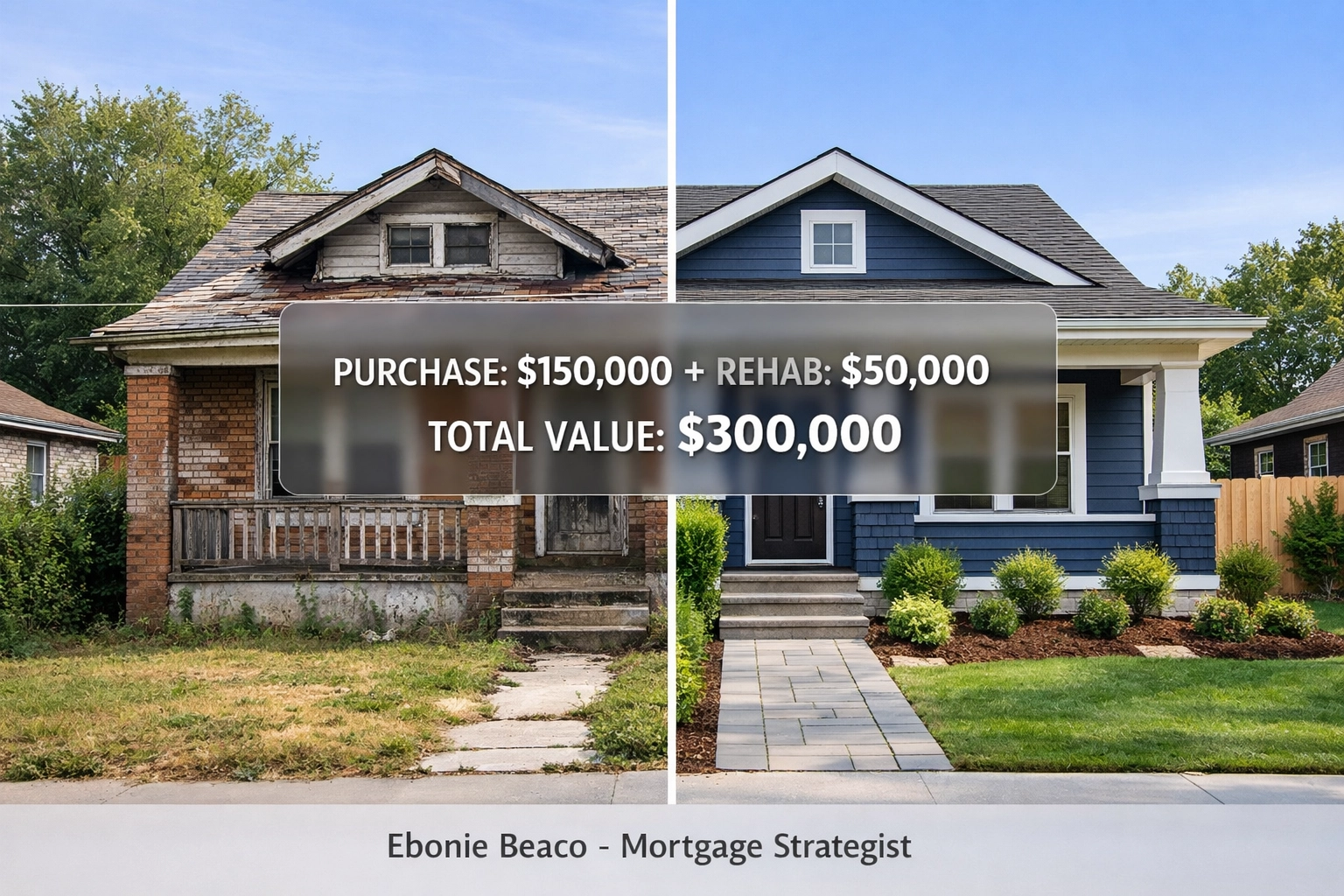 Visualizing the Fix-and-Flip Math: A guide to purchase price + renovation costs vs. After Repair Value (ARV).
Investor Strategies: Hard Money and DSCR
If you are a professional investor or a wholesaler in Arkansas or Illinois, traditional "owner-occupied" rules don't apply. You need speed and flexibility.
Hard Money Loans These are asset-based loans. The lender cares more about the property's value than your personal credit. These are perfect for the "Fix and Flip" model because they close fast, sometimes in just a few days. While interest rates are higher, they allow you to compete with cash buyers.
DSCR (Debt Service Coverage Ratio) Loans For long-term landlords, DSCR loans are the gold standard. We don’t look at your personal income or tax returns. Instead, we look at whether the rental income from the foreclosure covers the mortgage payment. Explore how DSCR rental property loans can help you scale a portfolio quickly.
Real-World Example: The BRRRR Strategy
Many investors use the BRRRR method (Buy, Rehab, Rent, Refinance, Repeat) to build wealth through foreclosures.
Scenario: You find a distressed property in Chicago for $150,000. It needs $50,000 in work.
- Initial Purchase: You use a Bridge Loan or Hard Money to buy and renovate.
- Total Investment: $200,000.
- After Repair Value (ARV): $300,000.
- The Refinance: Once the work is done and a tenant is moved in, you do a cash-out refinance at 75% of the new value.
- New Loan Amount: $225,000 ($300,000 x 0.75).
- Outcome: You pay back your initial $200,000 investment and have $25,000 in cash left over to put toward your next deal, all while owning a rental property with $75,000 in equity.
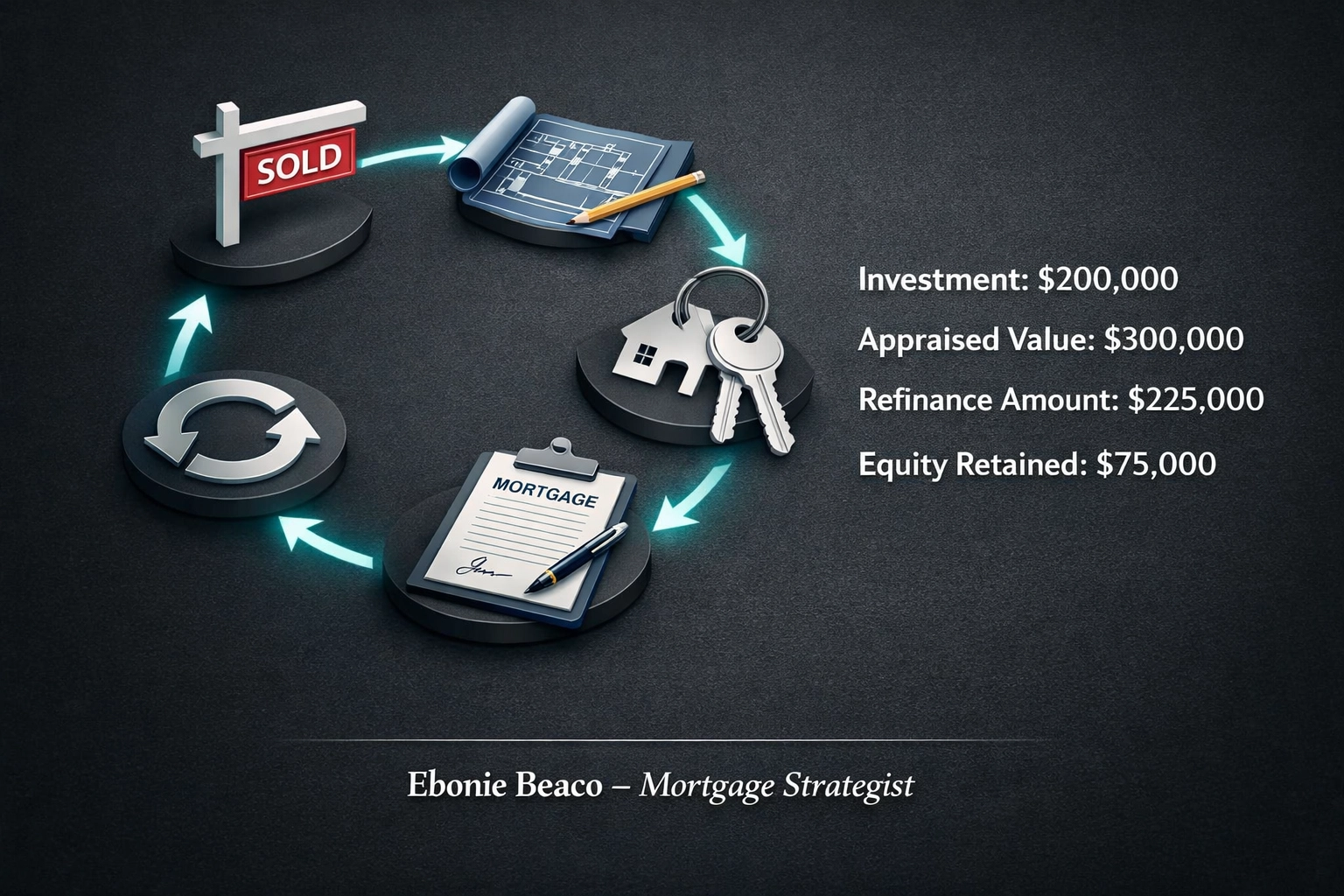 The BRRRR Calculation: Breakdown of Purchase $150k + Rehab $50k | ARV $300k | Refi $225k | Cash Out $25k.
Navigating the Hurdles
Buying a foreclosure isn't always a walk in the park. You need to be prepared for a few specific challenges:
- Property Condition: If the "bones" of the house are bad, a traditional bank will say no. You must have a backup plan like a Bridge Loan or Hard Money.
- Title Issues: Foreclosures can have hidden liens or back taxes. Always insist on a thorough title search.
- The "As-Is" Factor: Banks rarely make repairs. What you see is what you get. Budget for a thorough inspection before you commit.
- Appraisal Gaps: Sometimes the bank's opinion of value doesn't match the purchase price. Having a mortgage calculator handy helps you run different "what-if" scenarios.
Why You Need a Mortgage Strategist
Foreclosure financing is a specialized niche. Most "big box" lenders don't have the patience or the products to handle a complex REO or a renovation project.
Working with a strategist means you get access to Non-QM Mortgage Loans, Bank Statement Loans for the self-employed, and specialized Airbnb/Short-Term Rental financing.
If you are looking to secure your first foreclosure or you're an experienced investor looking to scale your portfolio in Florida, California, or anywhere in between, I am here to guide you clearly and confidently through the process.
Explore your options. Compare the numbers. Access the capital you need to turn a distressed property into a high-value asset.
Ready to get started?
Whether you need financing for a specific deal or mentoring on how to structure your next investment, let's talk.
Contact Ebonie Beaco for foreclosure financing or mentoring at www.homeloansnetwork.com.
Schedule a 1 on 1 at https://calendly.com/homeloansnetwork
Ebonie Beaco Mortgage Strategist | Senior Loan Officer Home Loans Network powered by Loan Factory Inc. NMLS #2389954 HomeLoansNetwork.com 312-392-0664