Financing: Condo vs. Single-Family Home (What’s the Difference?)
Buying a home is one of the biggest moves you will ever make. Whether you are looking for a cozy bungalow in Virginia or a high-rise unit in downtown Chicago, the type of property you choose changes the financing landscape significantly.
Many buyers assume that a mortgage is a mortgage, regardless of the structure. However, the process for securing a loan on a condominium is different from securing one for a single-family home. Lenders view these properties through different lenses of risk. When you buy a house, the lender evaluates you and the house. When you buy a condo, the lender evaluates you, the unit, and the entire homeowners association (HOA).
Understanding these nuances helps you prepare for the timeline and the costs associated with your purchase. Let’s dive into the core differences and how they affect your path to homeownership or real estate investment.
Defining the Property Types
Single-Family Home: A standalone residential structure that sits on its own land. Practical Application: You own the structure and the ground beneath it, giving you full control over maintenance and modifications.
Condominium (Condo): An individual unit within a larger building or community where common areas are shared. Practical Application: You own the "air space" inside your unit, while a homeowners association manages the exterior, land, and shared amenities.
The Appraisal Process: Why Condos Are More Complex
When you apply for a home purchase loan, the appraisal is a standard requirement. For a single-family home, the appraiser looks at the condition of the house, the size of the lot, and comparable sales in the immediate area. It is a straightforward evaluation of one asset.
Condo appraisals are more comprehensive. The appraiser must evaluate your specific unit, but they also have to account for the health of the entire complex. If the hallways are crumbling or the roof of the building is in disrepair, it affects the value of your individual unit. Lenders want to ensure that the shared elements of the property are well-maintained because a decline in the building’s overall condition puts their investment at risk.
The HOA Review: The Lender’s Extra Homework
This is often where condo financing hits a snag. In a single-family home transaction, the lender rarely cares if there is an HOA unless they need to verify the monthly dues for your Debt-to-Income (DTI) ratio.
For a condo, the lender performs a Project Review. They examine the HOA’s financial health, insurance coverage, and legal standing.
Warrantable Condo: A project that meets the specific requirements of major investors like Fannie Mae or Freddie Mac. Practical Application: These units are easier to finance with lower down payments and standard interest rates.
Non-Warrantable Condo: A project that does not meet standard investor guidelines, often due to high levels of commercial space, a single entity owning too many units, or ongoing litigation. Practical Application: You may need a Non-QM Mortgage Loan or a portfolio product to finance these, which often requires a higher down payment.
Lenders look at the "investor concentration" within the building. If too many units are owned by investors rather than primary residents, it can trigger a "non-warrantable" status. This is a common scenario in vacation-heavy markets throughout Florida and California.
 Title: Condo vs. Single-Family Financing. Ebonie Beaco - Mortgage Loan Officer.
Interest Rates and Down Payment Requirements
Data shows that financing a condo typically comes with slightly higher interest rates than a single-family home. Lenders perceive condos as higher risk because your property value is partially tied to the financial decisions of your neighbors and the HOA board.
If the HOA mismanages funds or fails to keep up with insurance, your property value could drop through no fault of your own. To offset this risk, lenders often apply a "pricing adjustment."
Down Payment: The initial payment made when buying a property. Practical Application: While you can get into a single-family home with as little as 3% or 5% down, many condo programs prefer or require 10% to 20% down to secure the best possible terms.
In competitive markets like Chicago or Atlanta, having a higher down payment can also make your offer more attractive to sellers who want to ensure your financing is solid and unlikely to fall through during the HOA review phase.
Insurance: HO-6 vs. Standard Homeowners Policies
Insurance is another area where the two property types diverge.
For a single-family home, you purchase a standard homeowners policy. This covers the structure, your belongings, and liability.
For a condo, insurance is a two-part system. The HOA maintains a "Master Policy" that covers the exterior of the building and common areas. You, as the owner, are responsible for an HO-6 Policy, often called "walls-in" coverage.
HO-6 Insurance: A policy that covers the interior of a condo unit, including floors, cabinets, and personal property. Practical Application: This policy fills the gap between what the HOA’s master policy covers and what you actually own inside your unit.
Financial Comparison: A Real-World Example
Let’s look at how the monthly costs might compare for a buyer in a market like Michigan or Indiana.
Scenario A: Single-Family Home
- Purchase Price: $300,000
- Down Payment (5%): $15,000
- Loan Amount: $285,000
- Interest Rate: 6.5%
- Estimated PITI (Principal, Interest, Taxes, Insurance): $2,250
Scenario B: Condo
- Purchase Price: $300,000
- Down Payment (10%): $30,000
- Loan Amount: $270,000
- Interest Rate: 6.75%
- Estimated PITI: $2,200
- HOA Dues: $350
- Total Monthly Obligation: $2,550
In this example, even though the loan amount for the condo is lower due to a larger down payment, the total monthly cost is higher because of the HOA dues and the slightly higher interest rate. When calculating your budget, you must include those dues in your mortgage calculators to get an accurate picture of your purchasing power.
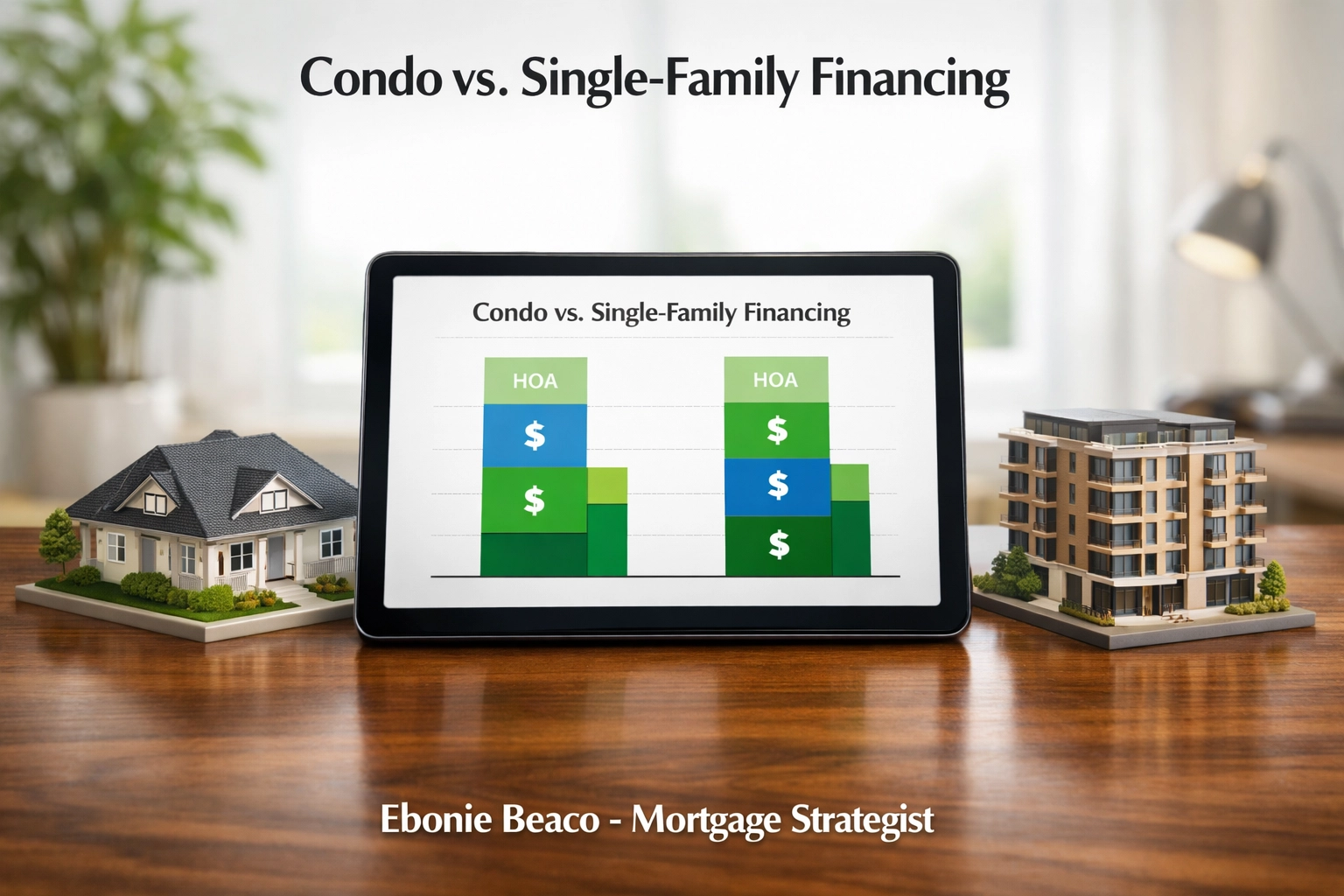 Title: Condo vs. Single-Family Financing. Ebonie Beaco - Mortgage Loan Officer.
Investment Considerations: DSCR and Landlord Loans
For real estate investors, the choice between a condo and a house involves different math. If you are looking at a DSCR Investor Loan (Debt Service Coverage Ratio), the HOA fee is a critical factor.
DSCR: A loan qualification method based on the property’s rental income rather than the borrower’s personal income. Practical Application: If a condo’s HOA fees are too high, they can eat into the cash flow, making it harder for the property to "cover" the debt and qualify for the loan.
Investors targeting short-term rentals (Airbnb) in Florida or California must be especially careful. Many condo associations have strict rules against short-term leasing. Always review the HOA bylaws before committing to a purchase for investment purposes. You can find more details on this in our mortgage basics section.
Loan Program Eligibility
FHA Loans and VA Loans have specific requirements for condos. For an FHA loan, the entire condo project must be on the FHA-approved list. If it isn’t, you cannot use FHA financing unless the lender can obtain a "Single Unit Approval," which is a complex process.
Single-family homes generally do not face these hurdles. As long as the home meets basic safety and habitability standards, it will typically qualify for FHA, VA, or Conventional financing.
Strategy for Homeowners and Investors
If you are leaning toward a condo, start by asking for the HOA's financial statements and a copy of the "Condo Questionnaire" early in the process. This document tells the lender everything they need to know about the project's health.
If you prefer the autonomy of a single-family home, be prepared for higher maintenance costs, as you won't have an association to handle the roof or landscaping.
Whether you are looking for a primary residence or a rental property, navigating these differences is easier with a strategist by your side. We can help you compare HELOC Loans, Cash-Out Refinance options, or Non-QM Mortgage Loans tailored to your specific property type.
Jump in to your next property search with confidence. If you have questions about a specific building or want to see how much equity you can access from your current home, reach out for a clear, transparent consultation.
Schedule a 1 on 1 at https://calendly.com/homeloansnetwork
Ebonie Beaco Mortgage Strategist | Senior Loan Officer Home Loans Network powered by Loan Factory Inc. NMLS #2389954 HomeLoansNetwork.com 312-392-0664