Deal or No Deal? How to Vet a Wholesale Real Estate Opportunity Instantly

Meta Title: How to Vet Wholesale Real Estate Deals | Deal Analysis Guide 2026
Meta Description: Learn how to vet a wholesale real estate deal instantly using ARV, rehab estimates, and the 70% rule. Expert insights for wholesaling houses in 2026.
The Art of the Instant Deal Assessment in Wholesale Real Estate
When you are active in the world of wholesale real estate, the ability to quickly distinguish a gold mine from a money pit is the single most important skill you can develop. Many beginners mistake a low asking price for a guaranteed profit, but experienced investors know that the purchase price is only one piece of a much larger financial puzzle. You must approach every lead with a healthy dose of skepticism and a calculator in hand to ensure that the numbers actually support a profitable exit for your cash buyers. Vetting a deal instantly requires a systematic approach where you evaluate the property’s potential, the local market demand, and the feasibility of the renovation. By mastering this initial screening process, you save yourself hundreds of hours of wasted effort on "dead" leads that would never make it to the closing table. Explore the fundamental metrics that seasoned pros use to validate their off-market finds before they ever sign a contract. Accessing the right data early on allows you to move with confidence, ensuring that your reputation remains solid among the local investor community.
Mastering the After Repaired Value (ARV) for Wholesaling Houses
The foundation of any successful venture in wholesaling houses is the After Repaired Value, or ARV, which represents what the property will sell for on the open market after it has been fully renovated. To calculate this accurately, you need to look at "solds" rather than "active" listings in high-demand markets like Chicago, Illinois, or the fast-growing neighborhoods of Virginia and Georgia. Look for properties within a half-mile radius that have similar square footage, bedroom counts, and finishes, ideally sold within the last ninety days. You should avoid using automated valuation models because they often fail to account for the specific condition or unique neighborhood pockets that significantly influence property value. Instead, jump in and perform a manual comparative market analysis to see exactly what buyers are willing to pay for a "turn-key" home in that specific zip code. Knowing the ceiling of your market helps you work backward to find a purchase price that leaves enough room for your assignment fee and the buyer's profit. You can even use mortgage calculators to estimate what an end-buyer's monthly carry costs might look like while they are finishing the project.
Breaking Down the Math: A Real-World Wholesale Deal Scenario
Let’s look at a concrete example to see how the numbers should flow in a healthy wholesale transaction involving a single-family home in a market like Indiana or Michigan. Imagine you find a distressed property where the ARV is firmly established at $400,000 based on recent neighborhood sales of fully updated homes. You negotiate a contract price with the motivated seller for $200,000, and your initial walkthrough suggests that the property needs about $80,000 in comprehensive renovations to reach that top-tier market value. To ensure the deal is attractive to a cash buyer, you decide on a $20,000 assignment fee for your work in sourcing and securing the opportunity. When your buyer evaluates the deal, they see a total acquisition cost of $220,000 plus an $80,000 rehab budget, bringing their total investment to $300,000. This leaves the buyer with $100,000 in potential equity or profit, which represents a very strong margin and makes the deal an easy "yes" for most experienced flippers.
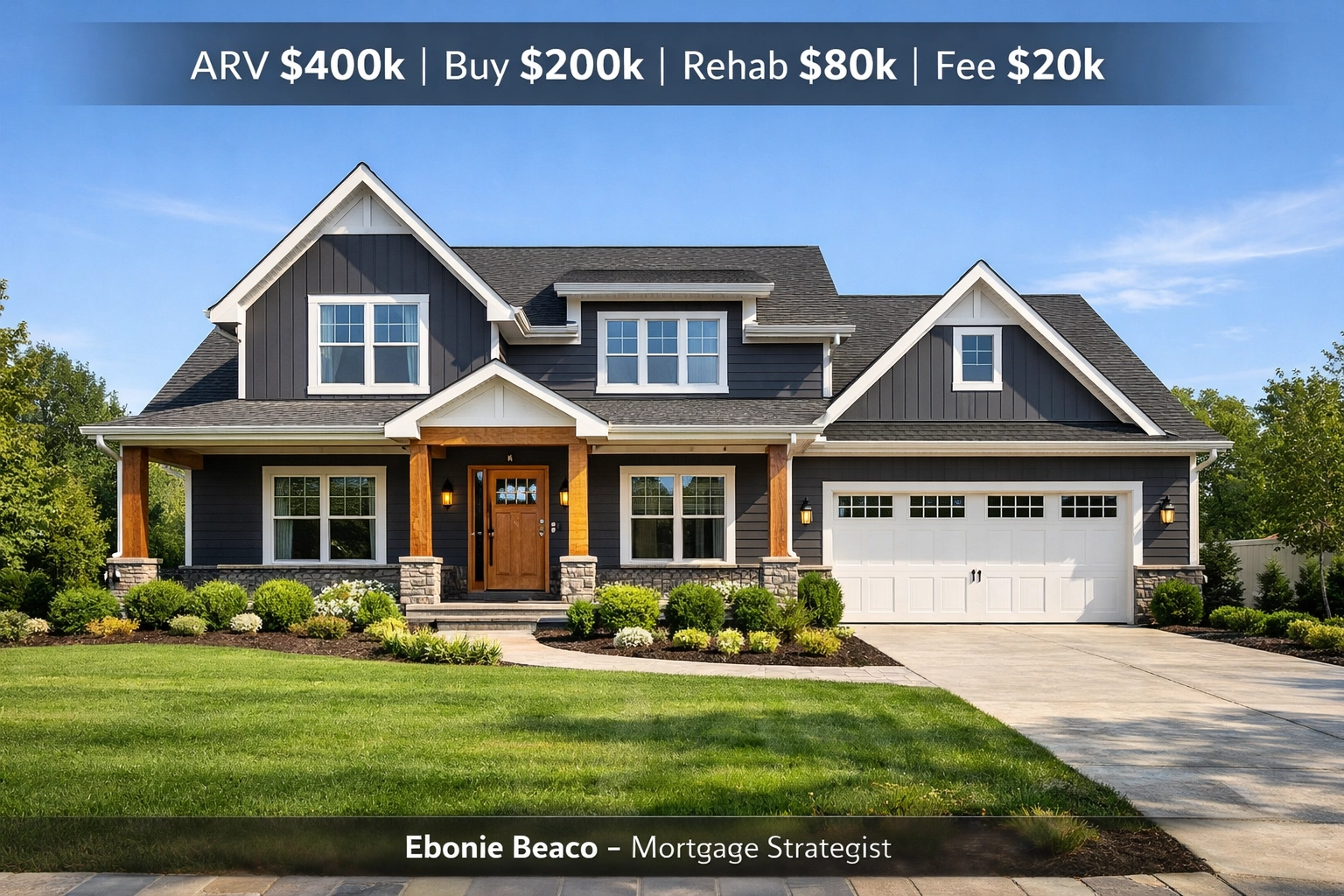
Visual: A realistic modern suburban house. Overlay text: ARV $400k | Buy $200k | Rehab $80k | Fee $20k. Footer: Ebonie Beaco - Mortgage Strategist.
Estimating Rehab Costs Without Losing Your Shirt
One of the most common reasons real estate investing deals fall apart is an inaccurate estimation of the renovation costs required to bring a property up to market standards. As a wholesaler, you do not need to be a licensed contractor, but you must have a working knowledge of local labor and material costs in states like Alabama, Arkansas, or Florida. Beginners often overlook "invisible" expenses such as outdated electrical panels, aging HVAC systems, or structural foundation issues that can easily add $20,000 to a budget. When you walk through a property, take detailed photos and videos of the roof, the windows, and the mechanical systems to share with your potential buyers. It is always better to over-estimate the repairs slightly than to present a "slim" deal that collapses during the buyer's inspection period. Transparently communicating these costs builds trust with your buyers, especially those using fix and flip financing who need to provide detailed budgets to their lenders. If you are unsure about a specific cost, reaching out to a local contractor for a "ballpark" estimate can save your deal from a late-stage cancellation.
Understanding Your Cash Buyer’s Financing Criteria
A deal is only a deal if you have a buyer who can actually close, which is why understanding the current lending landscape is vital for any wholesaler. Many of your best buyers will be using specialized products like DSCR investor loans or bridge loans to fund their acquisitions and renovations. In states like California or Florida, where property values are higher, buyers might even look for interest-only mortgage options to keep their monthly carrying costs low during the construction phase. By knowing what lenders require: such as minimum debt service coverage ratios or specific loan-to-value limits: you can vet your deals to match those exact parameters. If a deal doesn't fit the typical "fix and flip" mold but would make a great rental, you can market it to "buy and hold" investors who prioritize long-term cash flow. Being able to explain the financing potential of a property makes you a valuable partner rather than just another person sending out email blasts. Position yourself as a strategist who understands how to structure deals that are "bankable" for the end-investor.
Navigating Market Nuances Across Different Regions
Vetting a deal in the suburbs of Chicago requires a different lens than evaluating a waterfront property in Florida or a historic home in Virginia. Each region has specific factors that influence desirability, such as school districts, proximity to major employers, or local property tax rates that impact the final ARV. In Michigan and Indiana, you might focus on finding solid "bread and butter" family homes, while in California, the focus might be on luxury ADU (Accessory Dwelling Unit) potential to maximize density. You must also stay informed about local regulations regarding wholesale real estate contracts to ensure your transactions remain fully compliant with state laws. Some markets are currently experiencing high demand for short-term rentals, making properties near tourist hubs or hospitals excellent candidates for Airbnb-style investment strategies. Always tailor your "pitch" to the specific strengths of the local market where the property is located. This localized expertise allows you to speak the language of your buyers and provide the context they need to make a quick decision.
Building a Bulletproof Contract and Assignment Process
Once you have vetted the numbers and the physical condition, the final step in securing a "good" deal is ensuring your paperwork is airtight. You should use a purchase and sale agreement that clearly grants you the right to assign the contract to a third party, which is the essence of the wholesale model. Include a reasonable inspection period that allows you enough time to bring your cash buyers through the property without creating undue stress for the seller. Be transparent with the seller about your intentions to work with a partner or an investor to complete the transaction, as honesty prevents legal headaches later on. If you encounter a deal that requires a "double closing" due to lender requirements or high assignment fees, make sure you have a title company that understands the process. Using online forms and digital signatures can speed up this process significantly, allowing you to lock in deals before the competition arrives. Proper documentation protects your interests and ensures that your hard work results in a successful check at the end of the transaction.
Scaling Your Wholesale Business into Long-Term Wealth
Wholesaling is a fantastic way to generate active income and learn the intricacies of the real estate market, but the ultimate goal for most is to transition into owning assets. As you vet more deals, you will eventually find opportunities that are so good you’ll want to keep them for yourself as rentals or flips. This transition requires a shift in mindset and a deep understanding of home purchase strategies and long-term financing. By building a relationship with a mortgage strategist now, you can prepare your finances to move from the person "assigning" the deal to the person "closing" the deal. Whether you are looking to build a portfolio of multifamily buildings in Georgia or a string of vacation rentals in Florida, the vetting skills you learn today are the foundation of your future success. Every deal you analyze is a lesson in market dynamics, property valuation, and human psychology. Stay disciplined, keep your numbers realistic, and never stop building the connections that will help you grow.
📞 Work With Ebonie Beaco
If you are a wholesaler looking to:
- Close more deals
- Connect your buyers with financing
- Structure deals that actually get approved
- Learn how to grow into a real estate investor
I can help you every step of the way.
Ebonie Beaco
Mortgage Strategist | Senior Loan Officer
Home Loans Network powered by Loan Factory Inc.
NMLS #2389954
📱 Phone: 312-392-0664
📧 Schedule a 1 on 1: https://calendly.com/homeloansnetwork
🌐 Website: HomeLoansNetwork.com/contact-us
👉 Whether you need lending, deal structuring, or mentorship, reach out today.