Commercial Loans for 5+ Unit Multi-Family Buildings
Moving from small residential rentals to larger apartment buildings is one of the most effective ways to scale a real estate portfolio.
When you cross the threshold from four units to five, the rules of the game change entirely.
Properties with five or more units are officially classified as commercial real estate.
This means lenders no longer look at the property the same way they look at a single-family home or a triplex.
They stop focusing primarily on your personal income and start focusing on the income the building generates.
Explore how commercial multi-family financing works and how you can use these tools to grow your wealth in markets like Chicago, Florida, California, and Virginia.
What Defines a Commercial Multi-Family Loan?
Commercial multi-family loans are mortgage products specifically designed for apartment buildings with five or more residential units.
Unlike residential loans (1-4 units), these loans are underwritten based on the property's financial performance.
Commercial Multi-Family: A residential structure containing five or more dwelling units used for investment purposes. Benefit: Allows investors to leverage business income rather than personal debt-to-income ratios.
Net Operating Income (NOI): The total income generated by a property minus all necessary operating expenses. Benefit: This figure tells the lender exactly how much cash is available to pay the mortgage.
If you are looking to acquire a 10-unit building in Birmingham, Alabama or a 50-unit complex in Orlando, Florida, you will be using commercial financing.
You can jump in and learn more about the mortgage basics to see how these differ from standard home loans.
Common Types of Commercial Multi-Family Financing
There is no "one size fits all" loan for apartment buildings.
The right program depends on the condition of the property and your long-term goals.
1. DSCR Investor Loans
DSCR Loans (Debt Service Coverage Ratio) are a favorite among professional investors.
These loans focus on whether the property's rental income can cover the monthly mortgage payment.
If the building brings in $10,000 a month and the mortgage is $8,000, the property "covers" the debt.
Debt Service Coverage Ratio (DSCR): A calculation that compares a property’s annual net operating income to its annual mortgage debt service. Benefit: Simplifies the qualification process by removing the need for personal tax returns or employment verification.
2. Agency Loans (Fannie Mae and Freddie Mac)
Government-sponsored entities like Fannie Mae and Freddie Mac have specific divisions for multi-family housing.
These programs often offer the most competitive interest rates and long-term fixed periods.
They are ideal for stabilized buildings in major markets like Los Angeles or Atlanta.
3. Bridge Loans
If you are buying a "fixer-upper" apartment building that is half-vacant, a standard bank won't touch it.
Bridge Loans: Short-term financing used to "bridge" the gap between the purchase of a property and its eventual long-term financing or sale. Benefit: Provides the capital needed to renovate a building and increase its value before refinancing into a permanent loan.
This is a core component of the BRRRR strategy (Buy, Rehab, Rent, Refinance, Repeat) on a commercial scale.
4. Bank Statement Loans
For self-employed investors who have high cash flow but show low net income on tax returns, these are excellent options.
Bank Statement Loans: A non-QM mortgage where the lender uses 12 to 24 months of business bank deposits to calculate qualifying income. Benefit: Allows business owners to qualify based on real-world cash flow instead of depreciated tax totals.
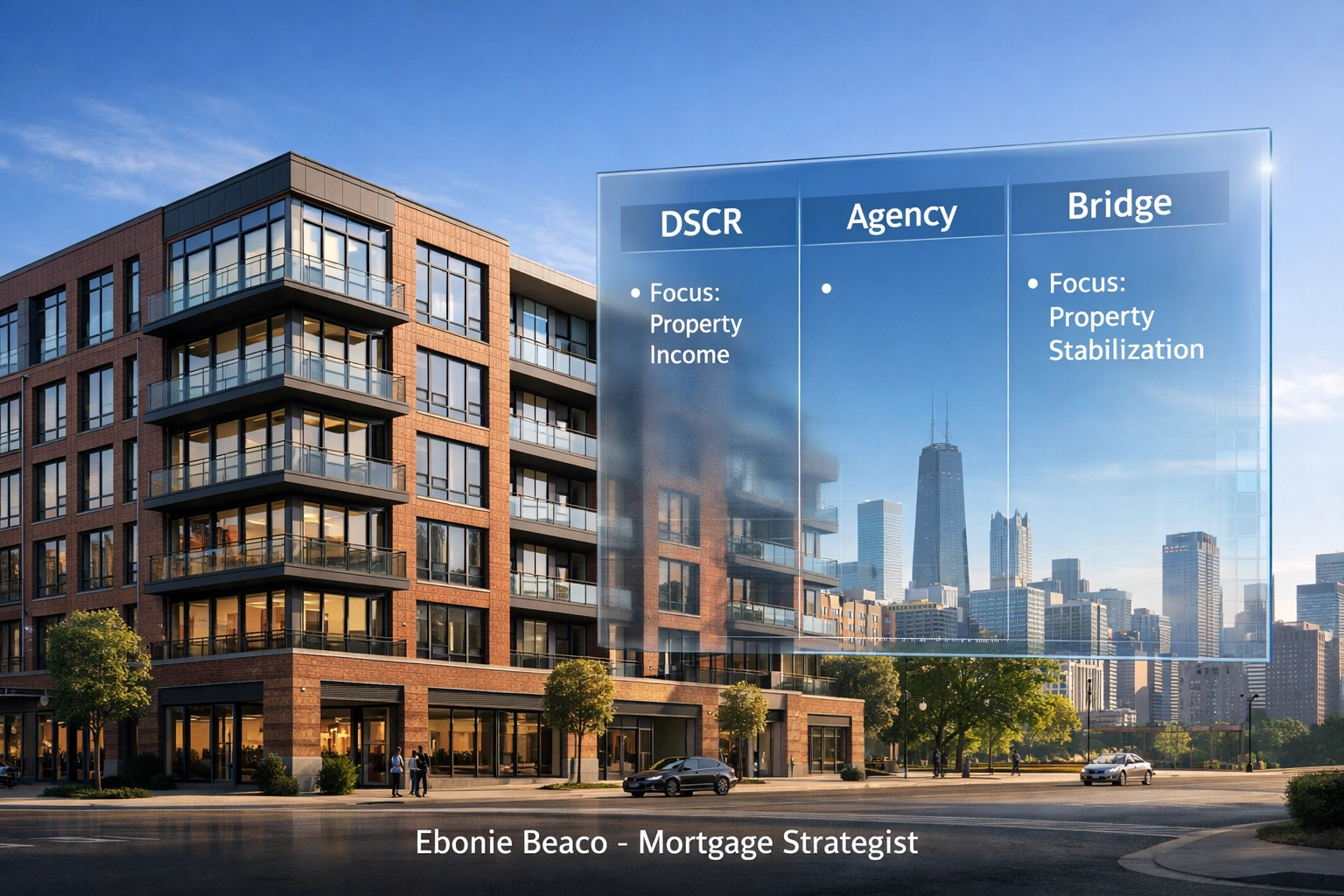 Visual: A chart titled 'Commercial Multi-Family Financing' comparing DSCR, Agency, and Bridge loans. The chart highlights 'Focus: Property Income' for DSCR and 'Focus: Property Stabilization' for Bridge Loans. At the bottom: 'Ebonie Beaco - Mortgage Loan Officer'.
How Lenders Evaluate Your Deal
When you apply for a loan for a 5+ unit building, the lender acts more like a business partner.
They want to ensure the investment is sound and that you have a plan to manage it.
Property Cash Flow
The most important factor is the rent roll.
Lenders will look at the history of collections and current vacancy rates.
If you are looking at properties in Chicago or Detroit, they will account for local property taxes and utility costs specific to those regions.
The Debt Service Coverage Ratio (DSCR)
Most commercial lenders require a DSCR of 1.20 or higher.
This means the building must generate 20% more income than the cost of the mortgage.
Loan-to-Value (LTV): The ratio of the loan amount to the appraised value of the property. Benefit: Determines the amount of "skin in the game" or down payment required from the investor.
For commercial deals, LTV usually ranges between 65% and 80%.
Experience Level
While some programs allow for first-time investors, many commercial lenders prefer to see that you have managed smaller multi-family properties (like duplexes) or have a professional property management company in place.
A Real-World Example: The 12-Unit Acquisition
Let's look at how the math works for an investor purchasing a 12-unit apartment building in Richmond, Virginia.
Scenario Details:
- Purchase Price: $1,500,000
- Down Payment (25%): $375,000
- Loan Amount: $1,125,000
- Gross Annual Rental Income: $180,000
- Annual Operating Expenses (Taxes, Insurance, Repairs): $63,000
- Net Operating Income (NOI): $117,000
To find the DSCR, the lender looks at the annual mortgage payment.
If the annual mortgage payment is $85,000: $117,000 (NOI) / $85,000 (Debt) = 1.37 DSCR.
Since 1.37 is higher than the standard 1.20 requirement, this deal is highly likely to get approved.
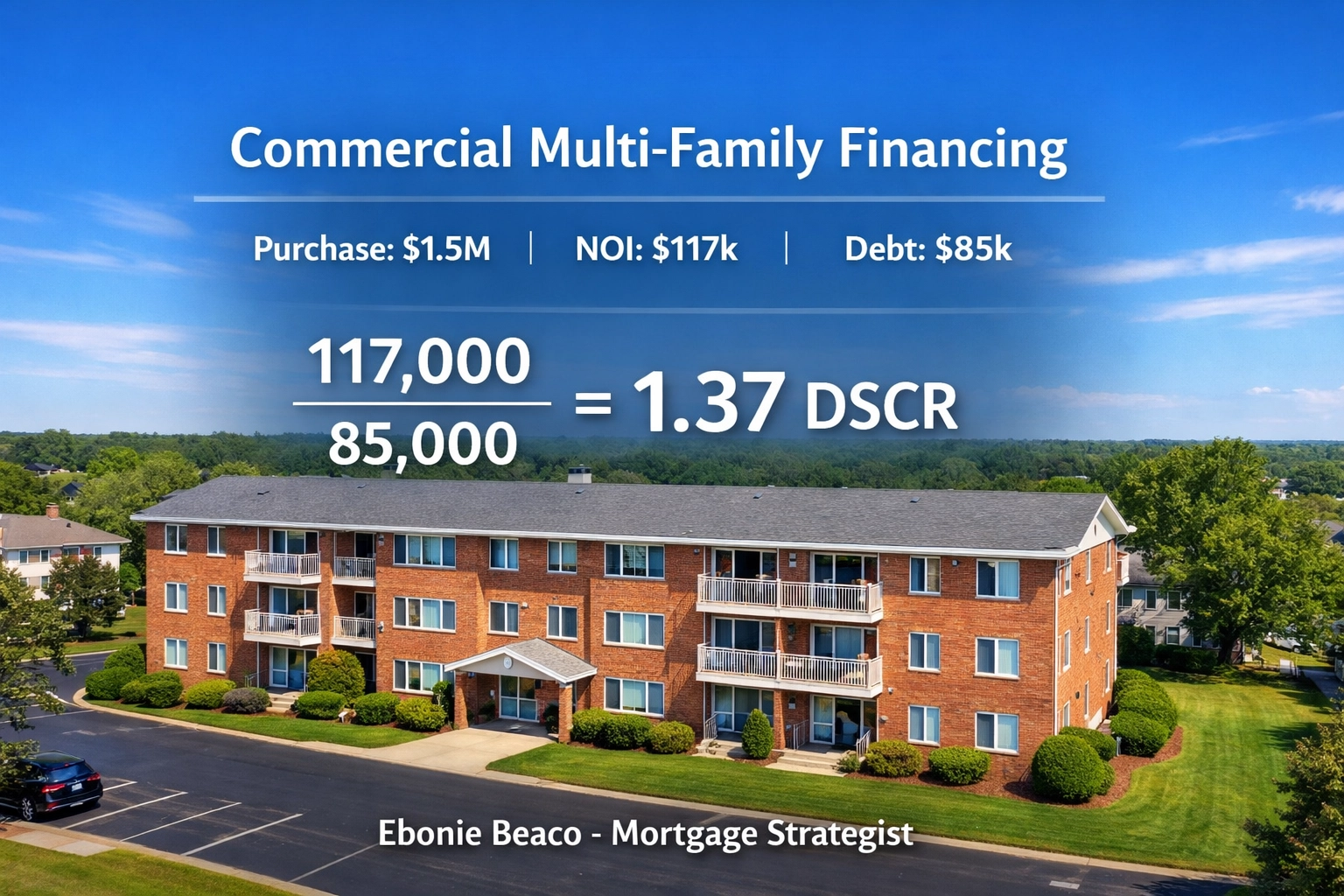 Visual: A deal breakdown graphic titled 'Commercial Multi-Family Financing'. It shows: Purchase Price: $1.5M, Loan Amount: $1.125M, NOI: $117k, Annual Debt: $85k. Large calculation at the bottom: $117,000 / $85,000 = 1.37 DSCR. Text at the bottom: 'Ebonie Beaco - Mortgage Loan Officer'.
Scaling Your Portfolio Across State Lines
One of the benefits of commercial multi-family loans is that they are available in almost every major market.
You might live in California but find that the cash-on-cash returns are better in Indiana or Missouri.
Commercial lenders often provide funding across multiple states, allowing you to diversify your holdings.
- Florida Markets: Cities like Tampa and Jacksonville are seeing massive growth, making them prime targets for apartment investors.
- Michigan and Illinois: These states offer higher yield opportunities for investors looking for "Value-Add" projects.
- Georgia and Virginia: Strong job markets in these states keep vacancy rates low, which lenders love to see.
If you are ready to start your journey, you can book an appointment to discuss specific state guidelines.
Financing Strategies for Different Investors
Different investors use these loans in different ways to achieve their goals.
The Buy-and-Hold Landlord
These investors use long-term DSCR or Agency loans to lock in fixed rates for 10, 20, or 30 years.
Their goal is steady cash flow and long-term appreciation.
The Fix-and-Flip or BRRRR Investor
These investors use Bridge Loans or Hard Money to purchase distressed apartment buildings.
They renovate the units, raise the rents, and then perform a Cash-Out Refinance to pull their initial capital back out and move to the next deal.
Cash-Out Refinance: A mortgage refinancing option where the new loan is larger than the existing one, and the difference is paid to the borrower in cash. Benefit: Provides liquidity to fund new acquisitions or property improvements.
The Short-Term Rental Portfolio
Some investors are converting 5+ unit buildings into "Apart-hotels" or Airbnb clusters.
This requires specialized Airbnb and Short-Term Rental Financing that accounts for the higher income potential of daily rates compared to monthly leases.
Why Work with a Mortgage Strategist?
The commercial loan landscape is complex.
Navigating the requirements for Non-QM Mortgage Loans or commercial-grade DSCR products requires more than just a standard loan officer.
You need someone who understands how to package a deal so a lender sees the value in the building.
Whether you are looking for mentoring on how to find your first 5-unit deal or you need a quote for a 100-unit portfolio, professional guidance is essential.
Access our loan process page to see exactly how we move a deal from application to the closing table.
Take the Next Step in Your Investment Journey
Commercial multi-family real estate is one of the most stable asset classes in the world.
By focusing on the numbers and the property's performance, you can break free from the limitations of personal income and scale your business to new heights.
Compare your options, run the numbers, and ensure your next acquisition is backed by the right financing strategy.
Schedule a 1 on 1 at https://calendly.com/homeloansnetwork
Ebonie Beaco
Mortgage Strategist | Senior Loan Officer
Home Loans Network powered by Loan Factory Inc.
NMLS #2389954
HomeLoansNetwork.com
312-392-0664
Reach out to Ebonie Beaco for commercial multi-family loans or mentoring at www.homeloansnetwork.com.