Chicago DSCR Loan Secrets Revealed: What Experts Don’t Want You to Know About Investor Financing
SEO Title: Chicago DSCR Loan Secrets Revealed: Investor Financing Secrets
Meta Description: Unlock the hidden strategies of Chicago DSCR loans. Learn how investors scale portfolios in Cook County using Debt Service Coverage Ratio financing and property cash flow.
URL Slug: chicago-dscr-loan-secrets-investor-financing
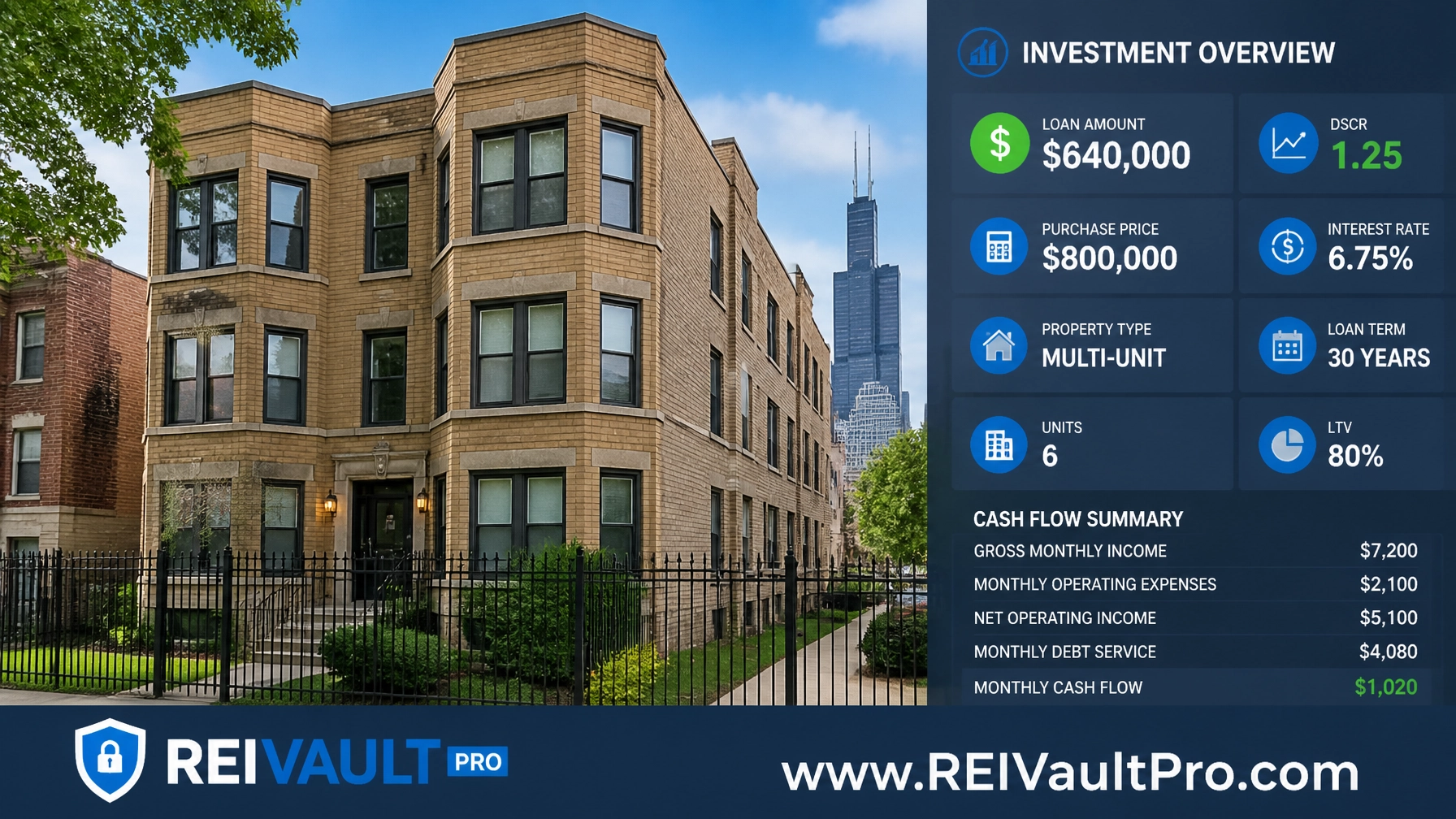
Featured Image Recommendation: A professional landscape of a Chicago residential multi-unit property with a financial dashboard overlay showing DSCR calculations and the REI Vault Pro URL.
SEO Alt Text: Chicago real estate investment property and financial dashboard illustrating DSCR loan calculation.
Social Media Excerpt: Tired of debt-to-income limits? Chicago investors are scaling faster with DSCR loans. Learn the "secrets" of Cook County financing and how to qualify even with low credit.
SEO Tags: Chicago DSCR loans, real estate investor financing, Cook County property taxes, DSCR calculation, landlord loans Chicago, scaling rental portfolio, multi-unit financing.
The Chicago real estate market remains a primary destination for investors seeking cash flow and long-term appreciation. However, the traditional mortgage path often creates a bottleneck for those trying to scale. Conventional lenders look at your personal income, debt-to-income (DTI) ratios, and tax returns, which can quickly limit how many properties you can own.
This is where DSCR rental property loans change the equation. Instead of scrutinizing your paycheck, these loans focus on the property’s ability to generate income. While the concept seems simple, the Chicago market, specifically Cook County, has unique nuances that can either make or break your deal.
What is a DSCR Loan?
Debt Service Coverage Ratio (DSCR) Loan: A specialized mortgage product for real estate investors that qualifies the borrower based on the rental income of the subject property rather than personal income documentation.
- Practical Application: You can use this loan to acquire a 4-unit building in Chicago without providing W-2s or tax returns, as long as the projected rent covers the mortgage payment.
Explore how these loans work by using the REI Vault Pro Deal Analyzer to run your own numbers before you even speak to a lender.
Secret 1: The Cook County Property Tax Trap
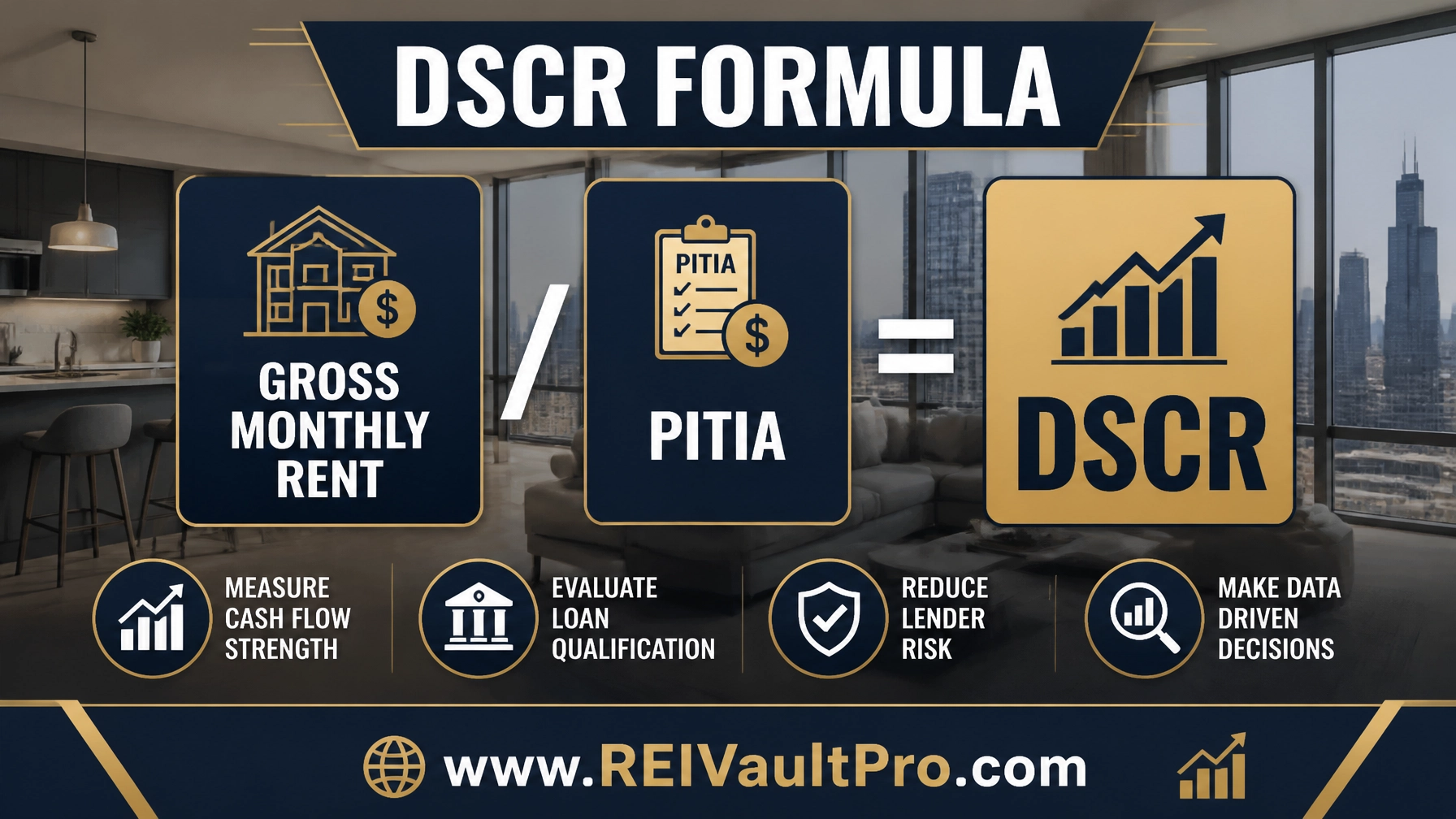
One of the best-kept secrets in Chicago investor financing is how much Cook County property taxes influence your borrowing power. In a DSCR calculation, the lender looks at the PITIA (Principal, Interest, Taxes, Insurance, and HOA).
Because property taxes in Chicago and the surrounding suburbs can be significantly higher than in other regions, your "I" and "A" in the PITIA can be substantial. If your tax bill spikes, your DSCR ratio drops.
Pro Tip: If your DSCR drops below a certain threshold (usually 1.0 or 1.25), you might be forced to put more money down or accept a higher interest rate. Always verify the most recent tax assessments using an AI Rent Analyzer to ensure your projected income stays ahead of the tax burden.
Secret 2: You Don't Need Perfect Credit
Many investors assume that because they are buying a multi-unit property or a commercial asset, they need a 750+ credit score. While a high score certainly helps you get the best rates, many Chicago-focused programs allow scores as low as 620, and some specialized lenders go down to 500 for experienced investors.
The "secret" here is that lenders view equity and cash flow as primary risk mitigants. If you have a solid down payment (typically 20% to 25%) and a property with a strong DSCR, your credit score becomes a secondary factor. You can compare different scenarios for cash-out refinance options if you already have equity in a Chicago property and want to use it to fund your next acquisition.
Secret 3: The "No-Ratio" or 0.75 DSCR Tier
Most mainstream DSCR programs want to see a ratio of 1.25, meaning the rent is 125% of the mortgage payment. However, experts in the Chicago market know how to access the 0.75 DSCR tier.
In this scenario, even if the property doesn't fully "break even" on paper, perhaps due to high Cook County taxes or a temporary vacancy, you can still get funded. These "No-Ratio" or low-ratio loans are perfect for properties in high-appreciation neighborhoods like Logan Square or the West Loop where rents might be lower relative to the high property values, but the long-term wealth potential is massive.
Jump in and see how a lower ratio affects your ROI with the REI Vault Pro ROI Calculator.
Financial Breakdown: The Chicago 4-Unit Example
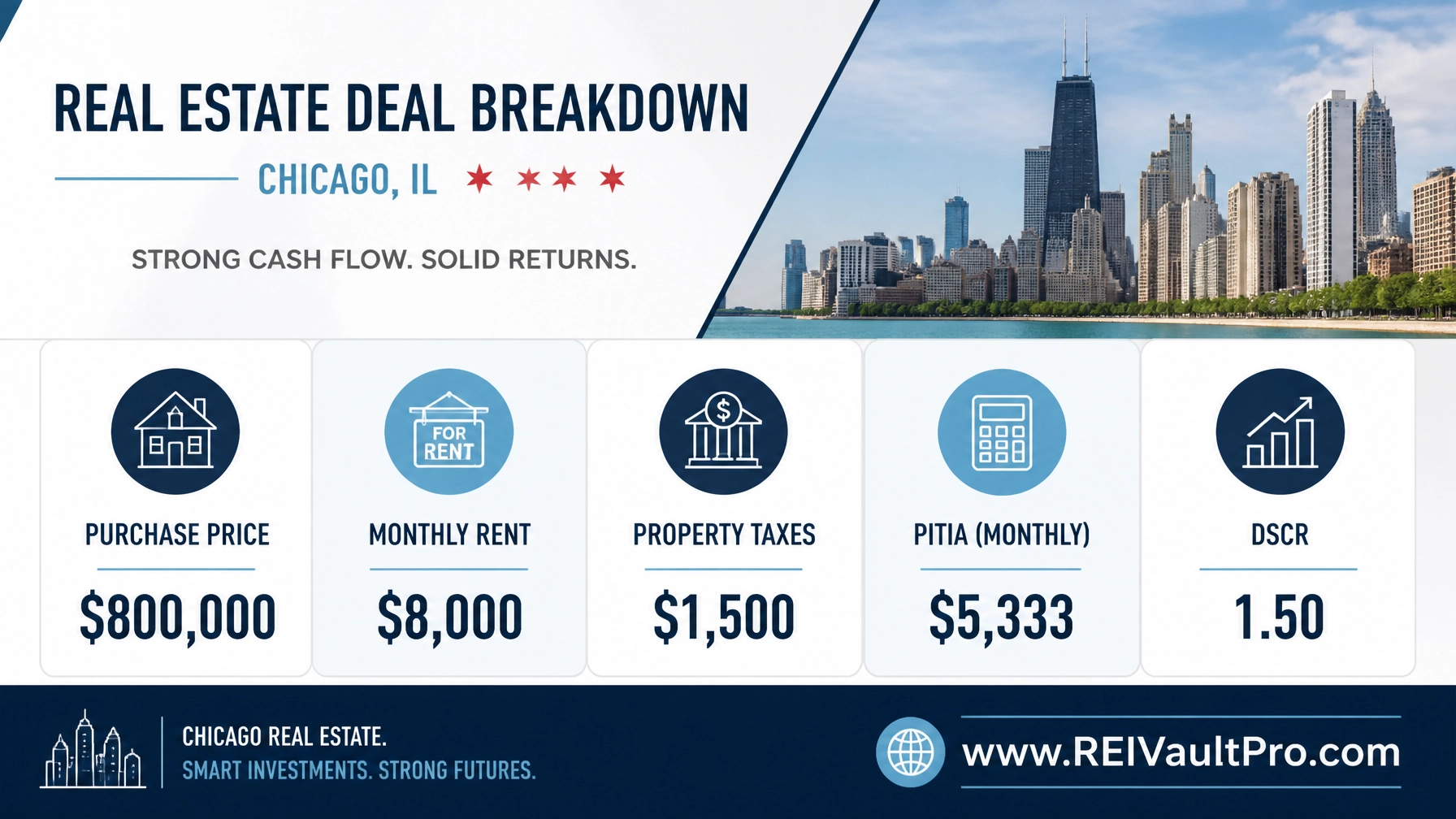
To understand how this looks in a real-world scenario, let's look at a typical 4-unit property purchase in Chicago.
- Purchase Price: $800,000
- Down Payment (20%): $160,000
- Loan Amount: $640,000
- Estimated Monthly Rent (4 units @ $2,000 each): $8,000
- Estimated PITIA (Principal, Interest, Taxes, Insurance): $5,333
In this case, we calculate the DSCR:
$8,000 (Rent) / $5,333 (PITIA) = 1.50 DSCR
A 1.50 DSCR is considered a very strong deal. This investor would likely qualify for the most competitive interest rates and might even be eligible for a HELOC on other properties to cover the down payment for this one.
Scaling Your Portfolio in Illinois and Beyond
Whether you are looking at properties in Chicago, Aurora, or even expanding into markets like Florida or Georgia, the strategy remains the same: use leverage wisely. DSCR loans allow you to scale because each property is its own financial entity. Your personal debt does not stop you from acquiring a fifth, tenth, or twentieth property.
For those managing Airbnb or short-term rentals, DSCR programs have evolved to accept "AirDNA" or short-term rental income projections. This is a game-changer for investors in Chicago’s tourism-heavy neighborhoods. You can analyze potential short-term rental profits using the AI Rehab Estimator to see if a property is worth the renovation cost to turn it into a high-yield rental.
Leverage Professional Tools for Success
Expert investors don't guess; they use data. Managing a growing portfolio requires more than just a spreadsheet. Accessing advanced tools can help you stay ahead of market shifts and interest rate fluctuations.
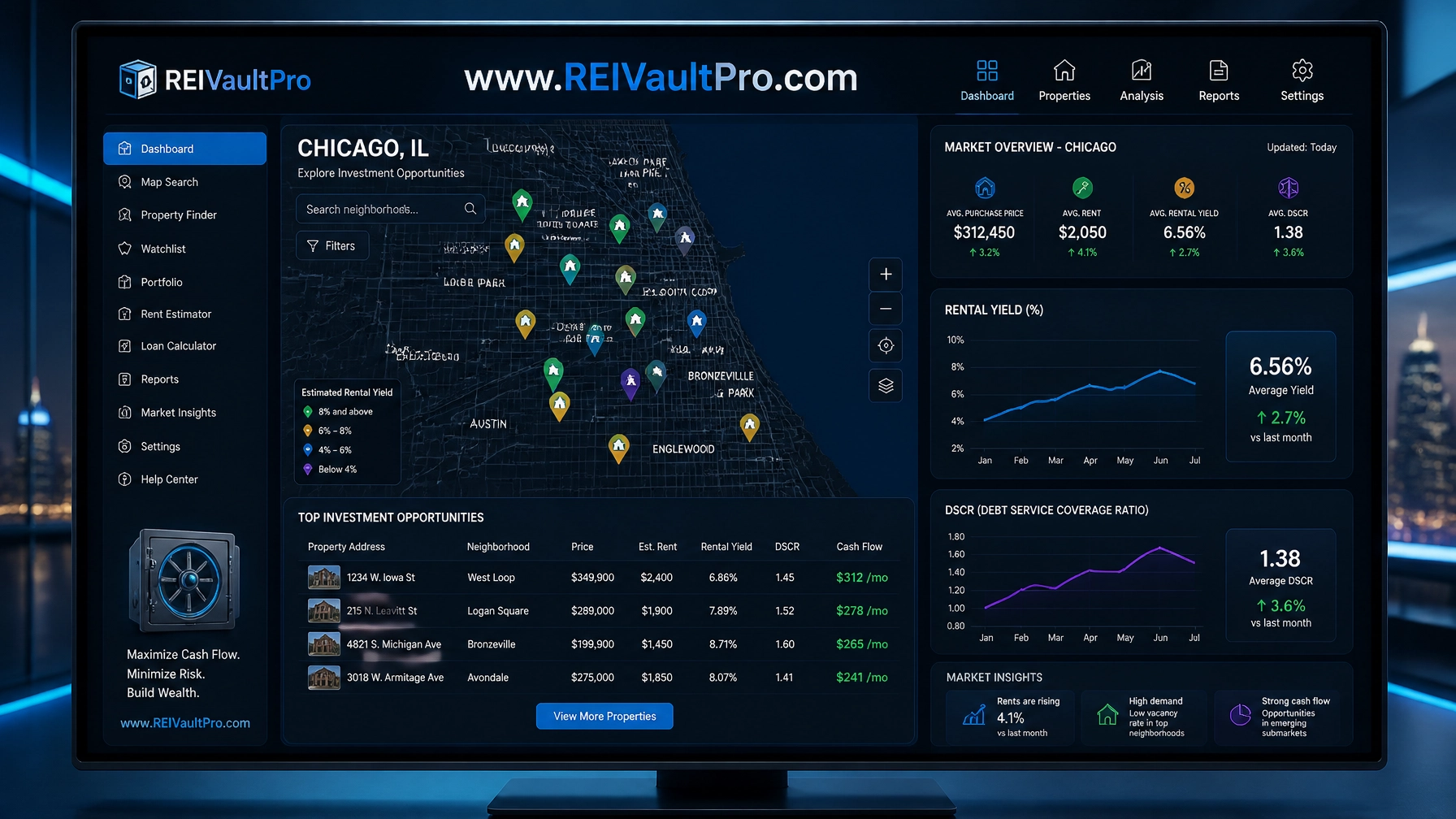
Compare your financing options by looking at mortgage calculators and integrating them with property-specific data. If you are a self-employed entrepreneur, you may also want to explore bank statement loans if you prefer to qualify based on your business cash flow rather than just property rent.
Related REI Vault Pro Resources
- Deal Analyzer: This tool allows you to plug in property data to instantly calculate DSCR, cash-on-cash return, and cap rates for any Chicago investment.
- AI Rent Analyzer: Get accurate rental market data for any zip code in Illinois, ensuring your DSCR calculations are based on real-world numbers.
- AI Rehab Estimator: Planning a fix-and-flip or a BRRRR strategy? This tool helps you estimate renovation costs so you can project your final DSCR after the refinance.
- ROI Calculator: Understand the long-term wealth impact of your real estate investments by comparing different financing strategies.
If you are ready to take the next step in your investment journey, we guide you clearly and confidently through the process of choosing the right loan for your specific goals.
Watch a Demo to see how these tools and financing strategies can help you build your Chicago real estate empire.
FAQ Section
What is the minimum DSCR ratio required for Chicago properties?
Most lenders prefer a DSCR of 1.25 or higher, but many investor-focused programs in Chicago allow ratios as low as 1.0, 0.75, or even "No-Ratio" tiers depending on your credit and down payment.
Can I get a DSCR loan for an Airbnb in Chicago?
Yes. Many DSCR programs now allow for short-term rental income to be used for qualification. Lenders may use the average of the last 12 months of rental history or projections from reputable data providers.
Do DSCR loans require personal tax returns?
No. One of the primary benefits of DSCR financing is that it does not require personal tax returns, pay stubs, or W-2s. Qualification is based on the property’s cash flow.
How do Cook County property taxes affect my loan?
Property taxes are included in the PITIA payment. Higher taxes increase your monthly payment, which lowers your DSCR ratio. It is critical to use accurate tax estimates when analyzing a deal.
Is there a limit to how many DSCR loans I can have?
Unlike conventional loans which often cap at 10 properties, most DSCR lenders do not have a limit on the number of properties you can finance, making them ideal for scaling a large portfolio.