Cash-Out Refinancing in Florida: Is it Too Late as Rates Rebound?

Florida homeowners and real estate investors find themselves at a critical crossroads as we navigate late March 2026. After a period of relative stability, the mortgage landscape has shifted. According to recent reports, mortgage rates reached a seven-month high in mid-March, creating a sense of urgency for those looking to leverage their home equity.
As a mortgage strategist, I am seeing a surge of questions from homeowners in Miami, Tampa, and Orlando, as well as investors across our footprint in Alabama, Georgia, and Virginia. The primary concern is whether the window for a cash-out refinance has slammed shut or if there is still a strategic path to liquidity.
The answer is rarely a simple "yes" or "no." It requires a deep dive into your current debt structure, your long-term wealth goals, and a clear understanding of the difference between a total loan restructure and a supplemental lien strategy.
The 2026 Florida Market Reality
The current average for a 30-year fixed mortgage in Florida is hovering around 6.38%. While this is lower than the peaks seen in late 2023, it represents a significant rebound from the beginning of the year. For homeowners who secured rates in the 3% or 4% range during the 2020-2021 window, a traditional cash-out refinance looks less like an opportunity and more like a financial penalty.
However, equity positions remain remarkably strong. Property values across Florida and Georgia have held firm, leaving many homeowners "equity rich" but "cash poor."
Cash-Out Refinance: A mortgage restructuring that replaces your existing primary loan with a new, larger loan, allowing you to receive the difference in cash at closing.
Practical Application: Use this when your current mortgage rate is higher than or equal to current market rates to consolidate debt or fund large-scale property improvements.

Visual: A realistic high-rise luxury view overlooking a Florida coastline. Ebonie Beaco - Mortgage Strategist
Analyzing the "Golden Handcuffs"
Many homeowners in Illinois, Indiana, and Michigan are currently experiencing what we call the "Golden Handcuffs." You likely have a 3.25% or 3.75% interest rate on your primary residence. Refinancing that entire balance into a 6.5% or 6.75% loan just to pull out $100,000 for an investment property or a renovation is often a losing proposition.
Let’s look at a real-world scenario.
Imagine you own a home in Jacksonville valued at $600,000. You owe $300,000 at a 3.5% interest rate. You want to access $100,000 to purchase a rental property in Alabama or Arkansas.
If you choose a full cash-out refinance:
- New Loan Amount: $400,000
- New Interest Rate: 6.75%
- Previous Monthly Principal & Interest: ~$1,347
- New Monthly Principal & Interest: ~$2,594
- Total Monthly Increase: $1,247
In this scenario, you are paying a massive premium to access that $100,000 because you are forced to give up the 3.5% rate on the original $300,000 debt. This is where a strategic pivot becomes necessary.
The Second-Lien Strategy: Preserving Your Low Rate
For homeowners in Virginia, Missouri, and Kentucky who want to protect their low-interest primary mortgage, the HELOC (Home Equity Line of Credit) or a Fixed-Rate Second Mortgage is often the superior tool.
HELOC: A revolving line of credit secured by your home that allows you to borrow, repay, and borrow again.
Practical Application: This functions as an emergency fund or a flexible source of capital for real estate wholesalers who need quick access to earnest money deposits or "gap" funding.
Instead of refinancing the whole $400,000, you keep your $300,000 loan at 3.5%. You then take out a second lien (HELOC) for the $100,000 you need.
- Primary Loan Payment (3.5%): $1,347
- HELOC Payment (assuming 9% interest-only during draw): ~$750
- Total Monthly Outlay: $2,097
By using a second lien, you save approximately $497 per month compared to a full cash-out refinance. You can explore these options further on our home refinance page.
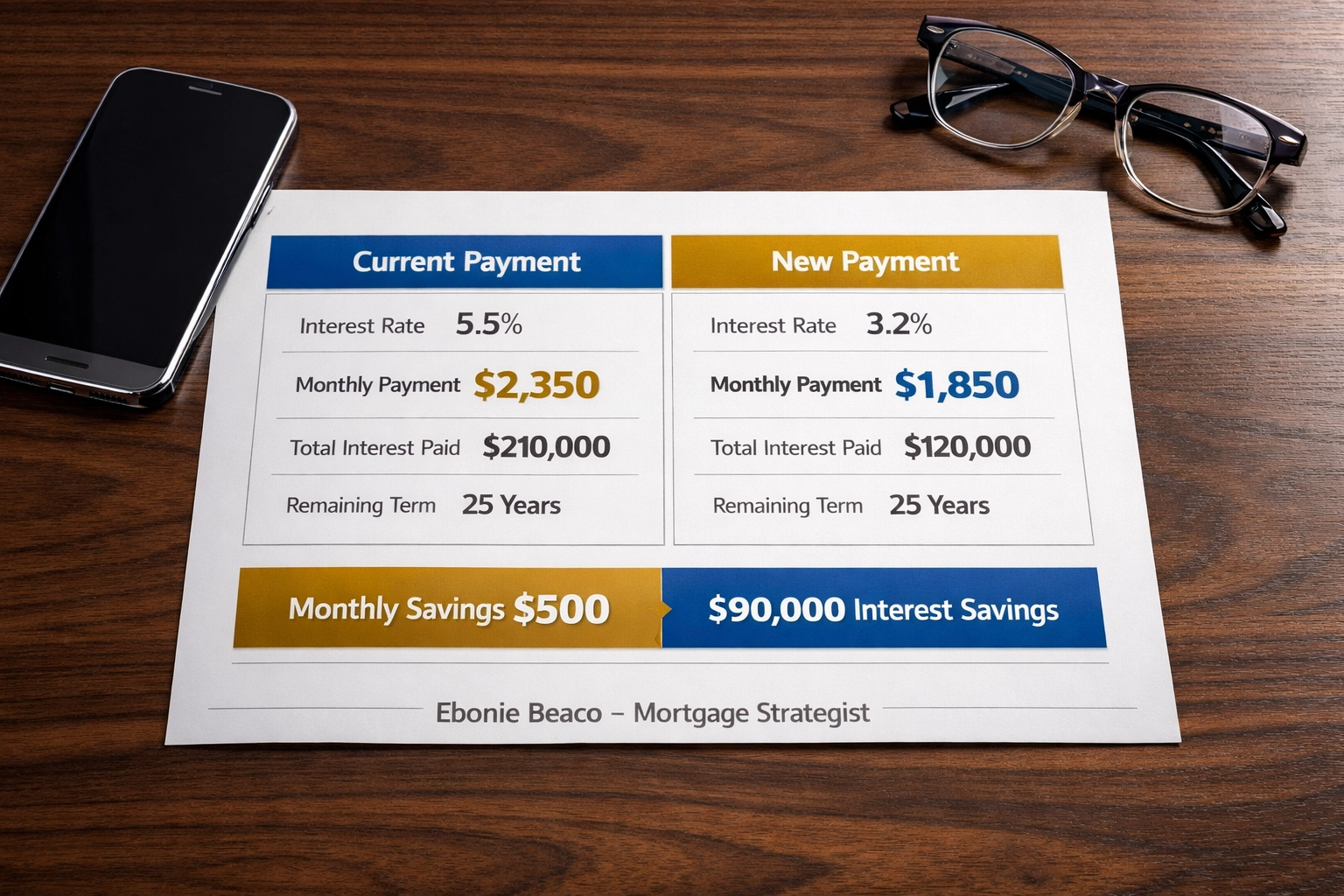
Visual: A financial comparison chart showing "Option A: Full Refinance" vs "Option B: Second Lien Strategy" with clear dollar savings highlighted. Ebonie Beaco - Mortgage Strategist
Strategic Moves for Real Estate Investors
Real estate investors and landlords in markets like Chicago or Atlanta are using equity extraction for different reasons. For those focused on the BRRRR (Buy, Rehab, Rent, Refinance, Repeat) method, the rebound in rates changes the "Exit Strategy."
If you are a fix-and-flip investor or a wholesaler in Florida, you must account for the higher cost of capital in your "After Repair Value" (ARV) calculations. When rates are higher, buyers have less purchasing power, which can lead to longer "days on market."
DSCR Loan (Debt Service Coverage Ratio): A mortgage program for investment properties that qualifies the borrower based on the property’s rental income rather than personal income or DTI.
Practical Application: Use this to scale a portfolio quickly without providing tax returns or personal pay stubs.
Investors often use a cash-out refinance on a recently renovated property to recoup their initial capital. Even at 7% or 8%, a DSCR loan can make sense if the property generates high cash flow. You can learn more about how we structure these at Home Loans Network.
Is it Too Late for Florida Homeowners?
The window is not closed, but the strategy has evolved. If you are looking to consolidate $50,000 in high-interest credit card debt (often at 24% to 29% APR), a cash-out refinance at 6.75% is still a brilliant financial move. It significantly reduces your total monthly liability and improves your cash flow.
However, if you are looking to "just have the cash," you must weigh the cost of that capital against the potential return or the peace of mind it provides.
Explore your options by using our mortgage calculators to see how a new rate impacts your specific situation. Access the data before making a move that could cost you thousands in unnecessary interest over the next decade.

Visual: A professional data graphic showing Florida's home equity growth over the last 24 months. Ebonie Beaco - Mortgage Strategist
Regional Nuances: Beyond the Sunshine State
While Florida is seeing a 2026 high, other states in our network are experiencing different pressures:
- Illinois and Indiana: Property tax adjustments often coincide with refinance cycles, requiring a careful look at escrow accounts.
- Alabama and Arkansas: Lower entry prices for investors make the "Blended Rate" strategy highly effective for those building portfolios.
- Virginia and Georgia: High demand in metro areas like Northern VA and Atlanta keeps equity levels rising, even as rates fluctuate.
Conclusion: Strategy Over Product
In this environment, you do not just need a loan; you need a strategy. We analyze your entire financial profile to see if a Jumbo Loan or an Interest-Only Mortgage might serve your goals better than a traditional 30-year fixed product.
Compare the long-term interest cost of a full refinance against the flexibility of a HELOC. Jump in to the market with a plan that protects your wealth rather than eroding it.
The current rate rebound is a reminder that the market is volatile. Waiting for a "perfect" rate that may never return can be as costly as moving too quickly without a professional analysis.
Schedule a 1-on-1 Strategy Session
If you are a homeowner, Realtor, or investor in Alabama, Arkansas, Florida, Georgia, Illinois, Indiana, Michigan, Kentucky, Missouri, or Virginia, let’s look at your specific numbers. We provide transparency throughout the loan process so you can move forward with confidence.
Scedule a 1 on 1 at https://calendly.com/homeloansnetwork
Ebonie Beaco
Mortgage Strategist | Senior Loan Officer
Home Loans Network powered by Loan Factory Inc.
NMLS #2389954
HomeLoansNetwork.com
312-392-0664