California Wholesaling: The 2026 Transparency Survival Guide
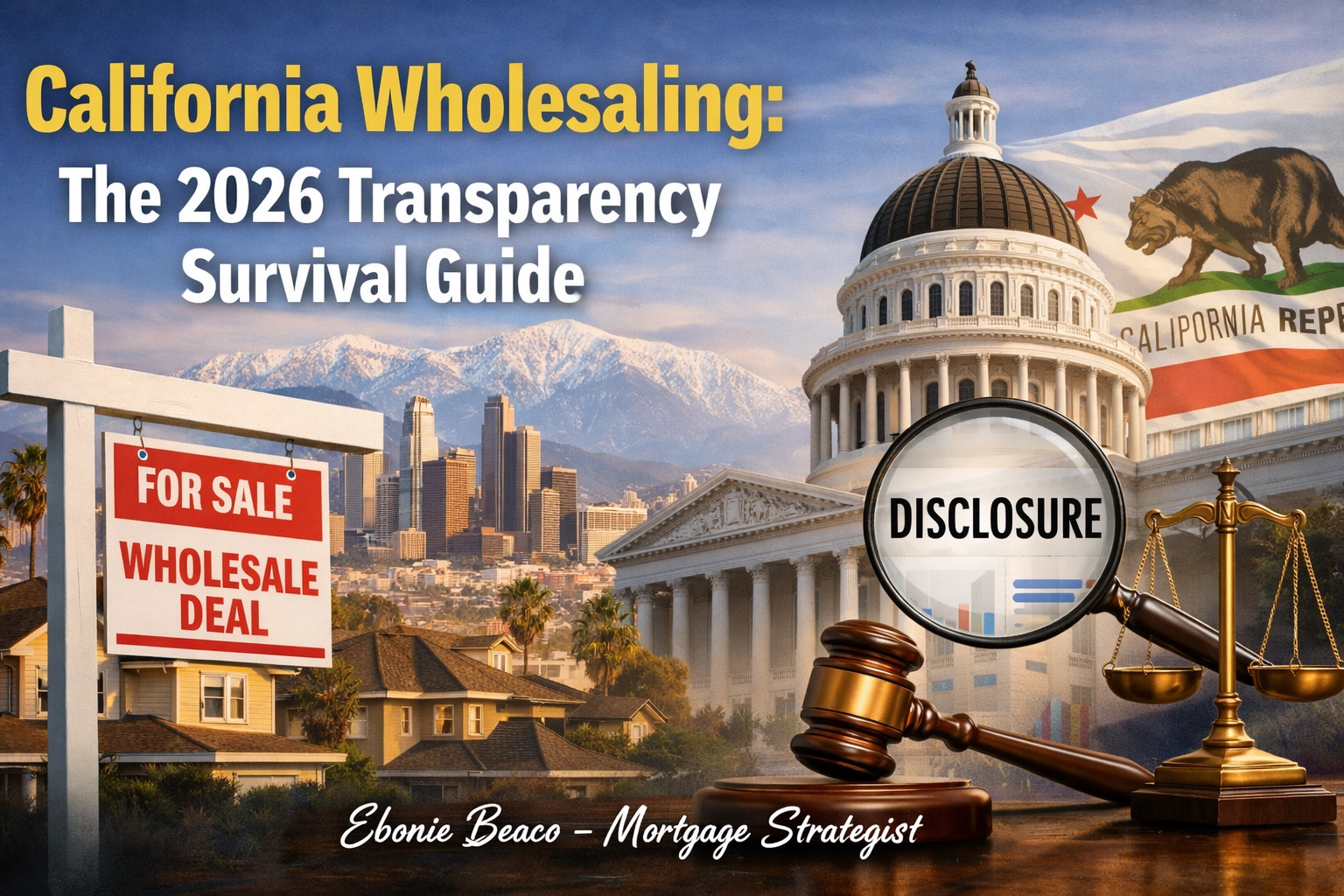
Friday, March 27, 2026
The landscape for California real estate wholesalers looks a lot different today than it did just a few years ago. If you are operating in the Golden State in 2026, you already know that the "wild west" era of off-market deals has effectively ended.
Legislative shifts, specifically the ripple effects of Assembly Bill 1850 and increased scrutiny from the California Department of Real Estate (DRE), have moved transparency from a "best practice" to a legal requirement. In this environment, your success depends on your ability to navigate the fine line between being a contract dealer and an unlicensed real estate agent.
Jump in as we break down the mechanics of compliant wholesaling in 2026 and explore how to keep your deals profitable while staying clearly within the bounds of the law.
Defining the 2026 Wholesaling Framework
Before we dive into the strategy, let's establish a clear baseline for the terms we are using.
Wholesaling The practice of a party (the wholesaler) entering into a purchase contract for a property and subsequently assigning their interest in that contract to another buyer for a fee. Practical application: You find a distressed property, secure it under contract, and find a cash buyer or investor to take over your position before the closing date.
Assignment of Contract A legal document that transfers the rights and obligations of a purchase agreement from the original buyer to a new entity. Practical application: This is the vehicle that allows you to collect an assignment fee without ever actually taking title to the property.
Transparency Mandate The 2026 regulatory expectation that all parties in a transaction are fully aware of the wholesaler’s role, the assignment fee, and the fact that the wholesaler does not currently own the property. Practical application: This ensures that sellers aren't misled into thinking you are the final occupant or that you are acting as their licensed fiduciary.
The Fine Line: Assigning Rights vs. Acting as an Agent
The biggest hurdle for California wholesalers right now is the DRE's focus on unlicensed brokerage activity. In the eyes of the law, there is a massive distinction between selling a contract you own and selling a house you don't own.
When you market a property on the MLS or public social media groups as if you are the owner, you are treading into "agent" territory. Unless you have a real estate license, this can lead to heavy fines or cease-and-desist orders.
Explore the distinction:
- The Licensed Agent: Represents a principal, owes fiduciary duties, and earns a commission for facilitating the sale of real estate.
- The Wholesaler: Acts as a principal in the contract, owns the right to purchase, and sells that right for a profit.
To stay safe in 2026, your marketing must focus on the contractual interest. Instead of saying "I am selling this 3-bed, 2-bath house," your language should reflect "I am assigning my interest in a purchase contract for a 3-bed, 2-bath house." It sounds like a small tweak, but it is a critical legal shield.
 Visual: A chart comparing "Marketing Property" vs. "Marketing Contract Rights" with Ebonie Beaco - Mortgage Strategist branding.
Disclosure: The New Gold Standard
Transparency is no longer optional. In 2026, the California real estate market thrives on clear communication. If you try to hide your assignment fee or mask your intentions from the seller, you are asking for a lawsuit or a rejected file at the escrow desk.
The most successful investors we work with at Home Loans Network use a "Total Disclosure" model. This means:
- Seller Awareness: The original seller knows you are an investor and that you intend to assign the contract for a profit.
- Buyer Awareness: The end buyer sees the assignment fee on the settlement statement.
- Documentation: Your contracts explicitly state that the buyer has the right to assign the agreement to a third party.
Accessing mortgage basics can help you understand how these contracts appear to lenders when the end buyer eventually seeks financing.
Marketing Rules in the Transparency Era
The days of "bandit signs" and public Facebook Marketplace posts are fading. In 2026, California wholesalers must be surgical with their marketing.
Avoid the MLS Unless you are a licensed agent or have a "Listing Agreement for Wholesalers" (a hybrid model emerging in some markets), stay off the MLS. Publicly advertising a property you do not own is the fastest way to trigger a DRE audit.
Build Private Lists Focus on building a robust, private list of "vetted" buyers. These are investors who understand the wholesale process and have their financing ready. Many of these buyers utilize DSCR rental property loans to close quickly, which makes your contract more valuable.
Standardize Your Paperwork Use a Two-Contract System.
- Contract A: The initial Purchase and Sale Agreement between you and the seller.
- Contract B: The Assignment Agreement between you and the end buyer.
Ensure both documents have clear language regarding the "Assignment Fee" and "Disclosure of Profit."
Financing the End Deal: What Wholesalers Need to Know
As a wholesaler, you aren't just selling a house; you are selling a deal. That deal only closes if your end buyer can get across the finish line. In the 2026 California market, high interest rates and tighter lending standards mean you need to understand the buyer's financing.
Most wholesale deals are picked up by:
- Fix and Flip Investors: They need "Hard Money" or bridge loans to renovate the property.
- Buy and Hold Landlords: They often look for DSCR loans which qualify based on the property’s rental income rather than the buyer's personal income.
- Self-Employed Professionals: These buyers might use bank statement loans to prove their ability to repay.
If your end buyer is using a traditional lender, the assignment fee can sometimes cause "appraisal friction." Lenders will typically only lend on the lower of the purchase price or the appraised value. If your assignment fee pushes the total price above the appraisal, the buyer has to bring more cash to the table.
 Visual: A deal breakdown graphic showing a $400,000 purchase price, $20,000 assignment fee, and $420,000 total acquisition cost for the investor. Includes Ebonie Beaco - Mortgage Strategist branding.
Case Study: The Transparent Wholesale Deal
Let’s look at a real-world scenario in San Bernardino, CA.
An investor finds a distressed property valued at $450,000 after repairs. The owner is in pre-foreclosure and needs to move fast.
- The Contract: The wholesaler signs a contract with the seller for $300,000. The contract includes a clear "Right to Assign" clause.
- The Disclosure: The wholesaler explains they are an investment firm that matches properties with cash buyers.
- The Assignment: The wholesaler finds an investor who wants to flip the home. They assign the contract for a $15,000 fee.
- The Closing: The end buyer pays $315,000 total. The escrow company handles the split, paying the seller $300,000 and the wholesaler $15,000.
Because the wholesaler was transparent, the title company is comfortable, the seller isn't surprised at closing, and the deal moves through the loan process without a hitch.
The Wholesaler’s Survival Checklist for 2026
To stay profitable and legal in California, follow this simple checklist:
- Audit your contracts: Ensure they clearly define your right to assign and disclose your intent to profit.
- Check your marketing: Are you advertising "the house" or "the contract"? Shift to the latter.
- Vet your buyers: Make sure they have proof of funds or a pre-approval from a reliable source like Home Loans Network.
- Keep records: Document all communications with the seller to prove they were informed of your role.
- Stay updated: California real estate laws change fast. Review the FAQ on our site or consult with a real estate attorney regularly.
Why Financing Knowledge is Your Secret Weapon
Even though you aren't the one getting the loan, understanding mortgage strategies makes you a better wholesaler. When you can tell an end buyer, "This property qualifies for a 5-unit multifamily loan" or "This is a perfect candidate for a Non-QM bank statement loan," you add value.
You become a strategist, not just a middleman.
If you are working with investors who are struggling to find the right leverage, or if you are looking to transition from wholesaling to buying and holding properties yourself, you need a partner who understands the California market.
Compare your options and see how different loan programs can make your deals more attractive to buyers. Whether it is a Jumbo loan for a luxury flip or a creative financing solution for a self-employed investor, having the right mortgage strategist in your corner is a game-changer.
Looking for Non-QM or Bank Statement loans? Ebonie has you covered.
Schedule a 1 on 1 at https://calendly.com/homeloansnetwork
Ebonie Beaco Mortgage Strategist | Senior Loan Officer Home Loans Network powered by Loan Factory Inc. NMLS #2389954 HomeLoansNetwork.com 312-392-0664