Buyer Backout: How to Protect Your Wholesale Real Estate Deal from Flakes
Wholesaling houses is an incredible way to enter the real estate market without a massive down payment, but nothing kills the excitement faster than a buyer who ghosts you at the finish line. You spend weeks searching for a motivated seller, negotiating a deep discount, and finally getting that property under contract only to have your "cash buyer" back out two days before closing. This scenario is a nightmare because it doesn't just cost you a wholesale fee; it damages your reputation with the seller and the title company. To thrive in wholesale real estate across competitive markets like Chicago, Illinois, or the fast moving suburbs of Atlanta, Georgia, you must learn to build a fortress around your transactions. Protecting your time involves more than just finding a warm body to sign an assignment; it requires a strategy rooted in financial commitment and high level vetting.
The most effective shield you can use against a flakey buyer is the non-refundable earnest money deposit. When you are wholesaling houses, you should never allow a buyer to tie up your deal without putting significant skin in the game. If you have $1,000 in earnest money held at the title company for the seller, your end buyer should be putting down at least $3,000 to $5,000 to take over that position. This creates a financial consequence for walking away, ensuring that only serious investors who have their Real Estate Investing ducks in a row will commit to your contract. You can learn more about how these funds move during the transaction by visiting the Home Loans Network loan process page. By making that deposit non-refundable immediately upon signing the assignment, you shift the risk from your shoulders to theirs, which is exactly how professional wholesalers operate in Virginia and Florida.
To understand how to navigate these hurdles, we should define a few core concepts that every investor needs to master.
Earnest Money Deposit (EMD): A sum of money a buyer pays to show they are serious about a transaction, typically held in escrow by a third party. This acts as a security deposit that is forfeited if the buyer defaults on the contract terms.
Assignment of Contract: A legal agreement where the original buyer (the wholesaler) transfers their rights and obligations to a distinct end buyer. This allows the wholesaler to collect a fee while the end buyer completes the purchase of the property.
Proof of Funds (POF): A document or bank statement demonstrating that a buyer has the liquid assets available to close a deal. This ensures you are dealing with a legitimate cash purchaser rather than someone hoping to find the money later.
Debt Service Coverage Ratio (DSCR): A calculation used by lenders to determine if a property’s rental income covers its debt obligations. Investors often use DSCR Investor Loans to take down wholesale deals when they want to keep the property as a long term rental.
Vetting your cash buyers is just as important as finding the motivated seller in the first place. You should never take a buyer's word that they have the money; instead, request a fresh Proof of Funds or a pre-approval letter for a specialized loan product. Many savvy investors in markets like Indianapolis, Indiana, or Little Rock, Arkansas, use Fix and Flip Loans or Bridge Loans to fund their acquisitions. If a buyer claims to be a "cash buyer" but actually intends to use a loan, you need to know that upfront so you can confirm their lender is reliable and fast. Asking for a screenshot of a bank account balance or a letter from a reputable mortgage strategist can save you weeks of wasted effort. You can point your buyers toward the Home Loans Network mortgage basics to ensure they are educated on their funding options before they sign your assignment.
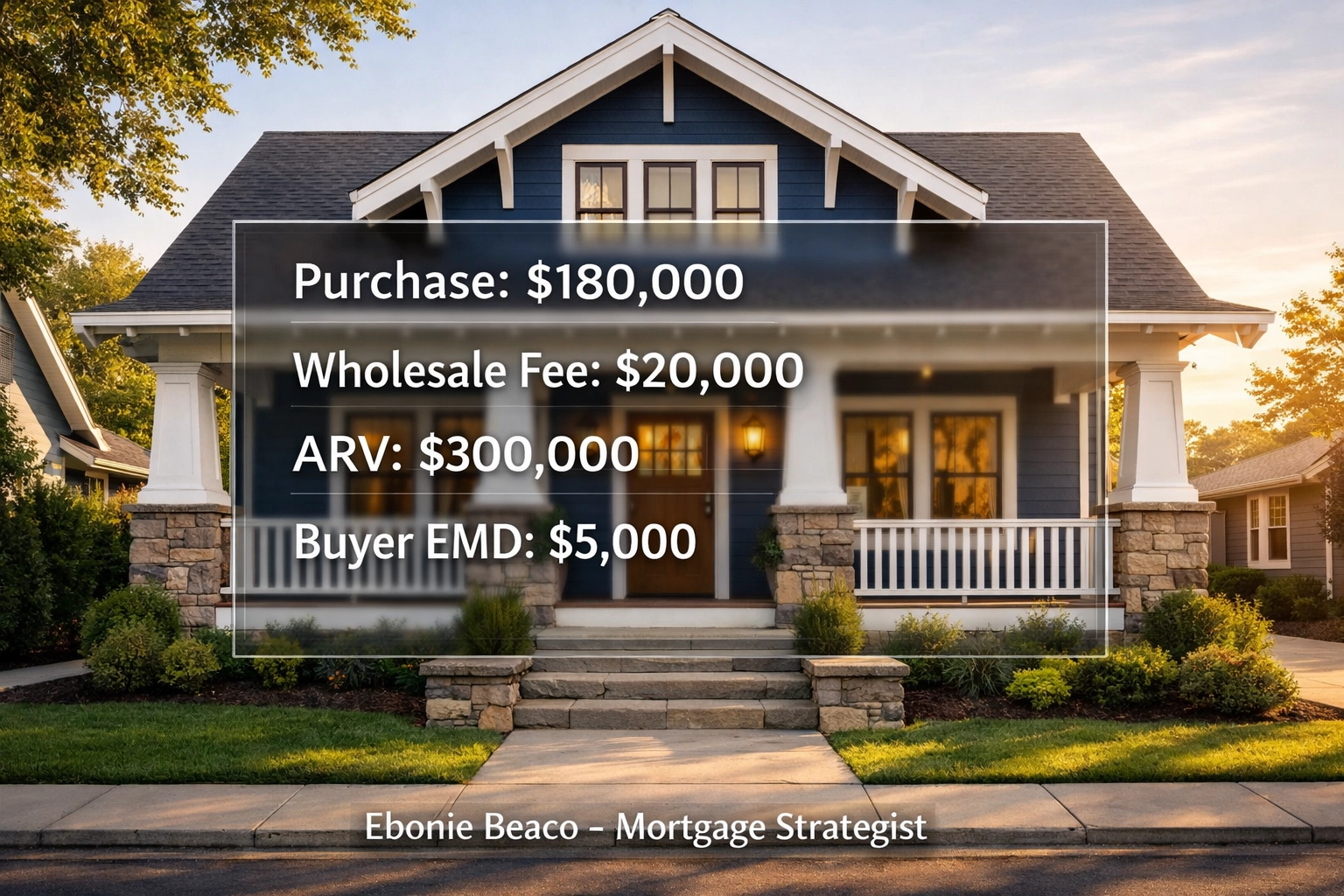
Let’s look at a practical example of how structuring your deal with a solid deposit can protect your profit. Imagine you find a distressed property in Richmond, Virginia, with an After Repair Value (ARV) of $300,000. You get it under contract for $180,000 and find a buyer willing to pay $200,000, which leaves you with a $20,000 assignment fee. By requiring a $5,000 non-refundable deposit from the buyer, you ensure that even if they flake, you have a cushion to potentially pay the seller or find a new buyer quickly.
Deal Breakdown Example:
- Original Purchase Price: $180,000
- Wholesale Assignment Fee: $20,000
- Total Price to End Buyer: $200,000
- Buyer Non-Refundable EMD: $5,000
- Wholesaler Original EMD to Seller: $1,000
- Net Protection for Wholesaler: $4,000 profit even if the buyer backs out.
Another layer of protection is your choice of contract and the specific language included in your assignment addendum. Your assignment agreement should explicitly state that the buyer is accepting the property in its current condition and that the inspection period has already passed. Many new wholesalers in California and Michigan make the mistake of giving the end buyer a new inspection period, which essentially gives them a "get out of jail free" card to back out. You must ensure that your buyer understands they are stepping into your shoes, which means they inherit all the responsibilities you agreed to with the seller. If you are unsure about how to structure these documents, exploring our FAQ section can provide clarity on common transactional hurdles. Keeping your contracts tight and your timelines short is the only way to maintain control over the deal flow.
As you grow your business, you might decide that wholesaling is just the first step and that you want to start keeping some of these properties for yourself. This is where moving into Real Estate Investing through strategies like the BRRRR method (Buy, Rehab, Rent, Refinance, Repeat) becomes incredibly powerful. Instead of just passing the deal to a buyer who might back out, you can use a Cash-Out Refinance or a DSCR rental property loan to fund the deal yourself and build long term wealth. At Home Loans Network, we specialize in helping investors move from the wholesale world into the landlord world by providing access to Non-QM Mortgage Loans and Airbnb and Short-Term Rental Financing. Whether you are in Birmingham, Alabama, or St. Louis, Missouri, having a lender who understands investment property is a massive advantage. You can even check your potential numbers using our mortgage calculators to see if a deal makes more sense as a flip or a hold.
Ultimately, protecting your deals comes down to professional standards and working with the right partners. You need to build a "buyer’s list" of real investors, not just people who saw a YouTube video and think wholesaling looks easy. When you work with buyers who are already pre-approved for Landlord Loans or Fix and Flip Financing, the likelihood of a backout drops significantly because their financing is already vetted. By being transparent with your sellers and firm with your buyers, you create a business model that is sustainable and respected in the industry. If you ever feel stuck on how to handle a difficult buyer or how to help them find the money to close your deal, remember that my team and I are here to provide the financial strategies you need to cross the finish line.
📞 Work With Ebonie Beaco
If you are a wholesaler looking to:
- Close more deals
- Connect your buyers with financing
- Structure deals that actually get approved
- Learn how to grow into a real estate investor
I can help you every step of the way.
Ebonie Beaco Mortgage Strategist | Senior Loan Officer Home Loans Network powered by Loan Factory Inc. NMLS #2389954
📱 Phone: 312-392-0664 📧 Schedule a 1 on 1: https://calendly.com/homeloansnetwork 🌐 Website: HomeLoansNetwork.com/contact-us
👉 Whether you need lending, deal structuring, or mentorship, reach out today.