Building in California: Financing Your Ground-Up Project

California’s real estate market remains one of the most dynamic in the world. Whether you are looking at the coastal stretches of San Diego or the urban density of Los Angeles, the demand for new housing and commercial spaces continues to outpace supply. For many developers and ambitious investors, the solution isn't just buying existing property: it is building from the dirt up.
Ground-up construction involves taking a vacant piece of land and turning it into a functional structure. This process is complex, especially in a state with rigorous zoning laws and environmental regulations. Financing these projects requires a shift in mindset compared to traditional home buying. You aren't just financing a finished product; you are financing a vision, a timeline, and a budget that evolves as the project moves forward.
Understanding Ground-Up Construction Loans
A ground-up construction loan is a short-term financing solution used to cover the costs of building a new structure on land that is currently vacant or has been cleared. Unlike a standard 30-year mortgage, these loans are typically interest-only during the building phase, meaning you only pay interest on the funds that have been disbursed.
Construction-to-Permanent Loans
A construction-to-permanent loan: often called a one-time close loan: is a popular choice for developers in cities like San Francisco or Sacramento. This product combines the construction financing and the long-term mortgage into a single package.
Definition: A single loan that covers the building phase and then automatically converts into a traditional mortgage once the certificate of occupancy is issued. Practical Application: This saves you time and money by requiring only one set of closing costs and a single application process.
You can learn more about how these transitions work by visiting the Home Loans Network loan process page.
Two-Time Close Loans
In some scenarios, a two-time close loan is more appropriate. This involves taking out a short-term construction loan to finish the build, and then applying for a separate mortgage to pay off that construction loan once the property is complete. This is common for investors who plan to sell the property immediately upon completion or who want to shop for better long-term rates after the build is finished.
The Financial Foundation: Loan-to-Cost (LTC)
When you are planning a build in California, the most important metric you will encounter is the Loan-to-Cost ratio, or LTC. While traditional mortgages focus on Loan-to-Value (LTV), construction lenders focus on what it actually costs to build the project.
Definition: The ratio used to compare the amount of a loan to the total cost of a construction project. Practical Application: Lenders use LTC to determine how much skin you have in the game and how much risk they are taking on based on the actual budget.
In California, most lenders will provide an LTC of 75% to 85%. This means you, as the developer, are responsible for covering the remaining 15% to 25% of the total project costs.
Calculating Your LTC
To understand your borrowing power, you need to aggregate your "hard costs" (materials, labor, land) and your "soft costs" (architect fees, permits, engineering, insurance).
Let’s look at a scenario for a single-family home build in a growing area like Riverside or Fresno:
- Land Purchase Price: $250,000
- Hard Costs (Construction): $600,000
- Soft Costs (Permits/Architecture): $150,000
- Total Project Cost: $1,000,000
If a lender offers an 80% LTC, your loan amount would be $800,000. You would be responsible for a $200,000 down payment or equity contribution.
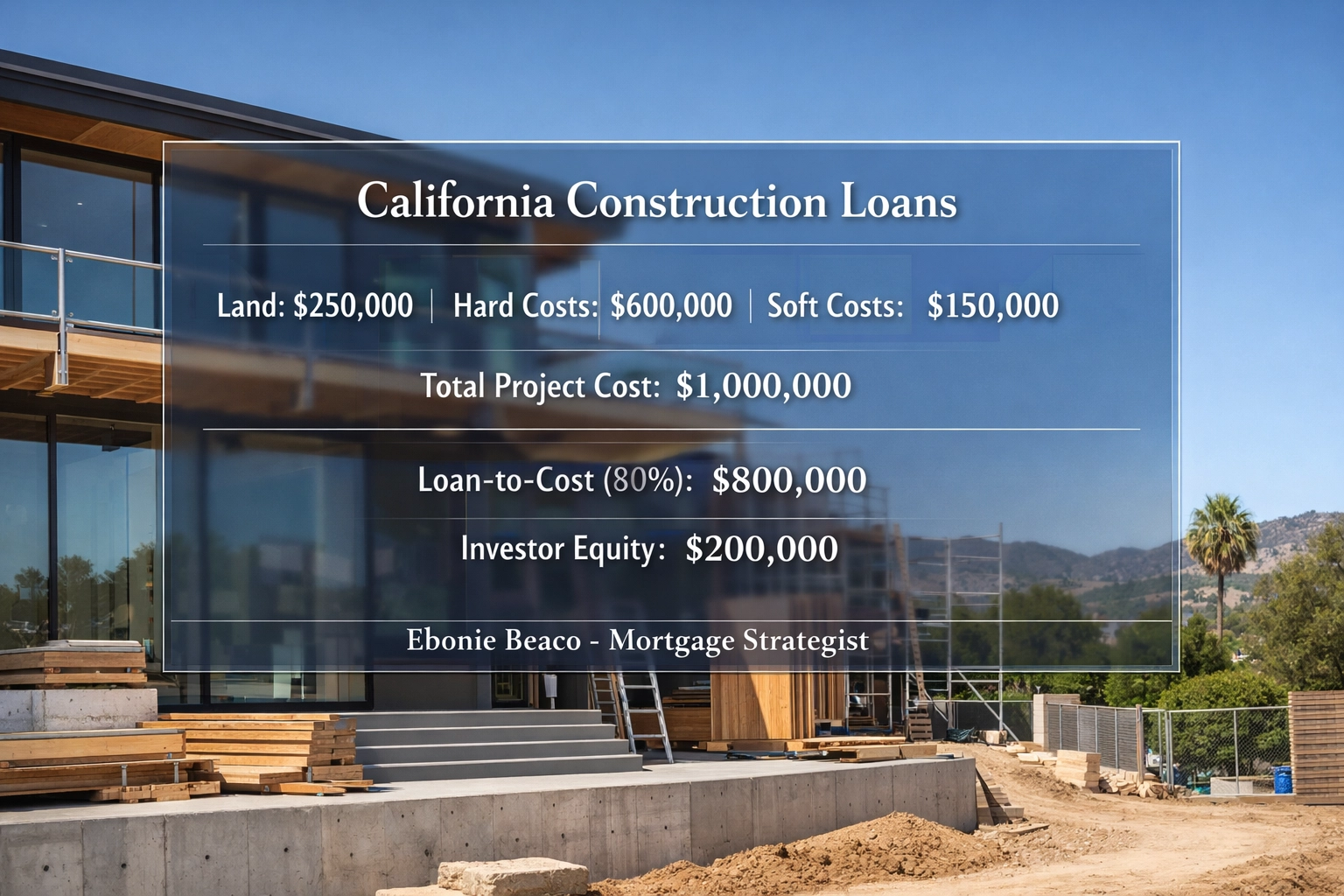 Image Description: A financial breakdown chart titled "California Construction Loans" showing: Land: $250k, Hard Costs: $600k, Soft Costs: $150k, Total: $1M. Loan-to-Cost (80%): $800k, Investor Equity: $200k. At the bottom: Ebonie Beaco - Mortgage Loan Officer.
For help running these numbers on your specific project, explore our mortgage calculators.
Qualification Requirements for California Developers
Building in California is not for the faint of heart, and lenders treat these applications with a high level of scrutiny. Because the collateral (the house) doesn't exist yet, the lender is betting on your ability to manage the project to completion.
1. Credit Profile
While some hard money lenders are more flexible, most institutional construction programs require a credit score of at least 680. Scores above 720 typically unlock the most competitive interest-only rates during the build phase.
2. Debt-to-Income (DTI)
For individual developers or those using personal signatures, a DTI below 43% is the standard. This ensures you can handle the interest-only payments even if the project hits a delay.
3. Liquid Reserves
California projects are notorious for delays due to weather, supply chain issues, or permit holdups in cities like Oakland or San Jose. Lenders want to see that you have "contingency cash." This usually means having 10% to 20% of the project cost sitting in a liquid account, separate from your down payment.
4. Experience
If you are building a multi-unit complex or a high-end luxury estate, the lender will want to see a resume of past projects. If you are a first-time developer, partnering with an experienced General Contractor (GC) is essential to securing funding.
The Draw Process: How the Money Flows
One of the biggest misconceptions about construction loans is that you get a lump sum of cash on day one. In reality, the lender releases money in "draws" based on completed work milestones.
- The Schedule: You and your builder create a draw schedule (e.g., Foundation, Framing, Rough-in, Finishes).
- The Inspection: When a milestone is reached, you request a draw. The lender sends an inspector to the site in California to verify the work is actually done.
- The Disbursement: Once verified, the funds are released to pay the subcontractors and suppliers.
This system protects both the lender and the developer, ensuring that the project remains solvent and that money isn't spent before the work is performed. You can find more answers to common questions about this process in our FAQ section.
Soft Costs and the "California Tax"
In states like Arkansas or Indiana, permit fees might be a small line item. In California, "soft costs" can be a significant portion of your budget. Impact fees, environmental assessments (CEQA), and school district taxes can add tens of thousands of dollars before a single shovel hits the dirt.
When presenting your budget to a lender, transparency is key. Attempting to hide these costs or underestimating them will lead to a "funding gap" halfway through the build. Professional developers always include a 10% contingency line item in their hard costs to account for the unexpected.
 Image Description: An architectural blueprint and a hard hat on a wooden table. No money or cash visible. Title: "California Construction Loans" on the image. At the bottom: Ebonie Beaco - Mortgage Loan Officer.
Why Ground-Up Investing is Trending
Despite the high barrier to entry, ground-up development in California offers a unique path to equity. When you buy an existing home in San Diego, you pay market value. When you build, you have the potential to create "forced equity."
If your total cost to build is $1,000,000 but the finished home appraises for $1,300,000, you have created $300,000 in equity. This is a primary strategy for BRRRR investors (Buy, Rehab, Rent, Refinance, Repeat) who have graduated to ground-up projects. They build the property, rent it out to high-quality tenants, and then execute a cash-out refinance to pull their initial capital back out for the next project.
Choosing the Right Lending Partner
A construction loan is a partnership. You need a lender who understands the California landscape and can move quickly when a draw request is submitted. Delays in funding lead to delays on the job site, which can cost thousands in "carrying costs" (the interest you pay while the project sits idle).
At Home Loans Network, we specialize in helping developers and homeowners navigate the complexities of real estate finance. From initial land acquisition to the final certificate of occupancy, having a clear roadmap is what separates successful projects from those that stall.
If you are ready to explore your options, you can select a loan officer who understands the specific needs of the California market.
Final Thoughts for California Builders
Building ground-up is a marathon, not a sprint. It requires a detailed budget, a reliable contractor, and a robust financing strategy. By focusing on your LTC ratio and ensuring you have enough liquidity to weather the inevitable California permit delays, you position yourself for a profitable outcome.
Whether you are building a single-family residence for your own family or a multi-unit investment property to scale your portfolio, the right financing makes all the difference.
Developing in California? Contact Ebonie Beaco for ground-up construction loans.
Scedule a 1 on 1 at https://calendly.com/homeloansnetwork
Ebonie Beaco Mortgage Strategist | Senior Loan Officer Home Loans Network powered by Loan Factory Inc. NMLS #2389954 HomeLoansNetwork.com 312-392-0664