BRRRR Strategy: How to Build a Portfolio with Less Cash Out of Pocket
If you have spent any time in real estate circles, you have probably heard the acronym BRRRR whispered like a secret code to wealth. It stands for Buy, Rehab, Rent, Refinance, Repeat. While it sounds like a cold winter day, it is actually one of the hottest strategies for scaling a rental portfolio using the same "pot" of money over and over again.
For many investors in markets like Chicago, Atlanta, or Tampa, the biggest hurdle to growth is hitting a wall where you run out of cash for down payments. Traditional investing usually involves putting 20% to 25% down, locking that money away, and waiting years to save up for the next one. The BRRRR strategy flips that script. It focuses on the velocity of capital: getting your money back out of a deal as quickly as possible so you can use it to buy the next property.
The Power of the BRRRR Method
The core philosophy here is forced equity. Instead of buying a "turnkey" property at full market value, you are looking for a diamond in the rough. You want a property that needs some work but is located in a solid neighborhood. By renovating the property, you increase its value.
When you go to refinance that property later, the new loan is based on the higher, improved value: not what you originally paid for it. This is how you "pull" your initial investment back out. If you do it right, you end up owning a renovated, cash-flowing rental property with very little, or sometimes zero, of your own money left in the deal.
Step 1: Buy (The 70% Rule)
Everything starts with the purchase. If you pay too much for a property, the rest of the strategy falls apart. Most successful investors utilize the 70% Rule to ensure they have enough "meat on the bone" for the refinance step later.
The 70% Rule suggests that you should not pay more than 70% of the property’s After Repair Value (ARV), minus the cost of the needed repairs.
For example, if you find a distressed home in a neighborhood in Virginia where renovated homes sell for $300,000, that $300,000 is your ARV. If the house needs $40,000 in work, you would calculate your maximum purchase price like this:
The Calculation:
- ARV: $300,000
- 70% of ARV: $210,000
- Minus Repair Costs: $40,000
- Max Purchase Price: $170,000
By sticking to this formula, you build in a 30% equity cushion. This cushion is vital because most lenders will only let you refinance up to 75% or 80% of the new value. If you have 30% equity, you can often get all of your initial cash back.
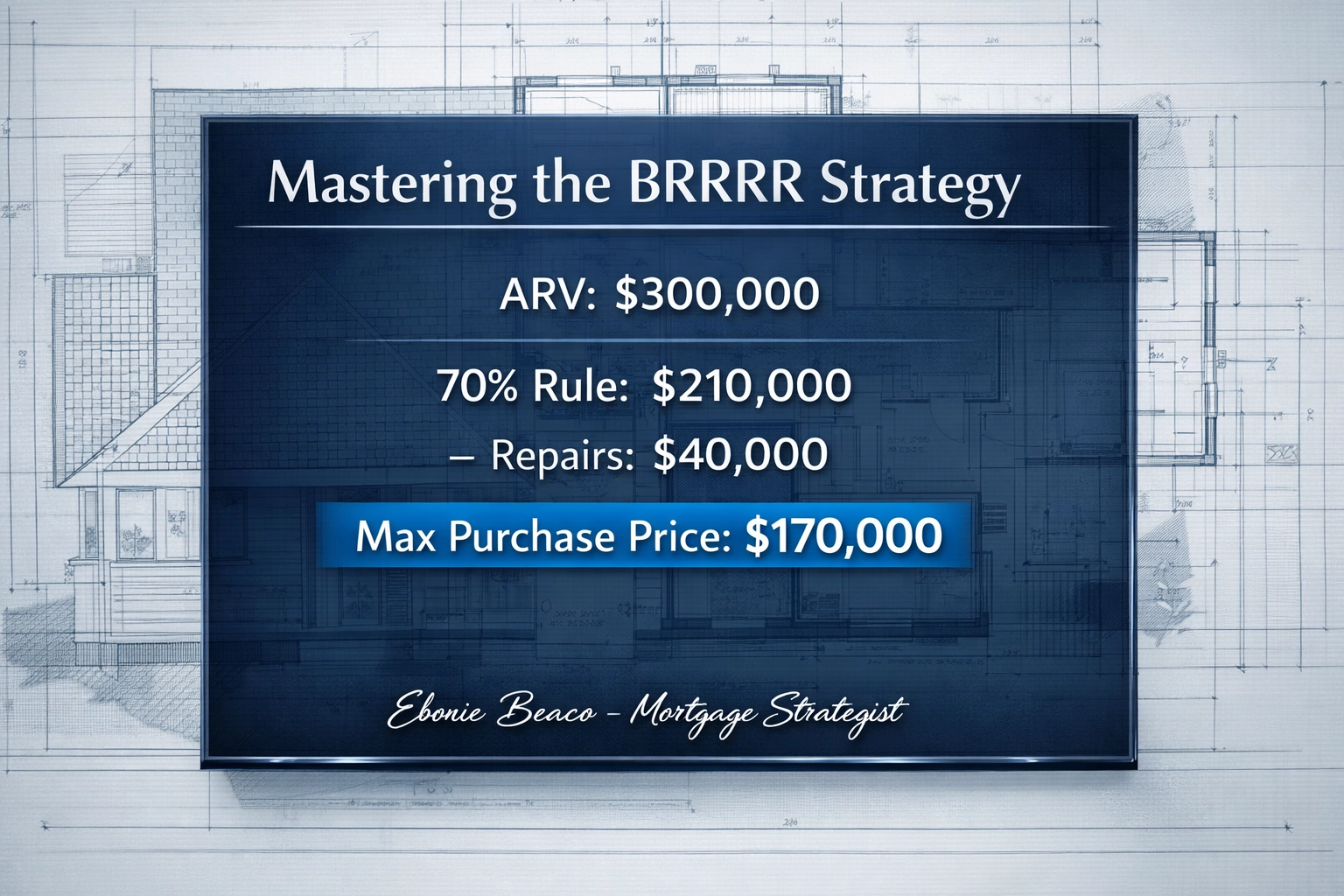 Image Instructions: Title "Mastering the BRRRR Strategy" at the top. Display the calculation: ARV ($300,000) x 70% = $210,000. $210,000 - $40,000 (Repairs) = $170,000 (Max Purchase Price). At the bottom: "Ebonie Beaco - Mortgage Loan Officer". No images of cash or money.
Step 2: Rehab
The goal of the rehab phase is twofold: make the property safe and functional for a tenant, and maximize the value for the appraiser. You are not building a dream home for yourself; you are creating a durable, attractive rental.
Focus on high-impact updates. Fresh paint, modern flooring, and updated kitchens or bathrooms provide the best return on investment. In states like Florida or Georgia, curb appeal and functional HVAC systems are also high priorities for appraisers. You can learn more about how different improvements impact your potential loan options at our mortgage basics page.
Step 3: Rent
Lenders generally want to see that a property is occupied before they allow a long-term refinance. Having a signed lease and a security deposit in hand proves that the property is an "income-producing asset."
The rental income is also a key factor if you plan to use a DSCR (Debt Service Coverage Ratio) loan. These loans are popular with BRRRR investors because they qualify the property based on the rental income rather than your personal tax returns. If the rent covers the mortgage payment (and then some), you are usually in good shape. You can check how your projected rent compares to a potential mortgage payment using our mortgage calculators.
Step 4: Refinance
This is where the magic happens. After the property is fixed up and rented, you reach out to a mortgage strategist to start the refinance process.
There are two main things to watch out for during this stage:
- Seasoning Requirements: Some traditional lenders require you to own the property for 6 to 12 months before they will let you refinance based on the new appraised value. However, many of our investor-focused programs, like DSCR loans, have much shorter seasoning periods: sometimes as low as 30 to 90 days.
- The Appraisal: The appraiser will look at recent sales of similar homes in the area (comps). This is why knowing your ARV ahead of time is so important.
If your ARV came in at $300,000 and the lender allows a 75% loan-to-value (LTV) refinance, your new loan amount would be $225,000.
Let’s look at the cash flow of the deal:
- You bought it for $170,000.
- You spent $40,000 on repairs.
- Your total "all-in" cost was $210,000.
- Your new loan is $225,000.
In this scenario, you just received $225,000, which pays back your original $210,000 and leaves you with an extra $15,000 in your pocket (minus closing costs). You now own a $300,000 asset with $0 of your own money left in it. This is often called a "Perfect BRRRR."
To explore how a refinance could work for your current project, visit our home refinance section.
Step 5: Repeat
Since you have your original $210,000 back in your bank account, you are ready to go find the next deal. This is how investors in Michigan, Indiana, and Illinois are scaling from one property to ten properties in just a few years. Instead of needing $500,000 in savings to buy ten houses, they are using the same $50,000 or $100,000 over and over again.
Why Transparency in Financing is Vital
The BRRRR strategy is a powerful tool, but it requires precise execution. You need to have a clear understanding of your closing costs, interest rates, and loan terms from the start. Transparency in your financing prevents "surprises" at the closing table that could eat into your profit.
Whether you are looking for a fix-and-flip loan to fund the initial purchase and rehab, or a long-term DSCR loan for the refinance, working with a strategist who understands the investor mindset is a game changer. We see a lot of investors in the Chicago market who use bridge loans for the "Buy and Rehab" phase and then transition into a 30-year fixed landlord loan.
Common Pitfalls to Avoid
Even though the strategy is straightforward, there are risks.
- Overestimating the ARV: If the appraisal comes in lower than you expected, you might not be able to pull all your cash out.
- Underestimating Repairs: Renovation costs can spiral. Always have a contingency budget.
- Market Shifts: If interest rates rise significantly during your rehab phase, your monthly payment on the refinance might be higher than you planned.
To help mitigate these risks, it is a good idea to stay informed about market trends and loan requirements. You can find more information on our FAQ page.
Putting It All Together
The BRRRR strategy isn't just for "professional" investors. Many current homeowners are using the equity in their primary residence: perhaps through a cash-out refinance: to fund their first BRRRR project. By tapping into existing equity, you can jumpstart your journey toward financial independence.
If you are ready to stop trading your time for money and start building a portfolio that works for you, the BRRRR method is a proven path. It requires patience, a good eye for deals, and a solid financing partner.
Need to refinance your next BRRRR project? Reach out to Ebonie Beaco at Home Loans Network.
Scedule a 1 on 1 at https://calendly.com/homeloansnetwork
Ebonie Beaco Mortgage Strategist | Senior Loan Officer Home Loans Network powered by Loan Factory Inc. NMLS #2389954 HomeLoansNetwork.com 312-392-0664