Bridging the Gap: Using Bridge Loans to Secure Properties as Sales Cycles Lengthen

The 2026 real estate landscape presents a specific set of challenges for both traditional homeowners and seasoned real estate investors. Data from Redfin indicates that national sales cycles have extended, with the average home now sitting on the market for 66 days or longer (Source: https://www.redfin.com/news/homebuyers-taking-their-time-2026/).
This slowdown creates a liquidity trap. You find the perfect replacement property or a high-yield investment opportunity, but your capital remains locked in an existing asset that refuses to move at the pace of your ambitions.
In high-demand regions like Virginia and Florida, waiting 66 days to close a sale often means losing your next acquisition to a more liquid buyer. As a mortgage strategist, I view the Bridge Loan not merely as a debt instrument, but as a critical tactical tool to preserve your momentum in a sluggish market.
Defining the Bridge Loan
A Bridge Loan is a short-term financing solution designed to provide immediate liquidity by leveraging the equity in a currently owned property to fund the acquisition of a new one.
This structure allows you to bypass the traditional "sale contingency" that often weakens offers in competitive markets. By securing these funds, you effectively become a cash-equivalent buyer, providing the seller of your target property with the certainty they require.
Navigating the 66-Day Market Stagnation
When properties sit for over two months, the standard "buy-sell" sequence breaks down. If you are a homeowner in Illinois or Michigan looking to relocate, or an investor in Georgia or Alabama eyeing a distressed asset, the 66-day wait period is a liability.
 Ebonie Beaco - Mortgage Strategist
Bridge financing mitigates this risk. Instead of waiting for a buyer to clear their inspections and financing, you access your existing equity today. This is particularly vital for Real Estate Investors and Wholesalers who operate on tight timelines where the speed of execution dictates the profitability of the deal.
Explore our Home Purchase options to see how speed influences your offer strength.
Strategic Advantages for Multi-State Investors
Whether you are managing a portfolio in Indiana, Missouri, or Kentucky, or searching for luxury builds in Florida, the ability to move without selling is a competitive edge.
Eliminating the Sale Contingency
Most sellers in the current market are wary of "subject to sale" offers. They prefer the shortest path to a closed transaction. A bridge loan removes the contingency, making your offer significantly more attractive than those tied to a 66-day (or longer) marketing period.
Preserving Capital in High-Growth Markets
In states like Virginia and Florida, property values often appreciate faster than the national average. By using a bridge loan to "lock in" a purchase price now, you benefit from future appreciation while your previous asset continues to benefit from market growth until its eventual sale.
Financial Breakdown: A Bridge Loan Case Study
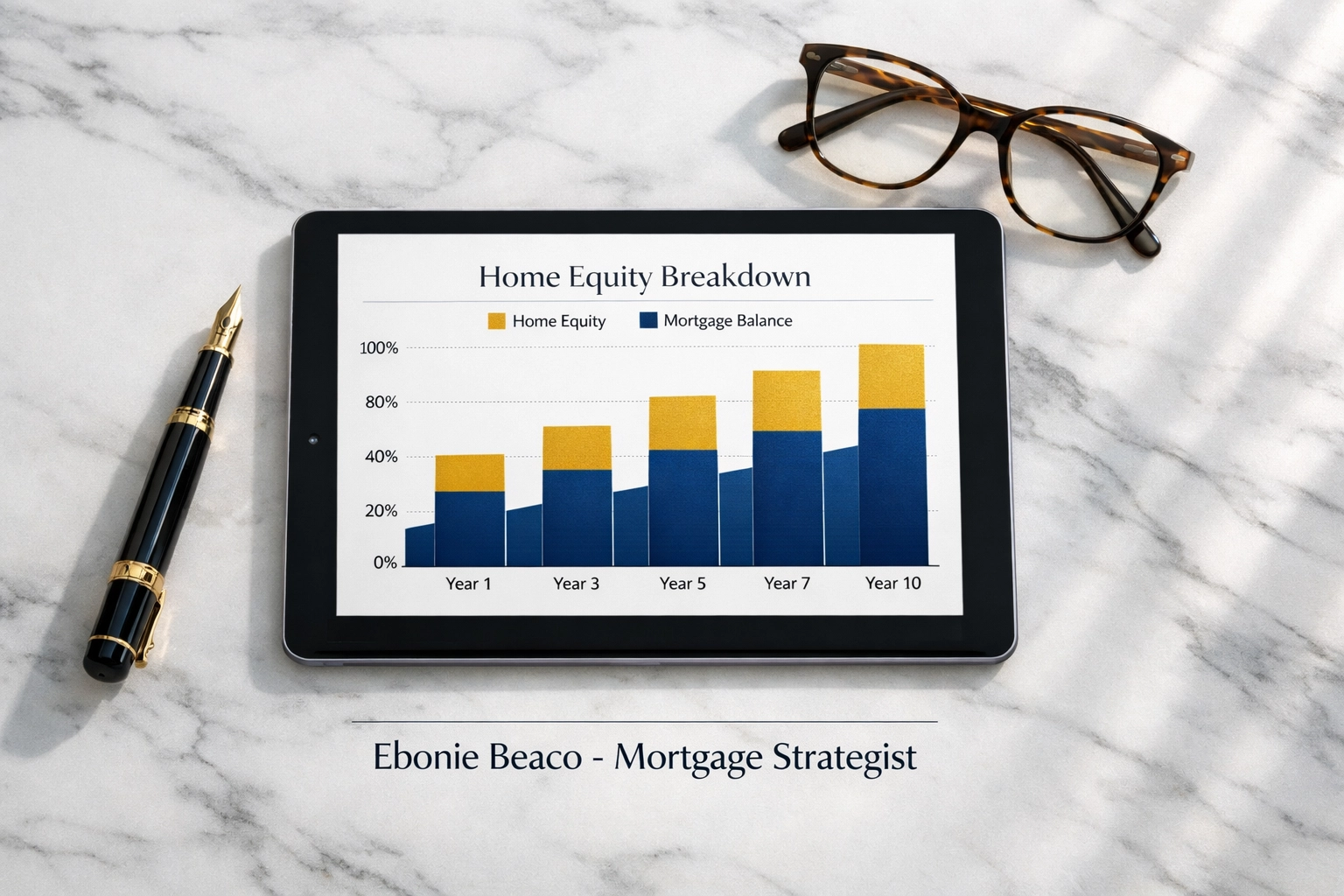
To understand the mechanics of this strategy, let’s look at a practical scenario involving a homeowner or investor with a primary asset and a desire to acquire a new property.
The Scenario:
- Existing Property Value: $750,000
- Current Mortgage Balance: $400,000
- Available Equity: $350,000
- New Property Purchase Price: $600,000
In this example, a strategist might structure a bridge loan at 75% Loan-to-Value (LTV) of the existing property.
- Total Bridge Loan Amount: $562,500 (75% of $750,000)
- Payoff of Existing Mortgage: $400,000
- Net Liquidity for New Purchase: $162,500 (Minus closing costs)
With $162,500 in hand, the buyer can place a substantial down payment on the new $600,000 property, securing a new mortgage with favorable terms without having to wait for the 66-day sales cycle of their $750,000 home to conclude.
 Ebonie Beaco - Mortgage Strategist
Access our Mortgage Calculators to run your own scenarios and see how your equity can be deployed.
Bridge Loans vs. Traditional Liquidity Options
It is essential to compare bridge financing against other methods of equity extraction to determine which fits your specific profile.
Bridge Loans vs. HELOCs
A HELOC (Home Equity Line of Credit) is an excellent tool for ongoing access to funds. However, many lenders will not approve a HELOC if the home is already listed for sale. Bridge loans are specifically designed for properties that are on the market or about to be, making them the superior choice for active sellers.
Bridge Loans vs. Cash-Out Refinancing
A Cash-Out Refinance involves replacing your entire primary mortgage with a new, larger loan. While this can provide liquidity, the closing costs and long-term interest rates may be higher than a short-term bridge loan intended to be repaid within 6 to 12 months.
Use Cases for Real Estate Professionals
For Realtors, Wholesalers, and Real Estate Investors, understanding bridge financing is a way to "save the deal."
- Realtors: When a client’s home is sitting for 66+ days and they are at risk of losing their dream home, suggesting a bridge loan keeps the transaction alive.
- Wholesalers: If you have a motivated seller who needs to move but cannot afford the down payment on their next place, a bridge loan provides the exit strategy they need.
- Fix-and-Flip Investors: Bridge loans provide the quick capital needed to acquire distressed assets in Alabama or Arkansas before traditional bank financing can even get through the appraisal stage.
 Ebonie Beaco - Mortgage Strategist
Technical Requirements and Terms
Bridge loans are typically Non-QM (Non-Qualified Mortgage) products. This means they do not always follow the rigid debt-to-income (DTI) requirements of Fannie Mae or Freddie Mac.
- Duration: Usually 6 to 12 months.
- Interest Rates: Typically higher than conventional 30-year fixed rates, reflecting the short-term nature and convenience of the capital.
- Payments: Often interest-only, which helps manage monthly cash flow while both properties are held.
- Collateral: The loan is secured by your existing property, and sometimes cross-collateralized with the new purchase.
For those with complex income structures, such as self-employed investors, exploring Interest Only Mortgage options alongside bridge financing can maximize cash flow during the transition period.
Executing the Strategy in 2026
The current market does not reward hesitation. With homes taking longer to sell, the gap between your current position and your next goal is widening.
If you are a homeowner in Florida or an investor in Virginia, you must recognize that the 66-day average is a benchmark, not a guarantee. Some properties may take much longer. Relying on a traditional sale to fund your next move is a high-risk strategy in an environment where sales cycles are lengthening.
 Ebonie Beaco - Mortgage Strategist
By utilizing a bridge loan, you reclaim control over your timeline. You decide when to buy, and you allow the market the necessary time to find the right buyer for your existing property without the pressure of a looming deadline.
Conclusion: Take the Lead in a Slow Market
Success in real estate finance requires a shift in perspective. Instead of viewing a slow market as a barrier, view it as an opportunity to use more sophisticated financing tools.
Bridge loans provide the liquidity, flexibility, and speed required to navigate the complexities of today’s housing market across Alabama, Arkansas, Georgia, Florida, Illinois, Indiana, Michigan, Kentucky, Missouri, and Virginia.
Stop letting market stagnation dictate your growth. Analyze your equity, calculate your needs, and bridge the gap to your next successful transaction.
Compare your options and learn more about our Loan Process to see how we handle complex bridge scenarios.
Schedule a 1 on 1 at https://calendly.com/homeloansnetwork
Ebonie Beaco Mortgage Strategist | Senior Loan Officer Home Loans Network powered by Loan Factory Inc. NMLS #2389954 HomeLoansNetwork.com 312-392-0664