Bridge Loans vs. Hard Money: Choosing the Right Fast Financing
Speed is often the most valuable currency in the real estate world. Whether you are a fix-and-flip investor in Chicago trying to beat out a dozen other offers or a homeowner in California trying to buy a new property before your current one sells, traditional bank financing often moves too slow.
When you need to move quickly, you typically look at two primary options: Bridge Loans and Hard Money Loans.
While people often use these terms interchangeably, they serve different purposes and come with different expectations. Understanding the nuances allows you to choose the right tool for your specific transaction.
Explore the mechanics of these short-term financing strategies to see which one aligns with your next move.
Defining the Terms
Bridge Loan: A short-term loan used to "bridge" the gap between the immediate need for funds and the availability of long-term financing or the sale of an existing asset.
- Practical Application: Homeowners use these to buy a new residence using the equity in their current home while waiting for that home to sell.
Hard Money Loan: A specific type of asset-based financing where a borrower receives funds secured by real property, typically issued by private investors or companies rather than banks.
- Practical Application: Real estate investors use these to purchase distressed properties, fund renovations, and exit quickly via resale or refinancing.
Jump in to the mortgage basics to understand how these fit into the broader lending landscape.
The Collateral Difference
The fundamental difference between these two options usually starts with what is securing the loan.
Bridge loans are often secured by the equity in a property you already own. For example, if you own a home in Virginia and want to relocate to Florida, you might use a bridge loan to access your Virginia home's equity to put a down payment on the Florida property.
Hard money loans are almost always based on the value of the property being purchased. Hard money lenders look at the "as-is" value or the "after-repair value" (ARV) of the subject property.
They care less about your overall portfolio and more about the specific deal in front of them.
 Image Title: Bridge Loans vs. Hard Money: Collateral Comparison. Ebonie Beaco - Mortgage Loan Officer.
Credit and Qualification Standards
If you are looking for the path of least resistance regarding your credit score, hard money is usually the winner.
Hard Money Requirements:
- Focus is on the property value.
- Credit scores can often be lower (sometimes even in the 500s).
- Income verification is often minimal because the property’s potential is the primary security.
Bridge Loan Requirements:
- Requires a more traditional underwriting approach.
- Credit scores typically need to be in the 700 to 740 range.
- Lenders will check your debt-to-income (DTI) ratio to ensure you can carry the debt of both properties if necessary.
For many investors, especially those utilizing DSCR rental property loans later, starting with a hard money loan is a way to bypass strict personal income requirements during the acquisition phase.
Speed of Execution
How fast do you really need the capital?
Hard money loans are the sprinters of the lending world. Because the lender is private and focused on the asset, you can often get funded in 7 to 14 days. This speed is why wholesalers and flippers in competitive markets like Atlanta or Chicago rely on them so heavily.
Bridge loans involve a bit more due diligence. Since they often involve primary residences or more complex equity structures, they may take 15 to 45 days to close. While faster than a traditional 30-year mortgage, they aren't always fast enough for a "must-close-next-week" scenario.
Compare your timing needs by visiting our FAQ page.
Interest Rates and Cost Structures
Neither of these options is "cheap" in the traditional sense, but they are efficient. You are paying for speed and accessibility.
Bridge Loan Costs:
- Interest rates typically range from 8% to 12%.
- Origination fees are common.
- Best for borrowers who have strong credit and clear exit strategies.
Hard Money Costs:
- Interest rates typically range from 9% to 13% or higher.
- Points (origination fees) are standard, often ranging from 1 to 3 points.
- Best for high-risk, high-reward renovation projects.
Access our mortgage calculators to see how these rates impact your short-term carry costs.
Real-World Example: The Bridge Scenario
Imagine you own a home in Michigan valued at $400,000. You owe $200,000 on your current mortgage. You find your dream home in Indiana for $500,000, but the seller won't accept a "contingent on sale" offer.
You use a bridge loan to access $100,000 of your Michigan equity for the down payment and closing costs on the Indiana home.
The Math:
- Michigan Home Value: $400,000
- Current Mortgage: $200,000
- Bridge Loan Amount: $100,000 (Based on equity)
- Remaining Equity: $100,000
- New Indiana Purchase: $500,000 ($100k down / $400k new mortgage)
This allows you to move into the Indiana home while your Michigan home is still on the market. Once the Michigan home sells, you pay off the $100,000 bridge loan and the $200,000 original mortgage.
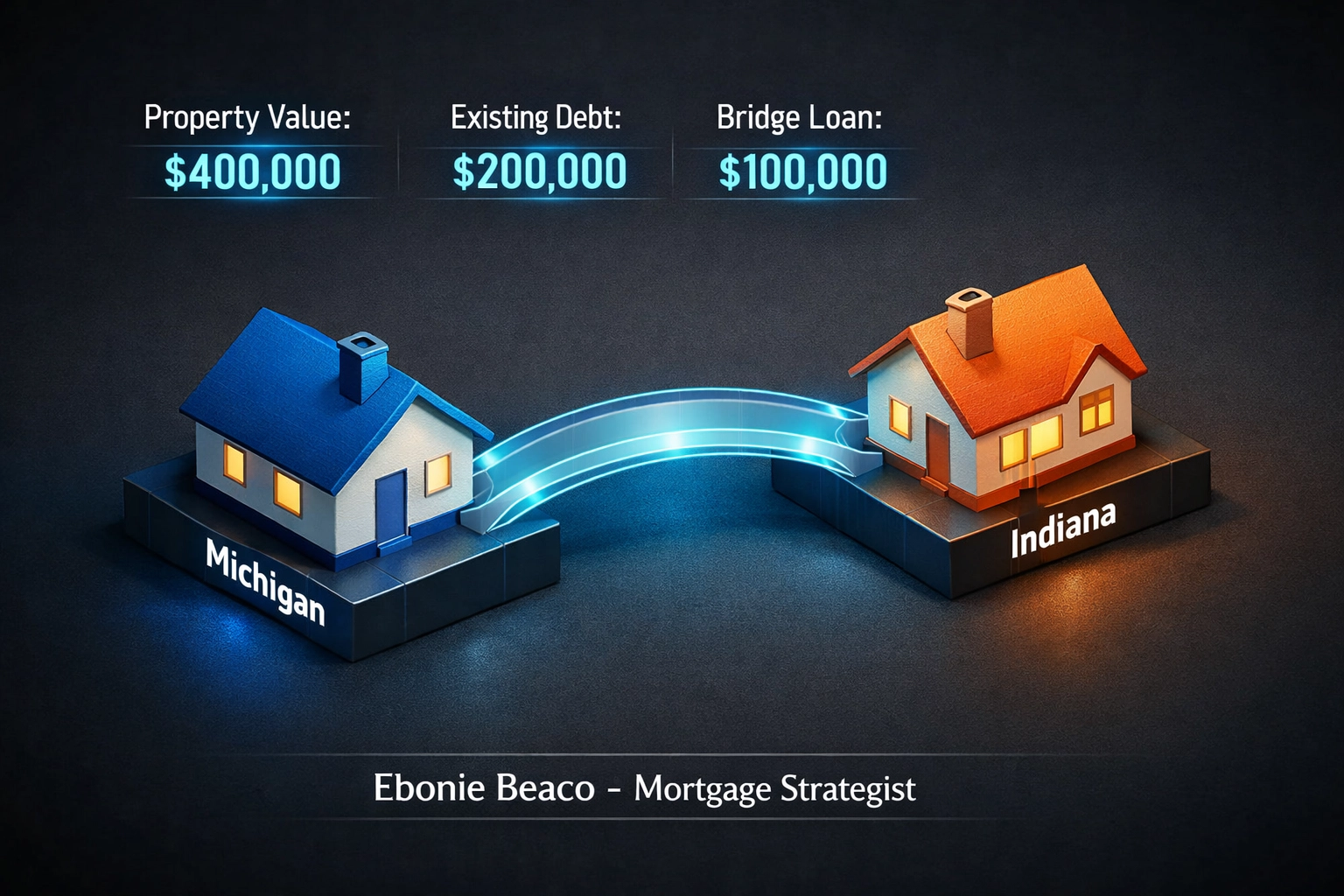 Image Title: Bridge Loan Equity Strategy. Michigan Property Value: $400,000. Existing Debt: $200,000. Bridge Loan: $100,000. Ebonie Beaco - Mortgage Loan Officer.
Real-World Example: The Hard Money Scenario
Now, imagine you are an investor in Chicago looking at a distressed two-unit building. The purchase price is $200,000, but it needs $60,000 in renovations. The After-Repair Value (ARV) is projected to be $350,000.
A traditional bank likely won't touch this because the kitchen is gutted and the roof is leaking.
The Math:
- Purchase Price: $200,000
- Renovation Budget: $60,000
- Hard Money Loan (75% of ARV): $262,500
- Funds Provided at Closing: $200,000 (Purchase) + $62,500 (Escrowed for repairs)
- Investor Contribution: Closing costs and a small portion of interest carry.
The investor completes the repairs in four months and then does a cash out refinance into a long-term rental loan.
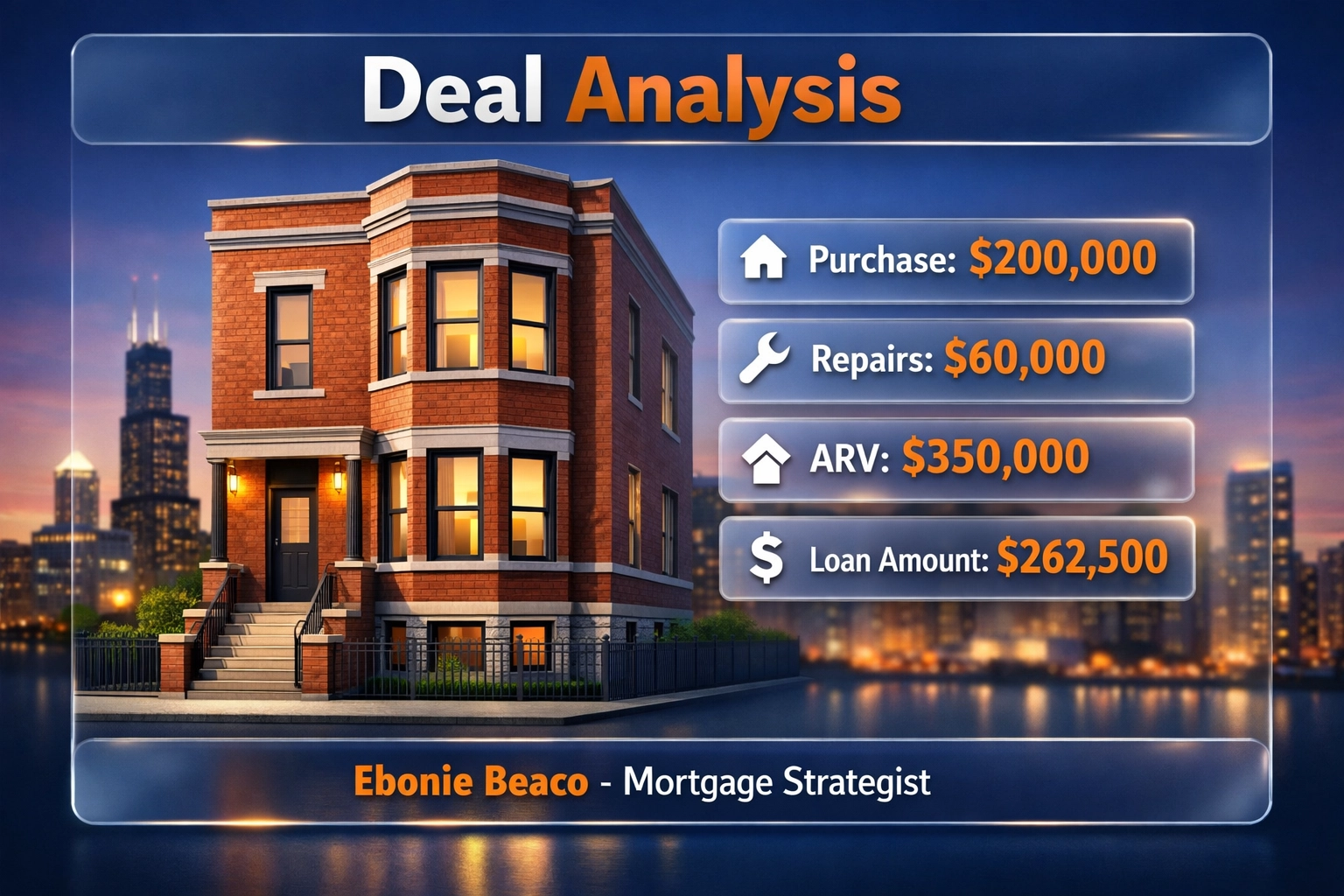 Image Title: Hard Money Fix-and-Flip Calculation. Purchase: $200,000. Repairs: $60,000. ARV: $350,000. Loan Amount: $262,500. Ebonie Beaco - Mortgage Loan Officer.
Choosing Your Financing Path
How do you decide which one is right for you? It boils down to your goals and your current financial profile.
Select a Bridge Loan if you:
- Are a homeowner buying a new primary residence before selling the old one.
- Have a credit score above 700.
- Have significant equity in an existing property.
- Are comfortable with slightly more documentation.
Select a Hard Money Loan if you:
- Are an investor doing a fix-and-flip or heavy renovation.
- Need to close in under two weeks.
- Have a lower credit score or unconventional income.
- Are buying a property that is currently "uninhabitable" by bank standards.
Regardless of which path you take, both require a solid exit strategy. Whether it is selling the property or refinancing into a traditional home purchase loan, you must know how you will pay the loan back before you sign the paperwork.
Why Local Market Knowledge Matters (Wait, Rules Apply!)
In states like Florida or Virginia, the market moves incredibly fast. In Chicago, the inventory of distressed properties is a primary driver for investor activity. Knowing the local customs for appraisals and title work can save you days on your closing timeline.
Working with a strategist who understands the specific nuances of Alabama, Arkansas, or Kentucky can be the difference between a winning bid and a missed opportunity.
Access our about us page to learn how we support investors across these diverse markets.
Moving Forward with Confidence
Financing is the engine of your real estate business or your home-buying journey. Using the wrong fuel: choosing a slow loan for a fast deal or a high-cost loan for a low-risk situation: can stall your progress.
Bridge loans provide the stability to transition between homes. Hard money provides the raw power to seize investment opportunities that traditional banks ignore.
If you are unsure which structure fits your specific scenario, it helps to walk through the numbers with someone who sees these deals every day.
Contact Ebonie Beaco for fast financing advice or mentoring at www.homeloansnetwork.com.
If you're ready to look at a specific scenario, you can start the process or check out our online forms.
Explore your options. Compare the numbers. Access the capital you need to grow.
Scedule a 1 on 1 at https://calendly.com/homeloansnetwork
Ebonie Beaco Mortgage Strategist | Senior Loan Officer Home Loans Network powered by Loan Factory Inc. NMLS #2389954 HomeLoansNetwork.com 312-392-0664