Atlanta Wholesaling Secrets Revealed: What Experts Don't Want You to Know About Finding Off-Market Deals
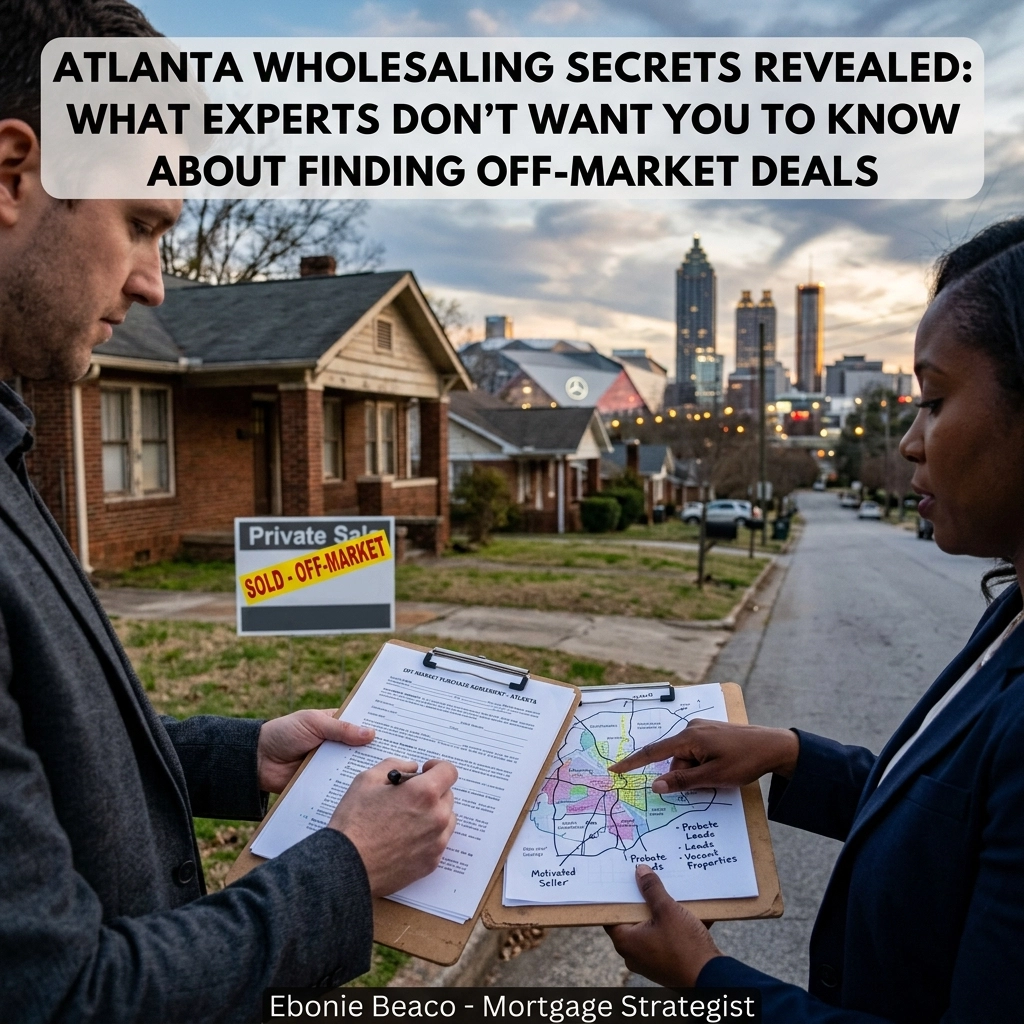
Atlanta remains one of the most competitive markets for real estate investors.
Whether you are scouting neighborhoods in Buckhead or looking for distressed assets in Decatur, the search for the perfect deal often leads to the world of wholesaling.
Many people believe wholesaling is a get-rich-quick scheme.
The reality is that successful wholesaling in Georgia, Florida, and California requires a deep understanding of off-market dynamics and professional networking.
Defining the Core Concepts
Real Estate Wholesaling: The process where an individual, known as the wholesaler, contracts a distressed property with a seller and then assigns that contract to an end buyer for a profit.
Practical Application: You use this strategy to generate immediate capital without the need for traditional mortgage basics or long-term property management.
Off-Market Properties: Real estate assets that are available for purchase but are not listed on public platforms like the Multiple Listing Service (MLS).
Practical Application: Finding these properties allows you to avoid bidding wars and negotiate directly with motivated sellers.
Assignment Fee: The dollar amount paid by the end buyer to the wholesaler for the right to step into the original purchase agreement.
Practical Application: This fee represents your gross profit for sourcing and securing the deal.
Distressed Property: A home that is under a foreclosure order, held by a bank, or in poor physical condition.
Practical Application: These properties provide the highest potential for equity growth after renovation.
The Myth of the Deep Discount
Many "experts" suggest that every off-market deal is a massive bargain.
In markets like Atlanta and Florida, the data suggests otherwise.
Recent market activity shows that off-market properties often command a 5% to 10% premium over comparable MLS listings.
This happens because the value is found in the speed and certainty of the transaction, not just the purchase price.
When an investor buys off-market, they often pay for the convenience of avoiding a 30-day closing cycle or appraisal contingencies.
You can learn more about how appraisals impact traditional sales to see why investors value the off-market alternative.
Strategies for Finding Off-Market Deals in Atlanta
Finding deals requires a proactive approach to lead generation.
Jump in to these proven methods to build your pipeline in Georgia and beyond:
- Driving for Dollars: Identifying vacant or neglected homes while physically traveling through specific neighborhoods.
- Direct Mail Campaigns: Sending personalized letters to property owners with high equity or those facing foreclosure.
- Networking with Local Attorneys: Connecting with probate and divorce lawyers who manage estates that need to be liquidated quickly.
- Cold Calling: Reaching out to owners of "zombie" properties to gauge their interest in a cash offer.
Lead Generation in Florida and California
Florida real estate investing often centers on distressed waterfront properties or aging retirement communities.
In California, the focus shifts toward high-equity owners who want to avoid the public spectacle of an MLS listing.
Explore these regional differences to refine your strategy:
- Florida Markets: Target high-density areas like Tampa or Orlando where short-term rental potential remains high.
- California Markets: Focus on pre-foreclosure leads where owners may have significant equity but are facing temporary financial hardship.
Understanding the Assignment Process
The mechanics of a wholesale deal rely on the Assignment Contract.
This document allows you to transfer your interest in a property to another investor.

Jump in to the steps of a typical transaction:
- Identify a Seller: Locate a motivated homeowner willing to sell below market value for a quick exit.
- Negotiate the Contract: Secure the property under a purchase agreement with an "assignment clause" included.
- Find an End Buyer: Market the deal to your list of cash buyers, landlords, or fix-and-flip investors.
- Execute the Assignment: Sign the assignment contract with the buyer and collect your non-refundable earnest money deposit.
- Close the Deal: The end buyer completes the purchase with the seller, and you receive your assignment fee.
Calculating the Assignment Fee: A Real-World Example
To understand the financial viability of a deal, you must perform accurate calculations.
Consider an Atlanta property with an After Repair Value (ARV) of $200,000.
If the property needs $30,000 in repairs and the investor wants a 20% profit margin, the Maximum Allowable Offer (MAO) might be $115,000.
If you secure the contract at $100,000, your assignment fee is the difference.

In this scenario:
- Contract Price: $100,000
- Investor Purchase Price: $115,000
- Wholesale Assignment Fee: $15,000
This $15,000 is earned for the work of sourcing the lead and managing the contract flow.
How Investors Finance Wholesale Deals
Wholesalers do not usually need financing, but their buyers do.
If you are the end buyer, you need to know which loan products allow for quick closings.
Compare these popular financing options for investment properties:
- Hard Money Loans: Short-term, asset-based loans used primarily for fix-and-flip projects.
- DSCR Investor Loans: Loans qualified based on the property's rental income rather than your personal credit or income.
- Bridge Loans: Temporary financing used to "bridge" the gap until long-term financing or a sale occurs.
- Fix and Flip Loans: Specifically designed for renovation projects, often covering both the purchase and the construction costs.
You can use mortgage calculators to estimate the monthly carrying costs for these loan types.
The Role of DSCR Loans in Wholesaling
Debt Service Coverage Ratio (DSCR) loans are a favorite for investors buying from wholesalers.
These loans focus on the property's ability to generate enough rent to cover the mortgage payment.
Access the benefits of DSCR financing:
- No Tax Returns Required: Ideal for self-employed investors or those with complex tax profiles.
- Quick Approval: Often faster than traditional bank financing, allowing you to meet tight wholesale deadlines.
- Scalability: Investors can hold multiple DSCR loans to build a large portfolio across states like Georgia and Virginia.

Accessing Equity for Future Deals
Established homeowners often use their current property to fund their first wholesale purchase.
A home-refinance or a cash-out refinance allows you to tap into the equity of your primary residence.
Explore the equity extraction process:
Imagine you own a home in Atlanta worth $500,000 with a $200,000 mortgage balance.
Depending on the loan-to-value (LTV) limits, you might access $150,000 or more in liquid cash.
This capital can be used as earnest money or to fund the marketing budget for your wholesaling business.
Why Your Reputation is the Real Secret
The "secret" that experts won't tell you is that your professional network is your greatest asset.
In the Atlanta market, wholesalers who fail to close on their contracts quickly gain a negative reputation.
Compare the characteristics of a successful wholesaler versus an amateur:
- The Professional: Has a vetted buyer list, understands local foreclosure laws, and only puts deals under contract that they know will sell.
- The Amateur: Puts any property under contract regardless of value, uses high-pressure tactics on vulnerable sellers, and disappears if they cannot find a buyer.
Building a reputation as a reliable closer ensures that agents and other wholesalers will bring you the best off-market deals first.
Moving Forward in the Atlanta Market
The Atlanta real estate landscape offers immense opportunities for those who understand the nuances of off-market sourcing and creative financing.
Whether you are interested in a home-purchase for yourself or building an investment empire, the fundamentals of deal-finding remain consistent.
Access more resources by visiting our FAQ page or reviewing our testimonials from successful investors.
If you are ready to explore financing options for your next deal, you can select a loan officer to discuss your specific scenario.
Understanding how to navigate these transactions is the first step toward long-term wealth in real estate.
Compare your financing options and start your journey today.
Schedule a 1 on 1 at https://calendly.com/homeloansnetwork
Ebonie Beaco
Mortgage Strategist | Senior Loan Officer
Home Loans Network powered by Loan Factory Inc.
NMLS #2389954
HomeLoansNetwork.com
312-392-0664