ARV Unlocked: The Number One Calculation for Wholesale Real Estate Success
You are walking through an off-market deal in Chicago or a suburban neighborhood in Virginia, trying to determine if the numbers align for a profitable wholesale flip. Wholesaling houses requires more than just finding a distressed property; it demands a precise understanding of the potential exit price for your cash buyers. This exit price is known as the After Repair Value, or ARV, and it serves as the absolute foundation for every calculation you will perform as a real estate investor. Without an accurate ARV, you risk overpaying for a property or presenting a deal to your buyers that lacks sufficient equity to justify their investment. Successful wholesalers in competitive markets like Florida or Georgia distinguish themselves by providing data-backed valuations that build trust with their acquisition partners. You must view the ARV as the target that dictates every other variable in your real estate investing journey. Exploring this metric with clinical precision ensures that your assignment fees remain protected and your reputation in the local market stays unblemished.
After Repair Value (ARV): An estimation of a property's total market value after all necessary renovations, repairs, and upgrades have been fully completed. This figure represents what a retail buyer would likely pay for the home on the open market if it were in top-tier condition compared to other local listings. You calculate this by looking at recent sales of similar homes, which helps you understand the ceiling price for your specific investment property. Understanding this value allows you to work backward from the finish line to determine what you can afford to pay today. Most real estate investors utilize this number to gauge the overall health of a fix and flip or a long-term rental acquisition. Accessing accurate data through professional tools or local realtor partners is the first step in ensuring your ARV is rooted in reality rather than optimism. You can find more foundational information on valuation by visiting our mortgage basics page to sharpen your financial literacy.
The most effective way to determine an accurate ARV is by conducting a Comparative Market Analysis (CMA) using recent sales data. You should look for properties within a one-mile radius that have sold within the last three to six months to ensure the data is current. These "comps" must share similar characteristics such as square footage, bedroom count, and architectural style to be considered valid. In cities like Indianapolis or Detroit, property values can change significantly from one block to the next, so staying within the immediate neighborhood is vital. You should aim to find at least three solid comparable properties that were sold in fully renovated condition to establish your target price point. If the comps in the area are selling for $350,000 after being updated, that becomes your baseline for your subject property’s ARV. Jump in and study the local home purchase trends to understand what retail buyers are currently prioritizing in your specific market.
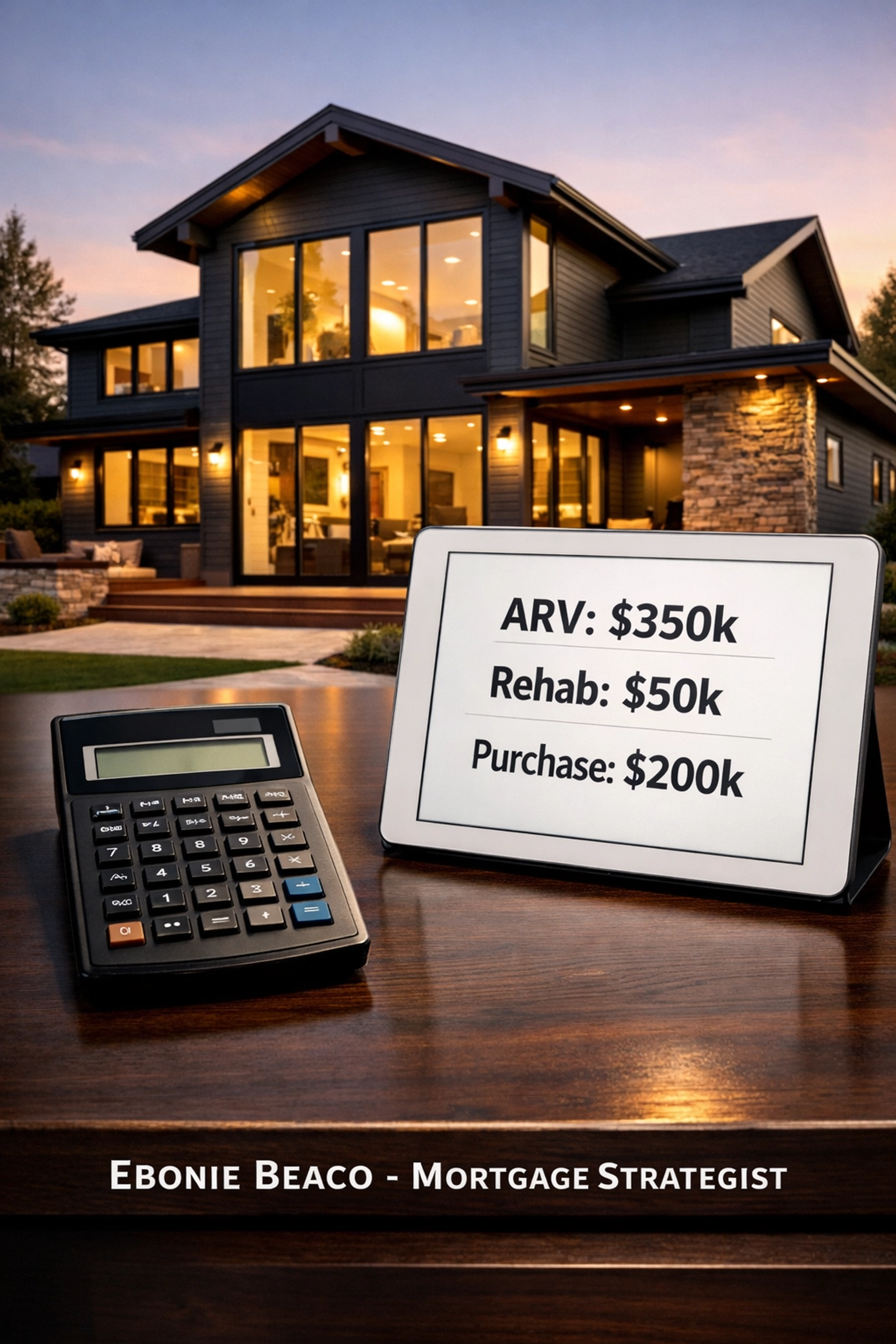
A realistic image of a modern residential house next to a high-end calculator on a wooden desk. Visible deal numbers are overlaid on the image: ARV: $350k, Rehab: $50k, Purchase: $200k. The image features a professional branding footer at the bottom that reads "Ebonie Beaco - Mortgage Strategist". No cash, coins, or currency symbols are visible.
Estimating renovation costs is the second critical component of the ARV equation, as it determines how much of that projected value is eaten up by construction. You do not need to be a licensed contractor to develop a working knowledge of repair costs, but you must be thorough in your assessment. This includes accounting for structural repairs, cosmetic updates like flooring and paint, and mechanical systems like HVAC or plumbing. In wholesale real estate, your cash buyers will conduct their own inspections, so your initial estimate needs to be as realistic as possible to maintain credibility. Underestimating these costs is a common mistake that can turn a seemingly great deal into a financial burden for the end investor. You should develop a standardized checklist to ensure you never overlook major expenses like roof replacements or foundation work during your walkthrough. Comparing your estimates with actual contractor quotes on previous deals will help refine your accuracy over time as you scale your business.
The 70% Rule is a widely accepted industry standard that helps you determine the maximum allowable offer (MAO) for a distressed property. By multiplying the ARV by 0.70 and then subtracting the estimated repair costs, you create a buffer that accounts for holding costs, closing fees, and profit margins. This formula protects the interests of your cash buyers while leaving room for your wholesale assignment fee. In high-demand markets like California or parts of Indiana, some investors might adjust this percentage to 75% or 80% due to low inventory. However, adhering to the 70% guideline remains the safest way to ensure a deal is attractive to the widest possible range of buyers. You should always prioritize these conservative calculations to mitigate the risks associated with market fluctuations or unexpected renovation hurdles. Using this mathematical framework allows you to present deals with confidence and clarity to any serious investor or select loan officer you partner with.
Let us look at a practical example using the numbers displayed in the visual above to see how this math functions in a real-world scenario. Imagine you find a property in a growing neighborhood where fully renovated homes are selling for an ARV of $350,000. After a thorough walkthrough, you estimate that the property requires $50,000 in renovations to reach that top-market condition. Using the 70% Rule, you first multiply the $350,000 ARV by 0.70, which gives you a starting figure of $245,000. You then subtract the $50,000 rehab estimate, leaving you with a Maximum Allowable Offer of $195,000 for your buyer. If you secure the property for a purchase price of $200,000, you are slightly above the strict 70% rule, but the deal may still be highly lucrative depending on the buyer's specific exit strategy. This level of transparency in your numbers helps your buyers see the potential for profit immediately, making it easier for them to commit to the deal.
Your ability to calculate ARV accurately also dictates whether your cash buyers can secure the necessary financing to close the deal. Many investors utilize DSCR loans or fix-and-flip bridge financing, which are heavily dependent on the property’s appraised value and its future income potential. If your ARV is inflated, the bank’s appraisal will come in low, potentially killing the deal during the underwriting process. By providing a realistic ARV from the start, you ensure that the loan process moves smoothly for your acquisition partners. Understanding how lenders view these numbers allows you to pre-vet your deals and only present the ones that are likely to get funded. You can explore different loan programs to see how investors leverage debt to maximize their returns on the deals you provide. This knowledge positions you as a strategic partner rather than just a source of off-market leads.
Mastering the ARV calculation is the bridge that takes you from being a novice to a professional wholesaler who commands respect in the industry. As you become more comfortable with these numbers, you might decide to move beyond wholesaling and begin funding your own fix-and-flip projects or rental portfolios. The same principles of valuation apply whether you are assigning a contract or seeking a home refinance for a long-term hold property. Consistency in your math builds a foundation of trust with lenders, buyers, and sellers alike across every state from Michigan to Arkansas. You should continue to educate yourself on market shifts and lending criteria to ensure your calculations stay relevant in an ever-changing economic landscape. If you are ready to take the next step in your real estate career, reach out to discuss how we can structure your next deal for maximum success. Compare your options and stay informed by checking our FAQ for more professional investment insights.
Meta Title: ARV Unlocked: The Number One Calculation for Wholesale Real Estate Success
Meta Description: Master After Repair Value (ARV) to ensure your wholesale real estate deals are profitable every time. Learn the exact math today.
📞 Work With Ebonie Beaco
If you are a wholesaler looking to:
- Close more deals
- Connect your buyers with financing
- Structure deals that actually get approved
- Learn how to grow into a real estate investor
I can help you every step of the way.
Scedule a 1 on 1 at https://calendly.com/homeloansnetwork
Ebonie Beaco
Mortgage Strategist | Senior Loan Officer
Home Loans Network powered by Loan Factory Inc.
NMLS #2389954
📱 Phone: 312-392-0664
🌐 Website: HomeLoansNetwork.com/contact-us
👉 Whether you need lending, deal structuring, or mentorship, reach out today.