Are You Making These Common HELOC Mistakes? The Truth About Tapping Into Equity for Renovations

You walk through your front door and see a kitchen that hasn't changed since the nineties. You envision granite countertops, a farmhouse sink, and an open floor plan that actually lets you breathe. You know your home has increased in value over the last few years, and you are ready to tap into that equity.
A Home Equity Line of Credit (HELOC) seems like the perfect solution. It is flexible, accessible, and often carries lower interest rates than a credit card or personal loan. But before you swing that sledgehammer or sign on the dotted line, you need to know the truth. HELOCs are powerful tools, but they are also packed with potential pitfalls that can turn your home renovation dream into a financial headache.
As a Mortgage Strategist, I see homeowners in states like Indiana, Kentucky, and Illinois make the same avoidable errors every single week. Whether you are looking for an Indiana HELOC lender to fix up a property in Indianapolis or searching for a Kentucky HELOC lender to renovate a Louisville rental, the rules of the game remain the same.
Let’s dive into the mistakes that could cost you thousands and how to navigate the equity landscape like a pro.
What is a HELOC?
Home Equity Line of Credit (HELOC): A revolving line of credit secured by your home that allows you to borrow against your equity as needed.
- Practical Benefit: You only pay interest on the money you actually spend, making it ideal for ongoing renovation projects where costs are spread out over time.
Mistake #1: Underestimating the Variable Rate Rollercoaster
Most HELOCs come with variable interest rates. These rates are typically tied to the Prime Rate. When the Federal Reserve adjusts interest rates, your HELOC payment follows suit.
Many homeowners look at the initial "teaser" rate and assume that is what they will pay forever. This is a dangerous assumption. If you are in Michigan or Virginia and the market shifts, your monthly payment could jump significantly in a very short window.
Explore the fine print of your agreement. Look for the "lifetime cap," which is the maximum interest rate the lender can legally charge you. If you cannot afford the payment at that maximum cap, you might want to reconsider the loan size or look into a fixed-rate mortgage option instead.

Mistake #2: The Renovation Tax Trap
There is a common myth that all HELOC interest is tax-deductible. This is not entirely true.
Under current tax laws, you can only deduct HELOC interest if the funds are used to buy, build, or substantially improve the home that secures the loan. If you use your HELOC to pay off high-interest credit cards or buy a new car, that interest is generally not deductible.
Furthermore, you must use the funds directly for the improvements. If you pay for your bathroom remodel using a credit card to get points, and then use the HELOC to pay off that credit card, the IRS might not see that as a qualifying expense. Always keep meticulous records of your contractor invoices and material receipts.
Mistake #3: Treating Your Equity Like a Piggy Bank
Because a HELOC works like a credit card, it is tempting to use it for non-essentials.
Secure your financial future by keeping your renovation budget strict. Over-borrowing is one of the quickest ways to erode the wealth you’ve built in your property. If you are a real estate investor in Florida or Georgia, you know that equity is your leverage for future deals. Spending it on a luxury vacation instead of a property-value-boosting renovation is a strategic error.
Remember: Your home is the collateral. If you cannot make the payments because you overextended yourself on "lifestyle" purchases, the lender has the right to initiate foreclosure.
Mistake #4: Forgetting the Repayment Phase
A HELOC typically has two phases: the Draw Period and the Repayment Period.
- Draw Period: The timeframe (usually 5 to 10 years) during which you can withdraw funds and often make interest-only payments.
- Repayment Period: The phase (often 10 to 20 years) where you can no longer access funds and must pay back both principal and interest.
The transition from the draw period to the repayment period is often referred to as "payment shock." Imagine your monthly payment moving from $200 of interest to $1,200 of principal and interest overnight.
Access our mortgage calculators to see how different balance amounts will look once the repayment period kicks in. Planning for this shift today prevents a crisis five years from now.
Real-World Example: The Indiana Kitchen Remodel
Let’s look at how a homeowner in Indiana might use a HELOC strategically versus making a common mistake.
The Scenario:
- Home Value: $400,000
- Current Mortgage Balance: $250,000
- Lender LTV (Loan-to-Value) Limit: 80%
- Renovation Cost: $50,000
The Calculation:
First, we find the maximum total debt the lender allows.
$400,000 (Value) x 0.80 (LTV) = $320,000 Max Total Debt.
Next, we subtract the existing mortgage.
$320,000 - $250,000 = $70,000 Available Equity for a HELOC.
The homeowner takes out a $50,000 HELOC for the kitchen.
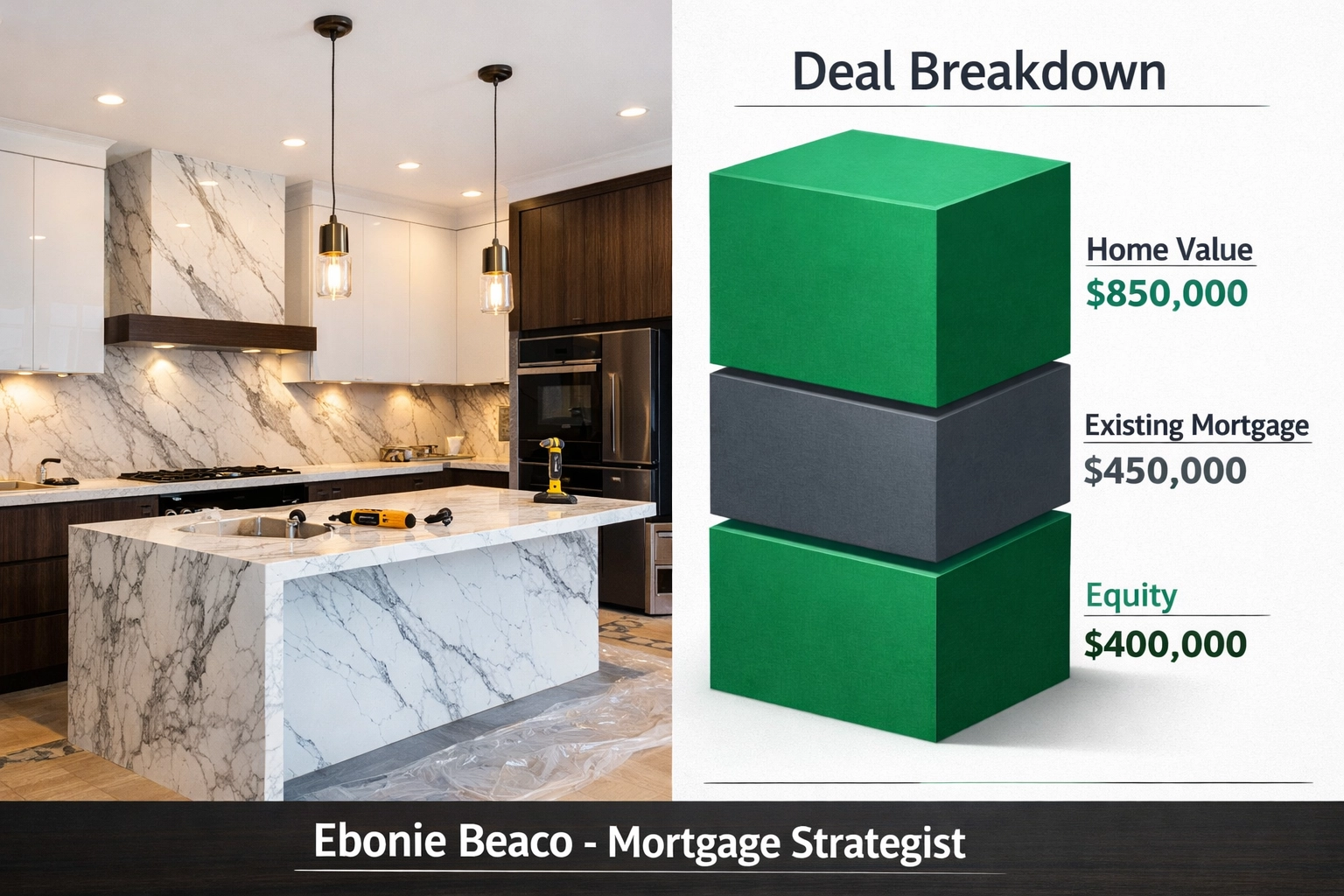
The Strategic Move: The homeowner uses exactly $50,000 for the renovation, which increases the home value to $460,000. They make small principal payments during the draw period to reduce the eventual "payment shock."
The Mistake: The homeowner sees they have $70,000 available. They spend $50,000 on the kitchen and $20,000 on a new boat. The boat depreciates, interest rates rise, and they are left with a massive payment they didn't prepare for.
Mistake #5: Ignoring Regional Market Trends
Renovating in California is different than renovating in Arkansas or Missouri.
If you are working with an Indiana HELOC lender, you need to ensure the renovations you are planning actually add value to your specific neighborhood. Over-improving a home: spending $100,000 on a kitchen in a neighborhood where the ceiling for home values is $250,000: is a recipe for losing money.
Compare recent sales in your area before deciding on the scope of your project. For real estate investors using DSCR rental property loans or fix and flip financing, the "After Repair Value" (ARV) is the most critical metric. Don't let your HELOC spending outpace the potential return on investment.
Is a HELOC Right for Your State?
Whether you are in the bustling Chicago market or the growing suburbs of Alabama, local factors play a role in your equity strategy.
- Illinois & Chicago: High property taxes mean you need to be certain your renovation provides enough utility or value to offset the potential tax assessment increase.
- Florida & California: Market volatility can be higher. A variable-rate HELOC requires a more robust "safety net" in case property values dip or rates spike.
- Virginia & Maryland: These markets often see steady appreciation, making a HELOC a great way to "re-invest" in a primary residence.
How to Avoid the HELOC "Debt Trap"
- Shop Around: Don't just go to your current bank. Look for specialized lenders who understand investor needs or specific regional markets.
- Get a Fixed-Rate Draw Option: Some lenders allow you to "lock in" a portion of your HELOC balance at a fixed interest rate. This protects you from the variable rate rollercoaster.
- Have an Exit Strategy: Whether it’s a cash-out refinance down the road or a plan to sell the property, know how you will eventually retire the debt.
- Read the Mortgage Basics: Understanding the lingo helps you stay in control of the conversation with your loan officer.
The Bottom Line
Tapping into your home equity is one of the smartest ways to build wealth, provided you treat that equity with respect. A HELOC offers the flexibility that conventional loans or FHA loans simply can’t match during a renovation project.
However, transparency is key. You need to know the risks of variable rates, the limitations of tax deductions, and the reality of future repayment obligations.
If you are ready to explore your options and want a clear, no-nonsense look at your equity, let’s talk. Whether you are a first-time homeowner or a seasoned investor scaling a portfolio with hard money loans and bridge financing, having a strategy in place is what separates a successful project from a financial disaster.
Jump in and start your equity journey with confidence.
Schedule a 1 on 1 at https://calendly.com/homeloansnetwork
Ebonie Beaco
Mortgage Strategist | Senior Loan Officer
Home Loans Network powered by Loan Factory Inc.
NMLS #2389954
HomeLoansNetwork.com
312-392-0664