Are DSCR Loans Dead? Do Real Estate Investors Still Use Them for Chicago Properties?
SEO Title: Are DSCR Loans Dead? Exploring Chicago Real Estate Financing in 2026
Meta Description: Discover if DSCR loans are still viable for Chicago real estate investors in 2026. Learn how debt service coverage ratios work and how to finance rental properties without W-2 income.
URL Slug: dscr-loans-chicago-real-estate-investing-2026
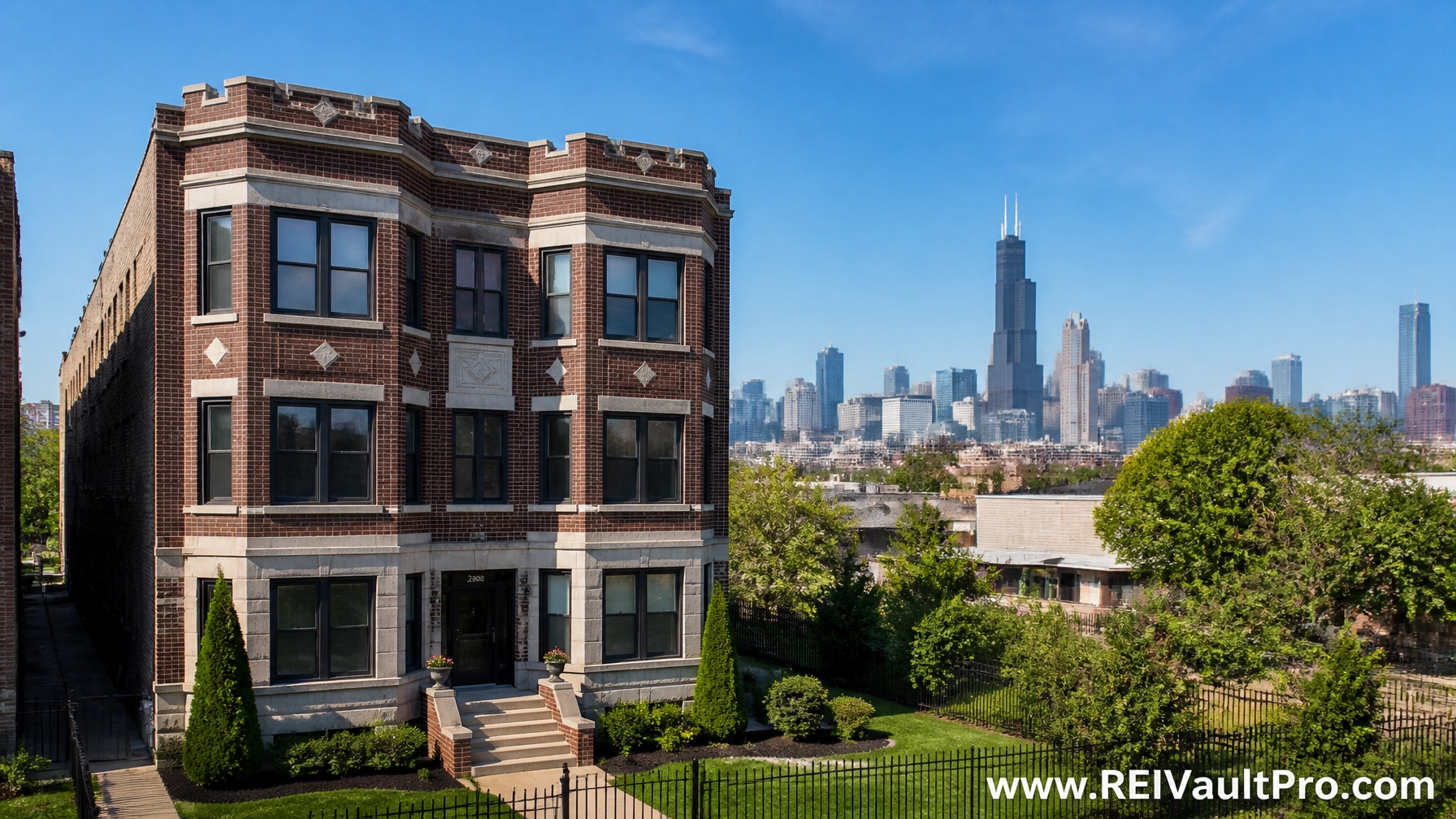
Featured Image Recommendation: A professional landscape photo of a Chicago greystone multi-unit building with the Chicago skyline in the background and the brand URL clearly visible.
SEO Alt Text: Chicago 4-unit apartment building with city skyline background representing DSCR loan opportunities in 2026.
Social Media Excerpt: Think DSCR loans are a thing of the past? Think again. Chicago investors are still using cash-flow-based financing to scale their portfolios in 2026. Here is why the Debt Service Coverage Ratio is more important than ever.
SEO Tags: DSCR Loans, Chicago Real Estate, Investment Property Financing, Landlord Loans, Real Estate Investing Illinois, Cash Flow Analysis, REI Vault Pro
Rumors often circulate in the real estate world that certain loan programs have "died" whenever interest rates shift or market conditions evolve. In 2026, many investors are asking if the Debt Service Coverage Ratio (DSCR) loan is still a viable tool for building wealth. The short answer is a resounding no: DSCR loans are not dead. In fact, for investors looking at the unique landscape of Chicago and the broader Illinois market, these loans are often the primary engine for portfolio growth.
The Chicago market remains a powerhouse for income-producing properties, from iconic greystones in Logan Square to multi-unit buildings in Bronzeville. While the "easy money" era of ultra-low rates has shifted into a more stabilized environment, the fundamental benefit of a DSCR loan remains unchanged. It allows you to acquire and refinance property based on the performance of the asset rather than your personal tax returns.
What is a DSCR Loan?
DSCR Loan Definition: A mortgage product that qualifies a borrower based on the cash flow generated by the investment property rather than personal income or employment history.
Practical Application: If you are a self-employed investor or an entrepreneur with complex tax returns that show high deductions, a DSCR loan bypasses the need for W-2s or pay stubs, focusing instead on whether the rent covers the mortgage payment.
In markets like Alabama, Florida, and Georgia, investors utilize these loans to move quickly on deals that conventional lenders might reject due to debt-to-income (DTI) limitations. In Chicago, where the rental market is robust and multi-unit living is a cultural staple, the DSCR loan is a specialized tool that helps landlords scale without the red tape of traditional banking.
Why Chicago Investors Still Rely on DSCR Financing
The Chicago real estate market is distinct because of its density of 2-to-4 unit buildings. These properties are the "bread and butter" for local landlords. Because these buildings are designed for multiple tenants, they often produce the high rental yields required to satisfy modern DSCR requirements.
When you compare financing options, you will find that conventional investor loans often have a "cap" on the number of financed properties you can own: usually ten. For serious investors in Illinois or Virginia, reaching that limit happens faster than you might think. DSCR loans typically do not have these same aggregate limits, allowing you to continue growing your portfolio as long as the properties themselves are profitable.
Furthermore, the speed of execution is a significant factor. Chicago is a competitive market. Using AI tools for real estate to find a deal is only half the battle; you also need to close it. DSCR lenders are often much faster than retail banks because they aren't scrutinizing your personal financial history with the same fine-toothed comb.
Understanding the Calculation: A Chicago 4-Unit Example
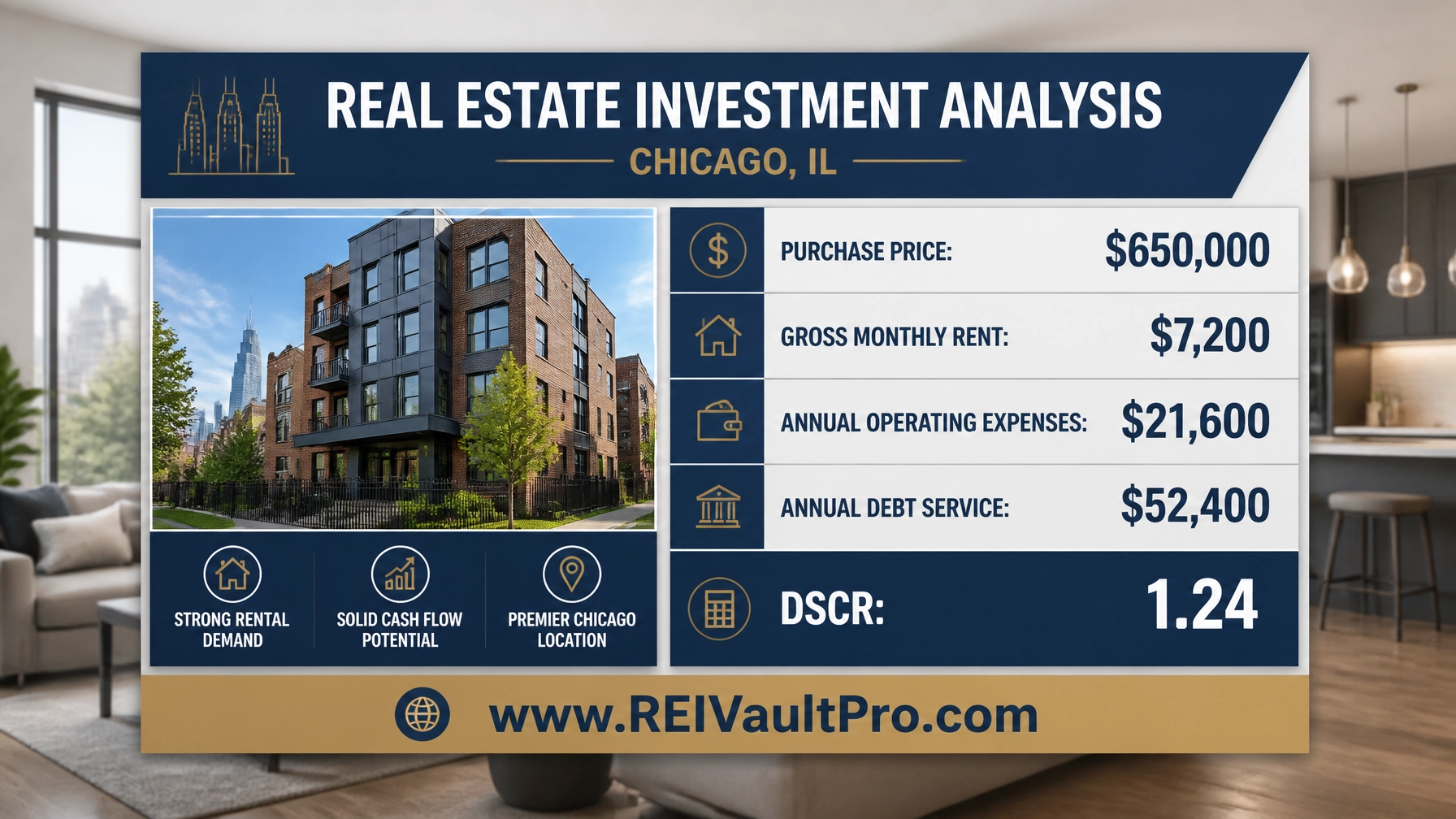
To understand why these loans remain popular, you must look at the numbers. Lenders calculate the Debt Service Coverage Ratio by dividing the Net Operating Income (NOI) or Gross Rents by the full mortgage payment (Principal, Interest, Taxes, Insurance, and HOA fees, often called PITIA).
Let’s look at a real-world scenario for a 4-unit building in a neighborhood like Avondale or Woodlawn.
Property Details:
- Purchase Price: $650,000
- Down Payment (20%): $130,000
- Loan Amount: $520,000
- Estimated Interest Rate (2026): 7.25%
- Monthly Principal & Interest: $3,548
- Monthly Taxes & Insurance: $800
- Total Monthly Debt Service (PITIA): $4,348
Income Details:
- Unit 1 Rent: $1,800
- Unit 2 Rent: $1,800
- Unit 3 Rent: $1,800
- Unit 4 Rent: $1,800
- Total Monthly Gross Rent: $7,200
To find the DSCR, you divide the gross rent by the debt service:
$7,200 / $4,348 = 1.65
In this example, the DSCR is 1.65. Most lenders in 2026 are looking for a DSCR of 1.15 or 1.20. Because this property has a ratio well above the minimum, the investor would likely qualify for the best available rates and terms. This level of cash flow provides a safety net for the lender and a healthy profit margin for the investor.
Strategy: Scaling with the BRRRR Method in Illinois
Many Chicago investors use DSCR loans as the "final" step in the BRRRR method (Buy, Rehab, Rent, Refinance, Repeat). You might purchase a distressed property using a fix and flip loan or a bridge loan. Once the property is renovated and a tenant is placed, you can perform a cash-out refinance into a long-term DSCR loan.
This strategy allows you to pull your initial capital back out of the deal based on the new, higher appraised value. Because the DSCR loan doesn't care about your personal DTI, you can repeat this process multiple times a year, provided your mortgage calculators show the numbers still work at current market rates.
DSCR for Short-Term Rentals (Airbnb)
Another area where DSCR loans are thriving is the short-term rental (STR) market. Whether you are looking at vacation properties in Florida or urban stays in Chicago, some lenders allow you to use "AirDNA" projections or documented STR history to qualify for a loan.
Traditional lenders often struggle with the fluctuating income of an Airbnb property. However, a DSCR lender that specializes in short-term rental financing understands that a high-performing Chicago rental can often out-earn a long-term lease. This flexibility is why investors who focus on hospitality and STR strategies continue to view DSCR loans as a cornerstone of their business.
Is Now the Right Time for a DSCR Loan?
Waiting for rates to drop back to historic lows is a common trap for investors. Real estate professionals in Missouri, Kentucky, and Indiana understand that you "marry the house and date the rate." If a property in Chicago or St. Louis provides a 1.25 DSCR at today's rates, it is a performing asset. If rates drop in the future, you can always look into a rate-term refinance to increase your monthly cash flow.
The risk of waiting is that property values in high-demand Chicago neighborhoods may continue to rise, pricing you out of the market. By securing the property now with a DSCR loan, you lock in your purchase price and begin building equity and benefiting from tax advantages like depreciation.

Related REI Vault Pro Resources
Access the tools you need to analyze your next Chicago deal and ensure your DSCR numbers are accurate before you apply for financing.
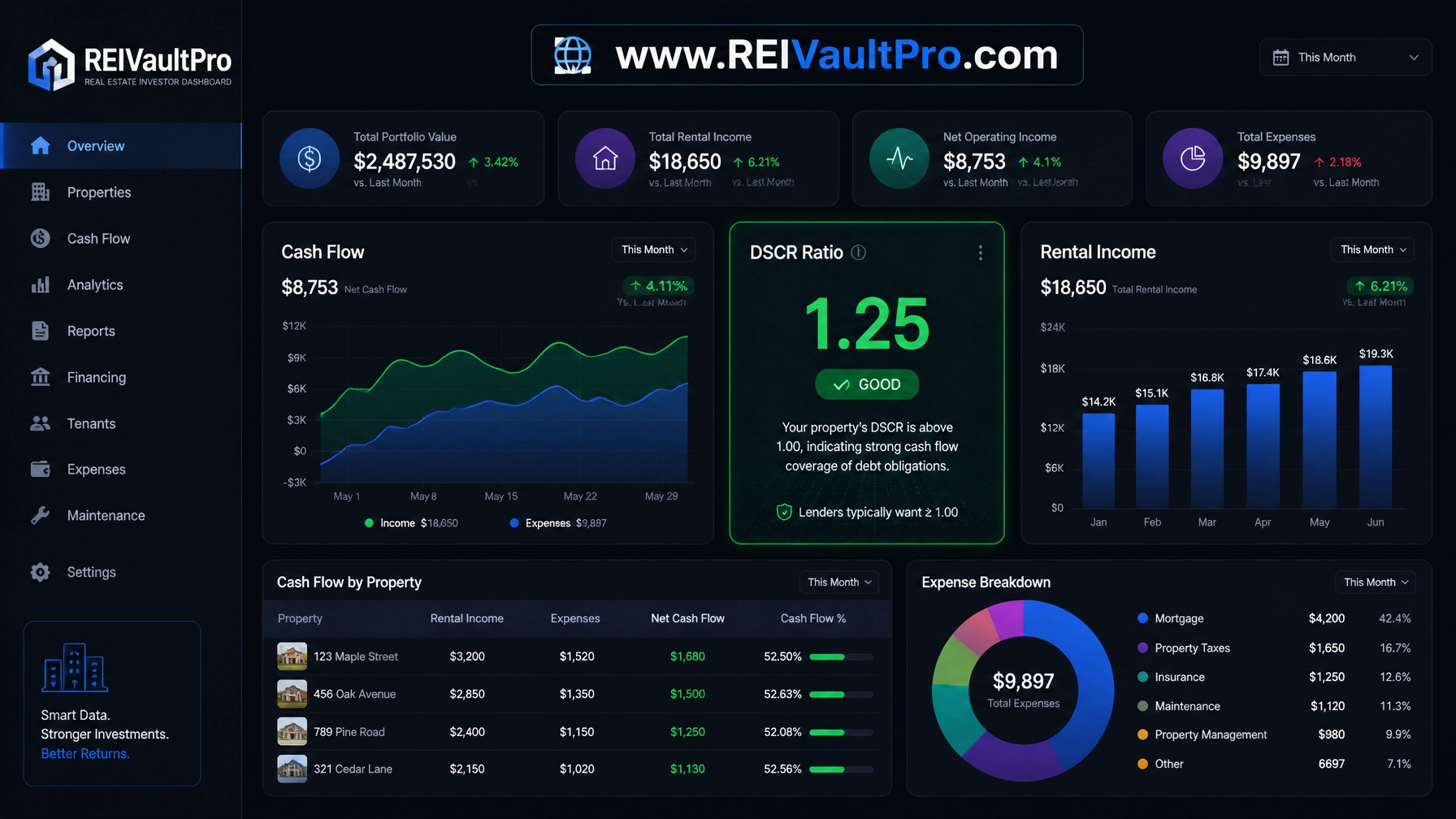
- AI Deal Analyzer: This tool allows you to input property data and instantly receive a comprehensive analysis of the potential ROI, cash flow, and DSCR ratio. Explore the Deal Analyzer.
- AI Rent Analyzer: Use this to get accurate rental estimates for any Chicago neighborhood, ensuring your DSCR calculations are based on real-world market data. Check Rental Rates.
- REI Vault Pro Membership: Join a community of serious investors and gain access to advanced property search tools and financing strategies. Join Now.
- AI Rehab Estimator: Before you buy that Chicago fixer-upper, use this tool to estimate renovation costs so you know exactly how much financing you need. Access Rehab Estimator.
- Lifetime Membership: For the professional investor looking for a long-term edge in markets like Illinois and California, our lifetime option provides permanent access to all current and future AI tools. Upgrade to Lifetime.
Conclusion
The era of "easy" financing may have evolved, but the DSCR loan remains one of the most powerful tools in a real estate investor's arsenal. Especially in a market like Chicago, where rental demand is high and multi-unit inventory is plentiful, these loans provide the flexibility and speed necessary to compete. By focusing on property performance rather than personal tax returns, you can continue to scale your portfolio across states like Alabama, Florida, and Illinois.
Stop wondering if the numbers work and start proving it with data-driven analysis. Whether you are a seasoned landlord or a first-time investor, understanding how to leverage your property's income is the key to long-term wealth.
Jump in and see how the numbers look for your next investment.
FAQ Section
Does my credit score affect a DSCR loan?
Yes. While the loan primarily qualifies based on the property's income, your personal credit score will influence the interest rate and the maximum Loan-to-Value (LTV) the lender is willing to offer. Higher scores typically result in lower rates.
Can I use a DSCR loan for a primary residence?
No. DSCR loans are strictly for investment properties. If you plan to live in one of the units of a multi-family building, you would typically look at FHA or conventional financing options.
What is a "good" DSCR ratio?
Most lenders prefer a ratio of 1.15 to 1.25. This indicates that the property generates 15% to 25% more income than the cost of the debt service, providing a comfortable margin for maintenance and vacancies.
Do DSCR loans have prepayment penalties?
Many DSCR loans do include a prepayment penalty, often for the first 3 to 5 years. However, these can sometimes be "bought down" or negotiated depending on the lender and the specific loan program.
Are DSCR loans available for self-employed borrowers?
Absolutely. This is one of the primary benefits of the program. Because the lender does not require personal income verification or tax returns, it is an ideal solution for self-employed individuals and entrepreneurs.