7 Mistakes You’re Making with Atlanta DSCR Loans (and How the REI Vault Pro Calculator Fixes Them)

SEO Title: 7 Mistakes You’re Making with Atlanta DSCR Loans | REI Vault Pro
Meta Description: Avoid costly errors with Atlanta DSCR loans. Learn how to calculate DSCR correctly, avoid prepayment penalties, and use REI Vault Pro tools to secure your rental property financing.
URL Slug: atlanta-dscr-loan-mistakes-calculator-fix
Featured Image Recommendation: A professional landscape photo of the Atlanta skyline or a high-end rental property in Buckhead with a financial dashboard overlay. Ensure "www.REIVaultPro.com" is visible.
SEO Alt Text: Atlanta skyline and real estate investment financial dashboard showing DSCR calculations.
Social Media Excerpt: Investing in Atlanta rentals? Don't let common DSCR loan mistakes kill your deal. Discover the 7 pitfalls to avoid and how our AI tools can help you scale your portfolio with confidence. 🏠📈 #AtlantaRealEstate #DSCRLoans #REIVaultPro
SEO Tags: Atlanta DSCR Loans, Real Estate Investing Atlanta, DSCR Calculation, Rental Property Financing, Investor Loans GA, REI Vault Pro, Mortgage Strategies
Atlanta has become a primary hub for real estate investors seeking a balance of appreciation and consistent rental demand. Whether you are targeting single-family homes in the West End or multi-unit buildings in Midtown, securing the right financing is the cornerstone of your success. Debt Service Coverage Ratio (DSCR) loans are a favorite among savvy investors because they focus on the property’s income rather than your personal debt-to-income ratio.
However, the Atlanta market presents unique challenges. From shifting property tax assessments in Fulton County to specific short-term rental (STR) regulations, the margin for error is slim. Many investors find their deals stalling at the closing table because of avoidable miscalculations.
Explore these seven common mistakes that can derail your Atlanta DSCR loan application and learn how the REI Vault Pro Deal Analyzer ensures your numbers remain accurate and lender-ready.
1. Overestimating Rental Income Potential
One of the most frequent errors involves using overly optimistic rental projections. Investors often look at the highest possible "pro forma" rent without considering seasonal vacancies or the specific neighborhood averages. In Atlanta, rent can fluctuate significantly between neighborhoods like Buckhead and suburban areas like Marietta.
Rental Projection: A calculated estimate of the monthly income a property is expected to generate based on comparable local listings.
When you overestimate this figure, your DSCR drops during the lender's appraisal process. Lenders typically use the lower of the actual lease amount or the appraiser’s market rent estimate (Form 1007). If your projected $2,500 rent comes in at $2,100, your loan-to-value (LTV) ratio might be cut, forcing you to bring more cash to the table. You can use the REI Vault Pro AI tools to pull real-time market data and ensure your projections align with what appraisers are seeing on the ground.
2. Neglecting the "PITIA" Components
DSCR is calculated by dividing the Gross Monthly Rent by the Monthly PITIA. Many investors forget to include the "A" (Association dues) or use outdated tax figures.
PITIA: An acronym for Principal, Interest, Taxes, Insurance, and Association dues, representing the total monthly holding cost of a financed property.
In Atlanta, property taxes are often reassessed after a sale. If you base your DSCR on the seller’s current tax bill from three years ago, you are walking into a trap. Once the county reassesses the property at your higher purchase price, your monthly payment increases, potentially pushing your DSCR below the lender's minimum threshold (typically 1.20 or 1.25).
Jump in and use a professional calculator to stress-test your deal. By inputting projected tax increases and current insurance quotes, you avoid the "surprise" of a rejected loan during underwriting.
3. Misunderstanding Prepayment Penalties
DSCR loans often come with prepayment penalties, which can be a shock to investors looking to flip or refinance quickly. These penalties are designed to ensure the lender receives a minimum return on the capital they deployed.
Prepayment Penalty: A fee charged by a lender if the borrower pays off the loan or refinances before a specified period, often structured as a 5-4-3-2-1 percentage decline over five years.
If your strategy in Atlanta is to "buy, rehab, and refi" (the BRRRR method), a five-year prepayment penalty could cost you tens of thousands of dollars. Always compare the loan terms against your intended hold period. Some lenders offer a "no-prepay" option in exchange for a slightly higher interest rate. Balancing these options is easier when you use a Deal Analyzer to see how the higher rate affects your long-term cash flow versus the cost of the penalty.
4. Underestimating Required Cash Reserves
Lenders want to see that you have a "cushion" to handle vacancies or unexpected repairs. A common mistake is spending all available capital on the down payment and closing costs, leaving nothing for the required reserves.
Reserves: Liquid assets that remain in a borrower's account after a real estate transaction closes, usually measured in months of PITIA payments.
For an Atlanta DSCR loan, lenders frequently require 3 to 12 months of PITIA in reserves. If your monthly payment is $2,000 and the lender requires 6 months of reserves, you must prove you have $12,000 in liquid funds. Failure to account for this can lead to a loan denial at the eleventh hour. Access the REI Vault Pro membership to learn how to structure your liquidity to satisfy even the most stringent lender requirements.
5. Applying DSCR to the Wrong Property Type
Not every property is a candidate for a DSCR loan. Many Atlanta investors try to use these loans for heavy "fix-and-flip" projects where the property is currently uninhabitable.
Non-QM Loan: A mortgage that does not meet the "qualified mortgage" standards set by the federal government, often used for investor-specific products like DSCR loans.
If a property cannot be leased immediately due to its condition, a DSCR lender cannot verify the income needed to support the loan. In these cases, a bridge loan or hard money loan is a better fit. Once the property is renovated and a tenant is placed, you can then transition into a long-term DSCR loan. Compare your property’s current status against the loan requirements before you pay for an appraisal.
6. Ignoring the Impact of Credit Scores
While DSCR loans prioritize property income, your personal credit score still influences your interest rate and LTV. A common misconception is that "the property qualifies, not me."
LTV (Loan-to-Value): The ratio of the loan amount to the appraised value of the property, which determines the required down payment.
In the current Atlanta market, a score of 720+ might grant you an 80% LTV, while a 640 score might limit you to 70% or 75%. This difference means you would need significantly more cash to close the deal. Keeping your credit utilization low while you are in the middle of a deal is critical. Before you apply, use the tools available at REI Vault Pro to understand how different credit tiers impact your projected ROI.
7. Failing to Calculate DSCR Correctly
The most fundamental mistake is simply getting the math wrong. Many investors use "Gross Rent - Expenses" to find cash flow, but they forget that the lender’s DSCR formula is strictly about the ratio of income to the debt payment.
DSCR (Debt Service Coverage Ratio): A financial metric used by lenders to measure a property's ability to cover its debt payments, calculated as Net Operating Income (or Gross Rent for some products) divided by Total Debt Service.
Case Study: The Atlanta Rental Example
Imagine you are looking at a single-family rental in Atlanta with the following profile:
- Property Value: $450,000
- Gross Monthly Rent: $3,000
- Monthly PITIA: $2,400
Using the formula (Rent / PITIA):
$3,000 / $2,400 = 1.25 DSCR
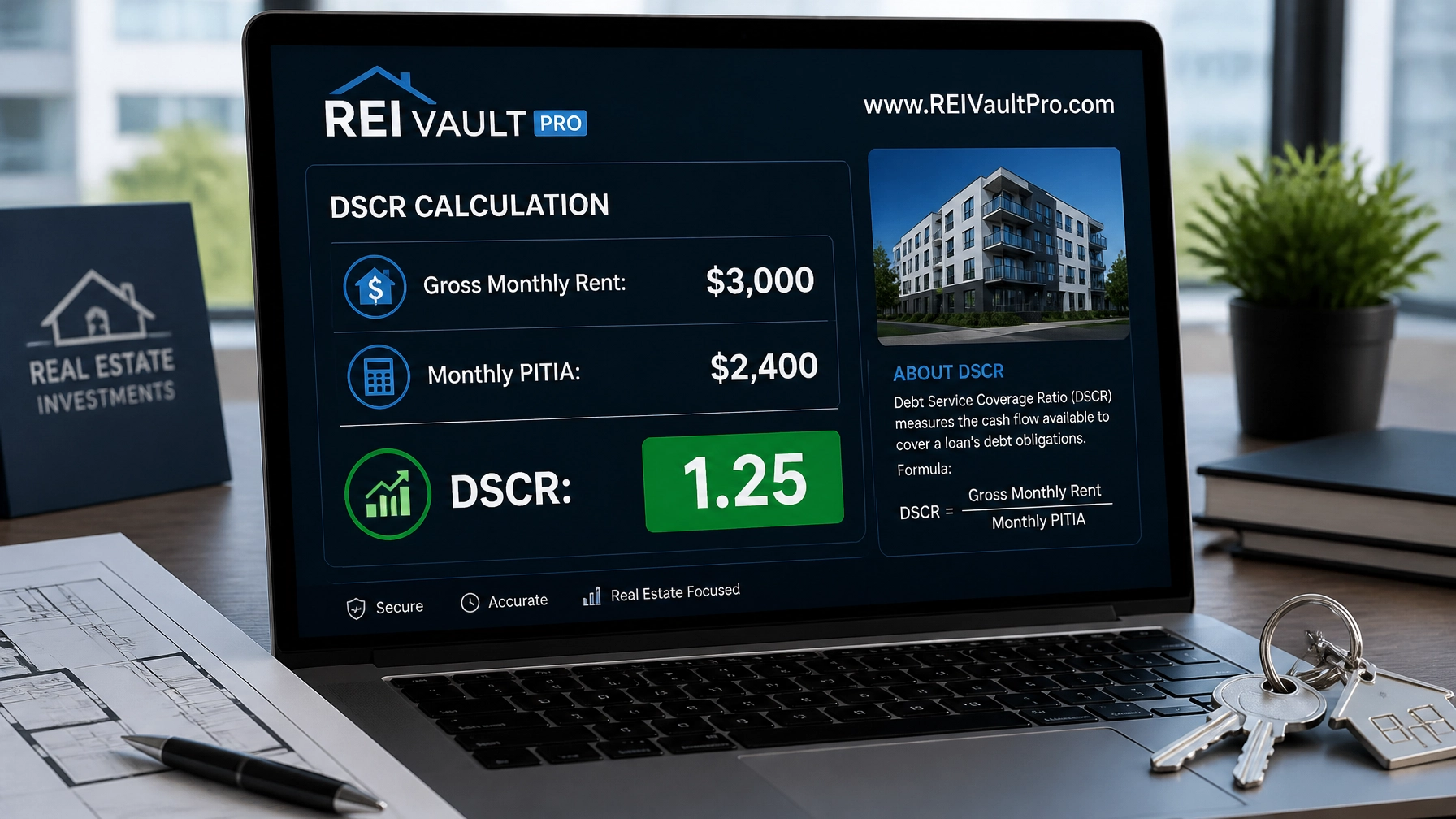
A 1.25 DSCR is generally the "sweet spot" for most lenders to offer their best rates. If your PITIA was higher, perhaps due to a high HOA fee in a Midtown condo, the ratio would drop. If the ratio falls below 1.0, the property is "breakeven" or losing money, which most DSCR lenders will not approve without a significant down payment to lower the debt service.
Related REI Vault Pro Resources
- AI Deal Analyzer: This tool allows you to plug in your Atlanta property details and instantly see if your DSCR meets lender requirements. It helps you avoid overpaying and ensures your exit strategy is sound.
- AI Rehab Estimator: Perfect for Atlanta investors looking at value-add properties. It helps you calculate the "after-repair value" (ARV) so you can plan your transition from a bridge loan to a DSCR loan.
- AI Rent Analyzer: Stop guessing what the rent will be in Decatur or Buckhead. This tool provides data-backed rental comps to ensure your DSCR calculation is based on reality, not hope.
- Lifetime Membership: Gain permanent access to our entire suite of investor tools and calculators, ensuring you never make a costly financing mistake again as you scale your Georgia portfolio.
Conclusion
Navigating the Atlanta real estate market requires more than just finding a good neighborhood; it requires a mastery of the financing that makes those deals possible. By avoiding these seven mistakes, from miscalculating your PITIA to ignoring the fine print of prepayment penalties, you position yourself as a professional investor that lenders want to fund.
Success in real estate is a game of precision. Don't leave your financing to chance or "back-of-the-napkin" math. Use professional tools to verify every decimal point before you sign a contract.
Watch a Demo of the REI Vault Pro platform today and see how our calculators can streamline your next Atlanta investment.
FAQ Section
What is a good DSCR for an Atlanta rental property?
Most lenders look for a DSCR of 1.20 to 1.25. This indicates that the property generates 20% to 25% more income than the cost of the monthly debt service. Some specialized lenders may go down to 1.0 or even offer "no-ratio" loans, but these usually come with higher interest rates and lower LTVs.
Can I use a DSCR loan for an Airbnb in Atlanta?
Yes, many DSCR lenders allow short-term rental (STR) income to be used for qualification. However, they may require a "haircut" (a reduction) on the projected AirDNA or Rabbu numbers to account for seasonality. It is vital to check the specific Atlanta city ordinances regarding STR permits before applying.
Do I need to be self-employed to get a DSCR loan?
No. One of the main benefits of DSCR loans is that they do not require proof of personal income. Whether you are a W-2 employee, self-employed, or a full-time investor, the lender primarily cares about the property’s ability to pay for itself.
How do property taxes in Georgia affect my DSCR?
Georgia property taxes are a significant component of the PITIA. Because taxes can jump significantly after a sale in counties like Fulton or DeKalb, you should always use a "post-sale" estimated tax figure in your calculations to ensure your DSCR remains accurate during the underwriting process.
Is there a limit to how many DSCR loans I can have?
Unlike traditional Fannie Mae or Freddie Mac loans, which often limit you to 10 financed properties, most DSCR lenders have no hard limit on the number of properties you can finance. This makes them the ideal tool for scaling a large portfolio in the Atlanta metro area.