10 Reasons Your Florida Rental Property Financing Isn't Working (And How DSCR Loans Can Fix It)

SEO Title: 10 Reasons Your Florida Rental Property Financing Fails | DSCR Solutions
Meta Description: Struggling with Florida rental property financing? Discover 10 common hurdles and how DSCR loans offer a streamlined path for real estate investors in FL.
URL Slug: florida-rental-property-financing-dscr-loans
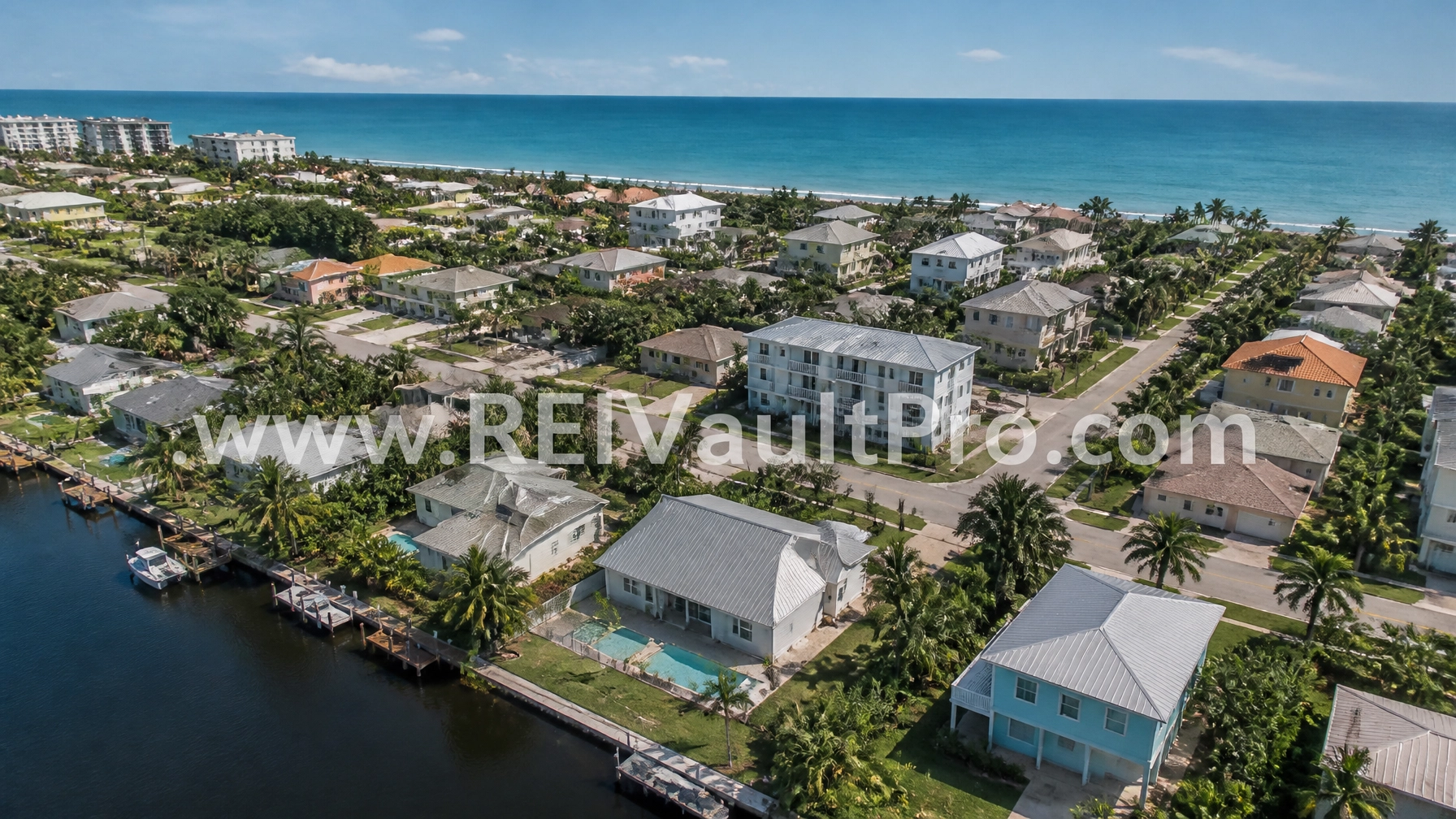
Featured Image Recommendation: Professional landscape photo of a Florida rental property with a DSCR calculation overlay and the REI Vault Pro watermark.
SEO Alt Text: Modern Florida rental property with palm trees and a financial dashboard showing a DSCR loan calculation.
Social Media Excerpt: Conventional financing hitting a wall in the Florida market? Learn why your rental property loans are stalling and how Debt Service Coverage Ratio (DSCR) loans provide the flexibility Florida investors need to scale.
SEO Tags: Florida real estate investing, DSCR loans Florida, rental property financing, real estate investment loans, landlord loans FL, REI Vault Pro
Securing financing for rental properties in the Florida real estate market presents unique challenges that often stall even the most experienced investors. From the competitive corridors of Miami to the growing suburban hubs of Orlando and Tampa, traditional lending criteria can create significant barriers to entry and expansion.
Many investors find that conventional mortgage products do not align with the fast-paced nature of the Florida market. Understanding why these obstacles occur is the first step toward finding a more efficient solution. Debt Service Coverage Ratio (DSCR) loans have emerged as a primary alternative for those looking to bypass common financing roadblocks.
1. High Debt-to-Income (DTI) Ratios
Debt-to-Income Ratio (DTI): A financial metric that compares an individual's monthly debt payments to their gross monthly income.
Traditional lenders use your personal DTI to determine your ability to repay a loan. For many real estate investors, especially those with multiple existing mortgages, this ratio quickly exceeds the limits set by conventional banks.
If your personal debts are too high relative to your documented income, a bank will likely deny your application. This occurs regardless of how much profit the specific Florida property produces.
2. Excessive Documentation Requirements
Full Documentation Loan: A mortgage requiring extensive proof of income, including tax returns, W-2s, and bank statements.
Conventional financing involves a deep dive into your personal financial history. This process is time-consuming and often intrusive. For self-employed investors or those with complex tax structures, providing this volume of paperwork can delay a closing for weeks.
In contrast, modern investors often choose to Join REI Vault Pro to access tools that simplify the analysis process, allowing them to focus on property performance rather than personal paperwork.
3. Strict Tax Return Scrutiny
Investors often utilize legal tax deductions, such as depreciation and business expenses, to minimize their taxable income. While this is a sound financial strategy, it can work against you during a traditional loan application.
Lenders look at the "bottom line" on your tax returns. If your deductions make your income appear low, you may not qualify for a traditional loan, even if your actual cash flow is robust.
4. Property Count Limits
Exposure Limit: The maximum number of loans or the total dollar amount a single lender is willing to extend to one borrower.
Fannie Mae and Freddie Mac typically limit the number of financed properties a single borrower can hold, usually capping at ten. For investors building a large portfolio in Florida, this limit is a significant bottleneck.
Once you reach this threshold, traditional banks will often stop lending to you, forcing you to seek alternative capital sources to continue growing.
5. Florida’s Rising Insurance Costs
Florida presents a specific challenge regarding property insurance. Rapidly increasing premiums for wind, flood, and homeowners insurance can drastically increase your monthly expenses.
When a conventional lender calculates your qualification, they include these high insurance costs in your DTI. If the insurance premium spikes during the escrow process, it can push your DTI over the limit, causing the deal to fall through at the last minute.
6. Challenges with Short-Term Rental Income
Short-Term Rental (STR): A furnished living space rented for short periods, typically through platforms like Airbnb or VRBO.
The Florida tourism market makes STRs a lucrative investment. However, most traditional lenders refuse to recognize potential STR income when qualifying a borrower. They often insist on using long-term lease rates, which may be significantly lower than what the property actually earns.
This discrepancy can make a high-performing vacation rental look like a losing investment on a bank's spreadsheet. You can use an AI Rent Analyzer to compare different rental strategies and see how the numbers shift.
7. Slow Closing Timelines
In the aggressive Florida market, speed is a currency. Conventional loans often take 45 to 60 days to close due to extensive underwriting and appraisal reviews.
Sellers in high-demand areas like Fort Lauderdale or Jacksonville often prefer cash offers or investors who can close quickly. If your financing takes two months, you will likely lose out to competitors who have more agile funding.
8. Low Appraisal and Rent Schedule Issues
Appraisal Rent Schedule: A formal report (often Form 1007) provided by an appraiser estimating the fair market rent for a property.
If an appraiser's estimate of market rent is lower than your actual or projected rent, it can jeopardize a conventional loan. Traditional lenders are often rigid about these figures, leaving little room for the reality of a high-demand rental market.
9. Self-Employed Status Hurdles
Independent contractors and business owners often face an uphill battle with big banks. Lenders prefer the "stability" of a W-2 employee. If you are a full-time real estate investor in Florida, you are technically self-employed, which automatically places you in a higher risk category for traditional mortgage products.
10. Lack of Flexibility for Entity Borrowing
Many savvy investors purchase properties under an LLC or Corporation to protect their personal assets. Most conventional residential loans require the borrower to be an individual.
Switching a property into an LLC after closing can sometimes trigger "due-on-sale" clauses. Finding a lender that allows you to close directly in the name of your business entity is crucial for long-term liability management.
How DSCR Loans Provide a Solution
DSCR Loan: A type of "non-QM" (non-qualified mortgage) loan that allows a borrower to qualify for a mortgage based on the cash flow generated by the investment property rather than personal income.
DSCR loans address almost every issue listed above. Because the lender focuses on the property's ability to cover the debt, your personal DTI and tax returns are generally not part of the equation. This allows for faster closings, more flexibility with STR income, and the ability to scale your portfolio without personal income constraints.
Calculating the DSCR: A Florida Example
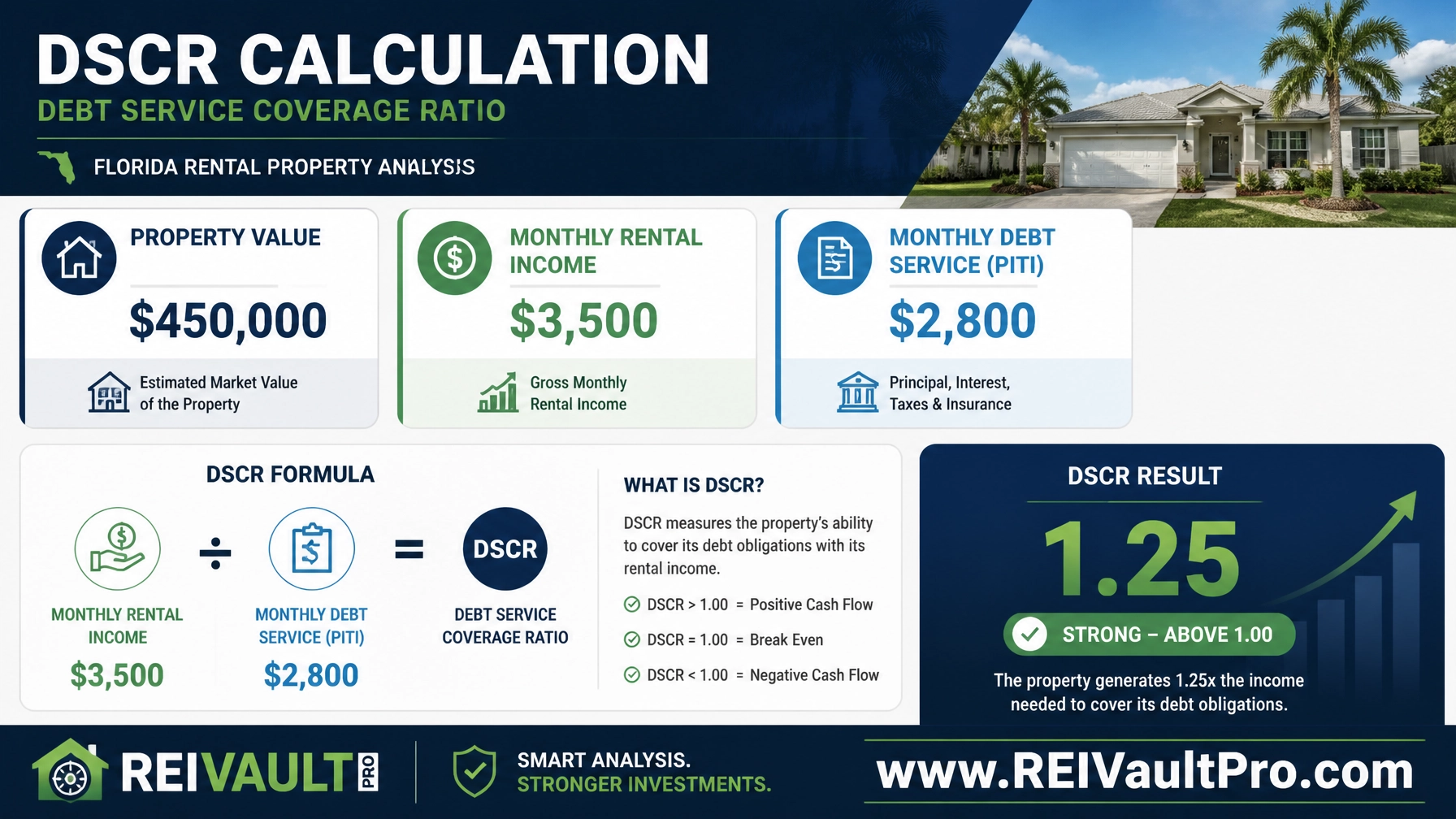
Consider a condo in Miami priced at $450,000. To see if it qualifies for a DSCR loan, you must calculate the ratio.
The Formula:DSCR = Gross Monthly Rental Income / Monthly Debt Service (PITIA)
- Gross Monthly Rent: $3,500
- Monthly PITIA (Principal, Interest, Taxes, Insurance, Association fees): $2,800
- Calculation: $3,500 / $2,800 = 1.25
A DSCR of 1.25 is considered strong, as it shows the property generates 25% more income than is required to pay the mortgage and associated costs. Most DSCR programs require a minimum ratio between 1.00 and 1.20.
Investors can utilize a DSCR Calculator to quickly run these numbers on potential acquisitions before making an offer.
Strategic Scaling in the Florida Market
To successfully navigate the Florida landscape, you need more than just the right loan; you need the right data. Using an AI Deal Analyzer allows you to process listing data instantly, ensuring that you only pursue properties that meet the necessary DSCR thresholds.
Whether you are a first-time landlord or a seasoned pro-investor, moving away from restrictive conventional financing opens doors to more opportunities across the Sunshine State. By focusing on the asset's performance, you remove the personal financial "ceiling" that prevents many from achieving true scale.
Explore the full suite of AI Tools available to modern investors to ensure your next Florida deal is your most profitable one yet.
Related REI Vault Pro Resources
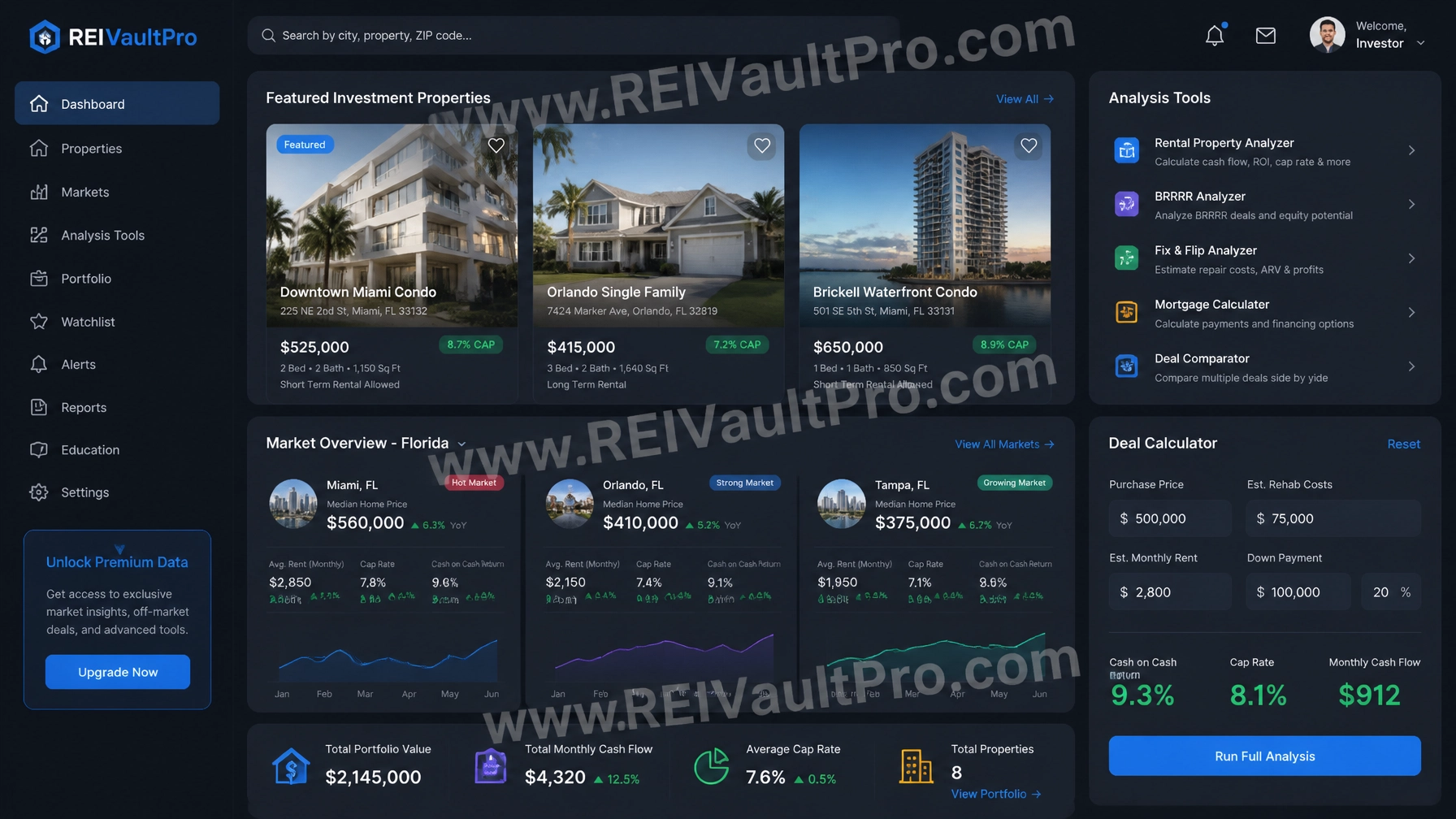
- AI Deal Analyzer: This tool automatically scans property listings and provides a comprehensive risk score and financial projection, helping you identify high-DSCR opportunities in Florida.
- AI Rent Analyzer: Use this to determine accurate market rents for long-term and short-term strategies, ensuring your DSCR calculations are based on real-world data.
- DSCR Calculator: A dedicated tool for quickly determining the debt service coverage ratio of any property, allowing you to verify loan eligibility in seconds.
- Investor CRM: Manage your Florida leads, track your closing timelines, and organize your growing portfolio within a single, integrated platform.
Conclusion
Financing a Florida rental property does not have to be a struggle. By identifying the limitations of traditional lending and pivoting toward DSCR solutions, you can streamline your acquisition process and focus on what truly matters: building your real estate portfolio.
Ready to stop guessing and start closing? Watch a Demo to see how the REI Vault Pro ecosystem can transform your investment strategy today.
FAQ
What is the minimum credit score for a DSCR loan in Florida?
Most DSCR lenders in Florida look for a minimum credit score of 620 to 680, although higher scores often result in better interest rates and lower down payment requirements.
Can I use a DSCR loan for an Airbnb in Florida?
Yes. Many DSCR programs are specifically designed to accommodate short-term rentals, allowing you to use projected or historical Airbnb income to qualify for the loan.
How much down payment is required for a Florida DSCR loan?
Typically, DSCR loans require a down payment of 20% to 25%. Some programs may allow for as little as 15% down if the property has a very high DSCR and the borrower has excellent credit.
Are DSCR loan interest rates higher than conventional rates?
Generally, yes. Because DSCR loans offer more flexibility and require less personal documentation, they typically carry interest rates that are 0.5% to 1.5% higher than standard conventional investment property loans.
Is there a limit to how many DSCR loans I can have?
Most DSCR lenders do not have a hard limit on the number of properties you can finance, making them an ideal choice for investors looking to scale beyond the standard 10-property limit found in conventional lending.